


MHT CET · Chemistry · Chemical Kinetics
Half-life of first order reaction X \(\longrightarrow\) \(\mathrm{Y}+\mathrm{Z}\) is 3 minutes. What is the time required to reduce the concentration of \({ }^{\prime} \mathrm{X}^{\prime}\) by \(90 \%\) of it's initial concentration?
- A \(4 \cdot 12\) minutes
- B \(9.969\) minutes
- C \(9 \cdot 105\) minutes
- D \(12 \cdot 05\) minutes
Answer & Solution
Correct Answer
(B) \(9.969\) minutes
Step-by-step Solution
Detailed explanation
(A)
\(\mathrm{t}_{1 / 2}=3 \mathrm{~min} \)
\( \therefore \mathrm{k}=\frac{0.693}{\mathrm{t}_{1 / 2}}=\frac{0.693}{3}=0.231 \mathrm{~min}^{-1}\)
\({[\mathrm{A}]_{0}=\text { Original amount of reactant }=100} \)
\([\mathrm{A}]_{t}=\text {Reactant remaining unreacted}=\) \(100-90=10\)
For first order reaction,
\(t=\frac{2.303}{k} \log _{10} \frac{[A]_{0}}{[A]_{t}}=\frac{2.303}{0.231 \mathrm{~min}^{-1}} \log _{10} \frac{100}{10}\)\(=9.969 \mathrm{~min}\)
\(\mathrm{t}_{1 / 2}=3 \mathrm{~min} \)
\( \therefore \mathrm{k}=\frac{0.693}{\mathrm{t}_{1 / 2}}=\frac{0.693}{3}=0.231 \mathrm{~min}^{-1}\)
\({[\mathrm{A}]_{0}=\text { Original amount of reactant }=100} \)
\([\mathrm{A}]_{t}=\text {Reactant remaining unreacted}=\) \(100-90=10\)
For first order reaction,
\(t=\frac{2.303}{k} \log _{10} \frac{[A]_{0}}{[A]_{t}}=\frac{2.303}{0.231 \mathrm{~min}^{-1}} \log _{10} \frac{100}{10}\)\(=9.969 \mathrm{~min}\)
See the Complete Solution
Get step-by-step explanations for this and 2.5 Lakh+ more JEE, NEET & CET questions.
- Unlock all solutions
- Practice the full chapter
- Track accuracy across PYQs
4.8 rated on Google Play · 14,000+ reviews
More questions from Chemistry
- Rate of reaction \(\mathrm{x}+\mathrm{y} \rightarrow\) product is \(5.4 \times 10^{-2} \mathrm{~mol} \mathrm{dm}^{-3} \mathrm{sec}^{-1}\). When \([\mathrm{x}]=0.2 \mathrm{~mol} \mathrm{dm}^{-3}\) and \([\mathrm{y}]=0.1 \mathrm{~mol} \mathrm{dm}^{-3}\), calculate rate constant of reaction if it is first order in \(\mathrm{X}\) and second order in \(\mathrm{Y}\)MHT CET 2022 Easy
- Which of following antihistamine contain -CN group?MHT CET 2020 Easy
- Which among the following is not a characteristic of alcohols?MHT CET 2022 Easy
- What is the wave number of lowest transition in Balmer series?MHT CET 2024 Medium
- What is IUPAC name of the following compound?
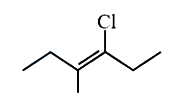 MHT CET 2021 Medium
 - Which among the following minerals contains radioactive element in it?MHT CET 2024 Easy
More PYQs from MHT CET
- Two charges \(\mathrm{q}_1=+6 \mathrm{q}\) and \(\mathrm{q}_2=-3 \mathrm{q}\) are placed as shown in figure. A proton is placed on x -axis away from \(\mathrm{q}_2\). To remain proton in equilibrium, the distance between \(\mathrm{q}_1\) and proton is
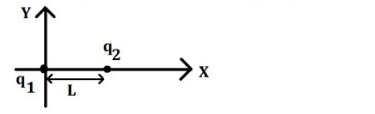 MHT CET 2025 Medium
 - The line \(\frac{x-1}{2}=\frac{y+2}{-1}=\frac{\mathrm{z}}{1}\) intersects the XY plane and the YZ plane at points \(A\) and \(B\) respectively. The equation of line through the points \(A\) and \(B\) isMHT CET 2025 Medium
- All of the following enzymes are present in the Succus entericus EXСЕРТ _________.MHT CET 2020 Hard
- If the truth value of the statement pattern \([\mathrm{p} \wedge \sim \mathrm{r}] \rightarrow \sim \mathrm{r} \wedge \mathrm{q}\) is False, then which of the following has truth value False?MHT CET 2025 Medium
- Solubility of \(\mathrm{Ca}_3\left(\mathrm{PO}_4\right)_2\) is 'S' mol \(\mathrm{dm}^{-3}\). Find solubility product.MHT CET 2025 Medium
- The frequency at resonance for the circuit is
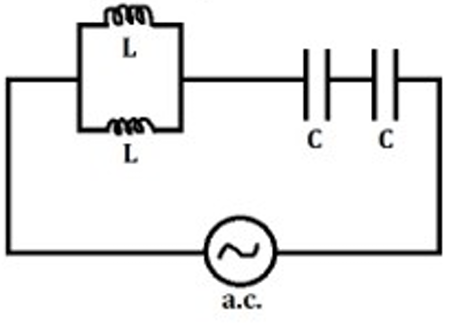 MHT CET 2025 Medium