


MHT CET · Chemistry · Chemical Kinetics
For the reaction,
\(3 \mathrm{I}^{-(\mathrm{aq}, \mathrm{~s})}+\mathrm{S}_2 \mathrm{O}_{8(\mathrm{aq})}^{2-} \longrightarrow 2 \mathrm{SO}_{4(\mathrm{aq},)}^{2-}+\mathrm{I}_{3(\mathrm{aq},)}^{-}\)
rate of formation of \(\mathrm{SO}_{4(\mathrm{aq} .)}^{2-}\) is \(0.044 \mathrm{~mol} \mathrm{dm}^{-3} \mathrm{~s}^{-1}\).
Calculate rate of consumptiuon of \(\mathrm{I}_{(\mathrm{aq} .)}^{-}\).
- A \(0.022 \mathrm{~mol} \mathrm{dm}^{-3} \mathrm{~s}^{-1}\)
- B \(0.044 \mathrm{~mol} \mathrm{dm}^{-3} \mathrm{~s}^{-1}\)
- C \(0.066 \mathrm{~mol} \mathrm{dm}^{-3} \mathrm{~s}^{-1}\)
- D \(0.088 \mathrm{~mol} \mathrm{dm}^{-3} \mathrm{~s}^{-1}\)
Answer & Solution
Correct Answer
(C) \(0.066 \mathrm{~mol} \mathrm{dm}^{-3} \mathrm{~s}^{-1}\)
Step-by-step Solution
Detailed explanation
\(3 \mathrm{I}_{\text {(aq) }}^{-}+\mathrm{S}_2 \mathrm{O}_{8(\mathrm{aq})}^{2-} \longrightarrow 2 \mathrm{SO}_{4(\text { aq })}^{2-}+\mathrm{I}_{3(\mathrm{aq})}^{-}\)
Rate of reaction
\(=-\frac{1}{3} \frac{\mathrm{~d}\left[\mathrm{I}^{-}\right]}{\mathrm{dt}}=-\frac{\mathrm{d}\left[\mathrm{~S}_2 \mathrm{O}_8^{2-}\right]}{\mathrm{dt}}=\frac{1 \mathrm{~d}\left[\mathrm{SO}_4^{2-}\right]}{2}=\frac{\mathrm{d}\left[\mathrm{I}_3^{+}\right]}{\mathrm{dt}}\)
\(\therefore \quad\) Rate of consumption of \(\mathrm{I}^{-}=-\frac{1}{3} \frac{\mathrm{~d}\left[\mathrm{I}^{-}\right]}{\mathrm{dt}}=\frac{1 \mathrm{~d}\left[\mathrm{SO}_4^2\right]}{2}\)
\(=\frac{3 \times 0.044}{2}=0.066 \mathrm{~mol} \mathrm{dm}^{-3} \mathrm{~s}^{-1}\)
Rate of reaction
\(=-\frac{1}{3} \frac{\mathrm{~d}\left[\mathrm{I}^{-}\right]}{\mathrm{dt}}=-\frac{\mathrm{d}\left[\mathrm{~S}_2 \mathrm{O}_8^{2-}\right]}{\mathrm{dt}}=\frac{1 \mathrm{~d}\left[\mathrm{SO}_4^{2-}\right]}{2}=\frac{\mathrm{d}\left[\mathrm{I}_3^{+}\right]}{\mathrm{dt}}\)
\(\therefore \quad\) Rate of consumption of \(\mathrm{I}^{-}=-\frac{1}{3} \frac{\mathrm{~d}\left[\mathrm{I}^{-}\right]}{\mathrm{dt}}=\frac{1 \mathrm{~d}\left[\mathrm{SO}_4^2\right]}{2}\)
\(=\frac{3 \times 0.044}{2}=0.066 \mathrm{~mol} \mathrm{dm}^{-3} \mathrm{~s}^{-1}\)
See the Complete Solution
Get step-by-step explanations for this and 2.5 Lakh+ more JEE, NEET & CET questions.
- Unlock all solutions
- Practice the full chapter
- Track accuracy across PYQs
4.8 rated on Google Play · 14,000+ reviews
More questions from Chemistry
- Which among the following compounds has highest boiling point?MHT CET 2020 Hard
- Which from following compounds has lowest boiling point?MHT CET 2025 Easy
- Which of the following amines undergoes acylation reaction?MHT CET 2024 Medium
- Identify the lanthanoid that exhibits zero effective magnetic moment in +3 state.MHT CET 2025 Medium
- How many hybrid orbitals of cobalt ion are involved in formation of hexaammine cobalt (III) chloride complex?MHT CET 2022 Medium
- Identify neutral sphere complex from following.MHT CET 2024 Easy
More PYQs from MHT CET
- Which from following functional groups has highest priority order for naming the polyfunctional group compounds?MHT CET 2025 Medium
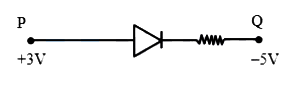
- In an ideal junction diode, the current flowing through \(\mathrm{PQ}\) is (resistance is 2 kilo-ohms)
 MHT CET 2021 Medium
 - Identify example of sorption from following.MHT CET 2025 Easy
- Given \(\mathrm{A}=\{1,2,3,4,5\}, \mathrm{B}=\{1,4,5\} .\) If \(\mathrm{R}\) is a relation from \(\mathrm{A}\) to \(\mathrm{B}\) such that \(\quad(x, y)\)
\(\in \mathrm{R}\) with \(x>y\), then range of \(\mathrm{R}\) isMHT CET 2020 Easy - If \(\mathrm{G}(4,3,3)\) is the centroid of the triangle \(\mathrm{ABC}\) whose vertices are \(\mathrm{A}(\mathrm{a}, 3,1), \mathrm{B}(4,5, \mathrm{~b})\) and \(\mathrm{C}(6, \mathrm{c}, 5)\), then the value of \(\mathrm{a}, \mathrm{b}, \mathrm{c}\) areMHT CET 2021 Easy
- If \(p_{1}\) and \(p_{2}\) are the lengths of perendiculars from the origin to the lines
\(x \sin \theta+y \cos \theta=5 \cos 2 \theta\) and \(x \operatorname{cosec} \theta+y \sec \theta-5=0\) respectively, then
\(p_{1}^{2}+4 p_{2}^{2}=\)MHT CET 2020 Easy