


MHT CET · Chemistry · Thermodynamics (C)
Equal masses in grams of \(\mathrm{H}_2, \mathrm{~N}_2, \mathrm{Cl}_2\), and \(\mathrm{O}_2\), are enclosed in cylinders separately. If these gases expand isothermally and reversibly by \(10 \mathrm{dm}^3\) at \(300 \mathrm{~K}\), the work done by gas is maximum for
- A \(\mathrm{H}_2\)
- B \(\mathrm{N}_2\)
- C \(\mathrm{Cl}_2\)
- D \(\mathrm{O}_2\)
Answer & Solution
Correct Answer
(A) \(\mathrm{H}_2\)
Step-by-step Solution
Detailed explanation
\(
\mathrm{W}_{\max }=-2.303 \mathrm{nRT} \log _{10} \frac{\mathrm{V}_2}{\mathrm{~V}_1}
\)
Hence, \(\mathrm{W}_{\max } \infty \mathrm{n}\) (Given: R, T, \(\mathrm{V}_2, \mathrm{~V}_1=\) Constant)
\(\therefore \mathrm{W}_{\max } \propto \frac{1}{\mathrm{M} . \mathrm{W} .}\) (Given: equal mass)
Hence, lower the molecular mass, greater is the work done. Among the given, \(\mathrm{H}_2\) has the lowest molecular mass.
\mathrm{W}_{\max }=-2.303 \mathrm{nRT} \log _{10} \frac{\mathrm{V}_2}{\mathrm{~V}_1}
\)
Hence, \(\mathrm{W}_{\max } \infty \mathrm{n}\) (Given: R, T, \(\mathrm{V}_2, \mathrm{~V}_1=\) Constant)
\(\therefore \mathrm{W}_{\max } \propto \frac{1}{\mathrm{M} . \mathrm{W} .}\) (Given: equal mass)
Hence, lower the molecular mass, greater is the work done. Among the given, \(\mathrm{H}_2\) has the lowest molecular mass.
See the Complete Solution
Get step-by-step explanations for this and 2.5 Lakh+ more JEE, NEET & CET questions.
- Unlock all solutions
- Practice the full chapter
- Track accuracy across PYQs
4.8 rated on Google Play · 14,000+ reviews
More questions from Chemistry
- The number of \(\sigma\) bonds in carbolic acid areMHT CET 2020 Easy
- Which from following is NOT a dicarboxylic acid?MHT CET 2024 Easy
- Which among following compounds contains phantom atom?MHT CET 2020 Hard
- What is the concentration of an electrolyte solution to have molar conductivity of \(101 \Omega^{-1} \mathrm{~cm}^2 \mathrm{~mol}^{-1}\) and conductivity of \(1.01 \times 10^{-2} \Omega^{-1} \mathrm{~cm}^{-1}\) at 298 K ?MHT CET 2024 Easy
- The IUPAC name of the compound
 MHT CET 2011 Easy
 - Identify lanthanoid element from following.MHT CET 2023 Easy
More PYQs from MHT CET
- Locus of the point of intersection of perpendicular tangents to the circle \(x^{2}+y^{2}=16\) isMHT CET 2009 Medium
- The volume of a metal block increases by \(0.225 \%\) when its temperature is increased by \(30^{\circ} \mathrm{C}\). Hence coefficient of linear expansion of the material of metal block isMHT CET 2023 Medium
- If feasible region is as shown in the figure, then the related inequalities are
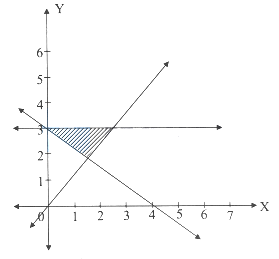 MHT CET 2023 Easy
 - The magnitude of gravitational potential energy of a body at a distance ' \(R\) ' from the centre of the earth is ' \(E\) '. Its weight at a distance ' \(1.5 R\) ' from the centre of the earth isMHT CET 2025 Medium
- In an isobaric process of an ideal gas, the ratio of work done by the system (W) during the expansion and the heat exchanged \((\mathrm{Q})\) is \(\left(\gamma=\frac{C_p}{C_v}\right)\)MHT CET 2024 Medium
- If \(y=\tan ^{-1}\left(\frac{4 x}{1+5 x^2}\right)+\tan ^{-1}\left(\frac{3+8 x}{3-3 x}\right)\), then \(\frac{d y}{d x}=\)MHT CET 2022 Medium