


MHT CET · Chemistry · Electrochemistry
During the electrolysis of fused \(\mathrm{NaCl}\), the product obtained at anode is
- A \(\mathrm{Na}_{(\mathrm{s})}\)
- B \(\mathrm{Cl}_{2(\mathrm{~g})}\)
- C \(\mathrm{O}_{2(\mathrm{~g})}\)
- D \(\mathrm{Na}_{(l)}\)
Answer & Solution
Correct Answer
(B) \(\mathrm{Cl}_{2(\mathrm{~g})}\)
Step-by-step Solution
Detailed explanation
Anode: The electrode of an electrochemical cell at which oxidation occurs.
Cathode: The electrode of an electrochemical cell at which reduction occurs.
Electrolysis of molten \(\mathrm{NaCl}\) or fused \(\mathrm{NaCl}\)
Sodium ions migrate to cathode, where electron enter, the melt is reduced to sodium metal
\(
\mathrm{Na}^{+}+\mathrm{e}^{-} \longrightarrow \mathrm{Cl}_2+\mathrm{e}^{-}
\)
Chlorine ions migrate to anode. They give up their electrons to the anode
and are oxidized to chlorine gas:
\(
\mathrm{Cl}^{-} \longrightarrow \frac{1}{2} \mathrm{Cl}_2+\mathrm{e}^{-}
\)
Overall reaction
\(
2 \mathrm{NaCl} \longrightarrow 2 \mathrm{Na}(\mathrm{s})+\mathrm{Cl}_2 \text { (g) }
\)
Cathode: The electrode of an electrochemical cell at which reduction occurs.
Electrolysis of molten \(\mathrm{NaCl}\) or fused \(\mathrm{NaCl}\)
Sodium ions migrate to cathode, where electron enter, the melt is reduced to sodium metal
\(
\mathrm{Na}^{+}+\mathrm{e}^{-} \longrightarrow \mathrm{Cl}_2+\mathrm{e}^{-}
\)
Chlorine ions migrate to anode. They give up their electrons to the anode
and are oxidized to chlorine gas:
\(
\mathrm{Cl}^{-} \longrightarrow \frac{1}{2} \mathrm{Cl}_2+\mathrm{e}^{-}
\)
Overall reaction
\(
2 \mathrm{NaCl} \longrightarrow 2 \mathrm{Na}(\mathrm{s})+\mathrm{Cl}_2 \text { (g) }
\)
See the Complete Solution
Get step-by-step explanations for this and 2.5 Lakh+ more JEE, NEET & CET questions.
- Unlock all solutions
- Practice the full chapter
- Track accuracy across PYQs
4.8 rated on Google Play · 14,000+ reviews
More questions from Chemistry
- Ethyl butyrate has the flavour of which fruit ?MHT CET 2009 Easy
- Which among the following amino acids NOT synthesized in our body?MHT CET 2022 Easy
- If Instantaneous rate of reaction is stated as \(-\frac{1}{2} \frac{\mathrm{~d}[x]}{\mathrm{dt}}=-\frac{\mathrm{d}[\mathrm{y}]}{\mathrm{dt}}=\frac{1}{2} \frac{\mathrm{~d}[\mathrm{z}]}{\mathrm{dt}}\), identify the reaction.MHT CET 2025 Medium
- Which from following activities results in to the formation of oleum in manufacture of sulphuric acid contact process?MHT CET 2022 Easy
- Given, for \(\mathrm{Sn}^{4+} / \mathrm{Sn}^{2+}\), standard reduction potential is \(0.15 \mathrm{~V}\) and for \(\mathrm{Au}^{3+} / \mathrm{Au}\), standard reduction potential is \(1.5 \mathrm{~V}\). For the reaction, \(3 \mathrm{Sn}^{2+}+2 \mathrm{Au}^{3+} \longrightarrow 3 \mathrm{Sn}^{4+}+2 \mathrm{Au}\)
the value of \(E_{\text {cell }}^{\circ}\) is,MHT CET 2010 Medium - How many pi bonds and sigma bond are present in following molecule?
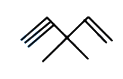 MHT CET 2020 Easy
More PYQs from MHT CET
- A circular coil of radius 'R' has a resistance of \(40 \Omega\). Figure shows two points 'P' and 'Q' on the circumference separated by a distance \(\frac{\pi \mathrm{R}}{2}\), which are connected to a \(16 \mathrm{~V}\) battery with internal resistance of \(0.5 \Omega\). What is the value of current 'I' flowing through the circuit?
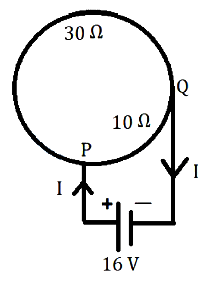 MHT CET 2020 Hard
 - Which of the following is correct statement?
(a) \(S_1:(p \wedge q) \equiv \sim(p \rightarrow \sim q)\).
(b) \(S_2:(p \wedge q) \wedge(\sim p v \sim q)\) is tautology.
(c) \(\left.S_3:[p \wedge(p \rightarrow \sim q)] \rightarrow q\right)\) is contradiction.
(d) \(S_4: p \rightarrow(q \rightarrow p)\) is contingency.MHT CET 2022 Easy - Select the correct statement regarding pancreas.MHT CET 2025 Hard
- How many optical isomers are possible for a compound having four asymmetric carbon atoms?MHT CET 2020 Easy
- What is the conductivity of 0.05 M KCl solution if cell constant is \(1.32 \mathrm{~cm}^{-1}\) and resistance is 528 ohm?MHT CET 2024 Easy
- Removal of suspended, floating, coarse and solid particles in sewage treatment is called _________.MHT CET 2023 Medium