


MHT CET · Chemistry · Some Basic Concepts of Chemistry
Chlorine has two isotopes \({ }^{35} \mathrm{Cl}\) and \({ }^{37} \mathrm{Cl}\) with average atomic mass of 35.5 . What is the ratio of their relative abundance respectively?
- A \(1: 1\)
- B \(2: 1\)
- C \(\cdot 1: 3\)
- D \(3: 1\)
Answer & Solution
Correct Answer
(D) \(3: 1\)
Step-by-step Solution
Detailed explanation
Average atomic mass
(atomic mass of \({ }^{35} \mathrm{Cl} \times\) percentage)
\(=\frac{+ \text { atomic mass of }{ }^{37} \mathrm{Cl} \times \text { percentage }}{100}\)
Let the \(\%\) abundance of \({ }^{35} \mathrm{Cl}\) isotope \(=x\). \(\%\) abundance of \({ }^{37} \mathrm{Cl}\) isotope \(=100-x\).
Average atomic mass \(=35.5\)
From formula, average atomic mass
\(=\frac{35 \times x+37 \times(100-x)}{100}=35.5\)
\(\begin{array}{ll}
\therefore & 35 x+3700-37 x=35.5 \times 100 \\
\therefore & -2 x=-3700+3550 \\
\therefore & -2 x=-150 \\
\therefore \quad & x=75 \% \text { and }(100-x)=25 \%
\end{array}\)
Ratio of relative abundance
\(=\frac{\% \text { abundance of }{ }^{35} \mathrm{Cl}}{\% \text { abundance of }{ }^{37} \mathrm{Cl}}=\frac{75}{25}=3: 1\)
(atomic mass of \({ }^{35} \mathrm{Cl} \times\) percentage)
\(=\frac{+ \text { atomic mass of }{ }^{37} \mathrm{Cl} \times \text { percentage }}{100}\)
Let the \(\%\) abundance of \({ }^{35} \mathrm{Cl}\) isotope \(=x\). \(\%\) abundance of \({ }^{37} \mathrm{Cl}\) isotope \(=100-x\).
Average atomic mass \(=35.5\)
From formula, average atomic mass
\(=\frac{35 \times x+37 \times(100-x)}{100}=35.5\)
\(\begin{array}{ll}
\therefore & 35 x+3700-37 x=35.5 \times 100 \\
\therefore & -2 x=-3700+3550 \\
\therefore & -2 x=-150 \\
\therefore \quad & x=75 \% \text { and }(100-x)=25 \%
\end{array}\)
Ratio of relative abundance
\(=\frac{\% \text { abundance of }{ }^{35} \mathrm{Cl}}{\% \text { abundance of }{ }^{37} \mathrm{Cl}}=\frac{75}{25}=3: 1\)
See the Complete Solution
Get step-by-step explanations for this and 2.5 Lakh+ more JEE, NEET & CET questions.
- Unlock all solutions
- Practice the full chapter
- Track accuracy across PYQs
4.8 rated on Google Play · 14,000+ reviews
More questions from Chemistry
- Calculate change in enthalpy when \(39 \mathrm{~g}\) acetylene is completely burnt with oxygen and enthalpy of combustion of acetylene is \(1300 \mathrm{~kJ} / \mathrm{mol}\).MHT CET 2021 Easy
- Vapour pressure of a pure solvent is 550 mm of Hg . By addition of a non volatile solute it decreases to 510 mm of Hg . Calculate the mole fraction of solute in solution.MHT CET 2024 Easy
- 0.2 molal aqueous solution of KCl freezes at \(-0.680^{\circ} \mathrm{C}\). Calculate van't Hoff factor for this solution. \(\left(\mathrm{K}_{\mathrm{f}}=1.86 \mathrm{~K} \mathrm{~kg} \mathrm{~mol}^{-1}\right)\)MHT CET 2024 Easy
- Henry's law is a relation betweenMHT CET 2020 Easy
- Calculate the edge length of unit cell if metal having atomic radius 170 pm forms simple cubic unit cell.MHT CET 2025 Easy
- What is the pOH of millimolar solution of \(\mathrm{Ca}(\mathrm{OH})_2\) ?MHT CET 2024 Hard
More PYQs from MHT CET
- Which of the following changes occurs during the discharging of lead accumulator?MHT CET 2024 Medium
- Error in the measurement of radius of the sphere is \(2 \%\). The error in the calculated value of its volume isMHT CET 2025 Easy
- A musical instrument ' P ' produces sound waves of frequency ' \(n\) ' and amplitude ' \(A\) '. Another musical instrument ' Q ' produces sound waves of frequency \(\frac{n}{4}\). The waves produced by ' \(P\) ' and ' \(Q\) ' have equal energies. If the amplitude of waves produced by ' P ' is ' \(\mathrm{A}_{\mathrm{P}}\) ', the amplitude of waves produced by ' Q ' will beMHT CET 2024 Hard
- Five current carrying conductors meet at point P. What is the magnitude and direction of the current in conductor PQ?
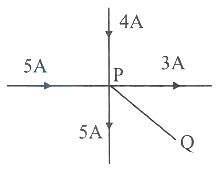 MHT CET 2023 Easy
 - Which of the following is NOT involved in the formation of secondary rainbow?MHT CET 2023 Easy
- How many isomers of \(\mathrm{C}_4 \mathrm{H}_{11} \mathrm{~N}\) are secondary amines?MHT CET 2024 Medium