


MHT CET · Chemistry · Solutions
Assuming complete ionisation, arrange the following solutions in order of increasing osmotic pressure.
a) \(0.5 \mathrm{~m} \mathrm{Li}_2 \mathrm{SO}_4\).
b) \(\quad 0.5 \mathrm{mKCl}\)
c) \(\quad 0.5 \mathrm{~m} \mathrm{Al}_2\left(\mathrm{SO}_4\right)_3\)
d) \(0.1 \mathrm{~m} \mathrm{BaCl}_2\)
- A d \( \lt \) b \( \lt \) a \( \lt \) c
- B b \( \lt \) d \( \lt \) c \( \lt \) a
- C a \( \lt \) d \( \lt \) c \( \lt \) b
- D c \( \lt \) d \( \lt \) b \( \lt \) a
Answer & Solution
Correct Answer
(A) d \( \lt \) b \( \lt \) a \( \lt \) c
Step-by-step Solution
Detailed explanation
Osmotic pressure is a colligative property that depends on number of particles in solution. The solution having more number of particles will have larger osmotic pressure.
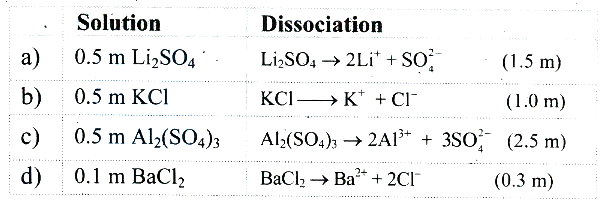
Hence, \(\mathrm{Al}_2\left(\mathrm{SO}_4\right)_3\) solution gives more number of particles and has the highest osmotic pressure among the given. So, the correct order of increasing osmotic pressure is \(\mathrm{d} \lt \mathrm{b} \lt \mathrm{a} \lt \mathrm{c}\)
Hence, \(\mathrm{Al}_2\left(\mathrm{SO}_4\right)_3\) solution gives more number of particles and has the highest osmotic pressure among the given. So, the correct order of increasing osmotic pressure is \(\mathrm{d} \lt \mathrm{b} \lt \mathrm{a} \lt \mathrm{c}\)
See the Complete Solution
Get step-by-step explanations for this and 2.5 Lakh+ more JEE, NEET & CET questions.
- Unlock all solutions
- Practice the full chapter
- Track accuracy across PYQs
4.8 rated on Google Play · 14,000+ reviews
More questions from Chemistry
- Identify the product ' B ' in the following reaction.
Sodium phenoxide \(\xrightarrow[6 \mathrm{~atm}]{\mathrm{CO}_2 ;~ 398 \mathrm{~K}} \mathrm{~A} \xrightarrow{\mathrm{H}_3 \mathrm{O}^{+}} \mathrm{B}\)MHT CET 2025 Medium - Blue colour of water in sea is due toMHT CET 2007 Hard
- Which from following polymers is obtained by addition polymerisation method?MHT CET 2025 Easy
- The conjugate acid of \(\mathrm{HS}^{-}\) isMHT CET 2012 Easy
- Which of the following dopant is used in silicon to produce p-type semiconductor?MHT CET 2025 Easy
- For first order reaction the concentration of reactant decreases form \(0 \cdot 2\) to \(0.1 \mathrm{M}\) in 100 minutes. What is the rate constant of the reaction?MHT CET 2020 Hard
More PYQs from MHT CET
- How many of the following are microelements?
Zn, P, Cu, Mg, K, Al, Ca, Mn, Mo, S, Fe etc.MHT CET 2025 Medium - If \(I_n=\int_0^{\frac{\pi}{4}} \tan ^n \theta d \theta\), then \(I_{12}+I_{10}=\)MHT CET 2023 Hard
- Which of the following is a tricarboxylic acid?MHT CET 2024 Medium
- In a parallel plate air capacitor the distance between plates is reduced to one fourth and the space between them is filled with a dielectric medium of constant 2. If the initial capacity of the capacitor is then its new capacity isMHT CET 2019 Medium
- If \(L\) is the inductance and \(R\) is the resistance then the SI unit of \(\frac{L}{R}\) isMHT CET 2025 Easy
- Light is incident at an angle \(i\) on a glass slab. The reflected ray is completely polarised. The angle of refraction isMHT CET 2010 Hard