


MHT CET · Chemistry · Solid State
An element with BCC structure has edge length of \(500 \mathrm{pm}\). If its density is \(4 \mathrm{~g} \mathrm{~cm}^3\), find atomic mass of the element?
- A \(150 \mathrm{~g} \mathrm{~mol}^{-1}\)
- B \(100 \mathrm{~g} \mathrm{~mol}^{-1}\)
- C \(125 \mathrm{~g} \mathrm{~mol}^{-1}\)
- D \(250 \mathrm{~g} \mathrm{~mol}^{-1}\)
Answer & Solution
Correct Answer
(A) \(150 \mathrm{~g} \mathrm{~mol}^{-1}\)
Step-by-step Solution
Detailed explanation
\(\mathrm{a}=500 \mathrm{pm}=500 \times 10^{-10} \mathrm{~cm} \)
\( =5 \times 10^{-8} \mathrm{~cm} \)
\( \mathrm{Z}=2(\text { for } \mathrm{BCC}) \)
\( \mathrm{d}=\frac{\mathrm{ZM}}{\mathrm{N}_{\mathrm{A}} \cdot \mathrm{a}^3} \)
\( \mathrm{M}=\frac{\mathrm{d} \times \mathrm{N}_{\mathrm{A}} \times \mathrm{a}^3}{\mathrm{Z}}=\) \(\frac{4 \times 6.022 \times 10^{23} \times\left(5 \times 10^{-8}\right)^3}{2} \)
\( \mathrm{M}=150 \mathrm{~g} \mathrm{~mol}^{-1}\)
\( =5 \times 10^{-8} \mathrm{~cm} \)
\( \mathrm{Z}=2(\text { for } \mathrm{BCC}) \)
\( \mathrm{d}=\frac{\mathrm{ZM}}{\mathrm{N}_{\mathrm{A}} \cdot \mathrm{a}^3} \)
\( \mathrm{M}=\frac{\mathrm{d} \times \mathrm{N}_{\mathrm{A}} \times \mathrm{a}^3}{\mathrm{Z}}=\) \(\frac{4 \times 6.022 \times 10^{23} \times\left(5 \times 10^{-8}\right)^3}{2} \)
\( \mathrm{M}=150 \mathrm{~g} \mathrm{~mol}^{-1}\)
See the Complete Solution
Get step-by-step explanations for this and 2.5 Lakh+ more JEE, NEET & CET questions.
- Unlock all solutions
- Practice the full chapter
- Track accuracy across PYQs
4.8 rated on Google Play · 14,000+ reviews
More questions from Chemistry
- An element crystallises in bcc type having atomic radius \(1 \cdot 33 \times 10^{-8} \mathrm{~cm}\), the edge length of unit cell will beMHT CET 2020 Easy
- Which of the following groups does not show (+R) effect?MHT CET 2020 Easy
- Which compound is used in medicine as barium meal for intestinal x-ray?MHT CET 2024 Medium
- What is the heat of formation of \(\mathrm{HCl}_{(\mathrm{g})}\) from following equation? \(\mathrm{H}_{2(\mathrm{~g})}+\mathrm{Cl}_{2(\mathrm{~g})} \rightarrow 2 \mathrm{HCl}_{(\mathrm{g})} \Delta_{\mathrm{f}} \mathrm{H}=-194 \mathrm{~kJ}\)MHT CET 2022 Easy
- Which of the following amines undergoes acylation reaction?MHT CET 2023 Easy
- The bond enthalpies of \(\mathrm{C}-\mathrm{C}, \mathrm{C}=\mathrm{C}, \mathrm{H}-\mathrm{H}\) and \(\mathrm{C}-\mathrm{H}\) bonds are \(360,600,400\) and \(410 \mathrm{~kJ} \mathrm{~mol}^{-1}\) respectively. What is the heat of hydrogenation of ethylene?MHT CET 2022 Easy
More PYQs from MHT CET
- Which among the following salt solution in water is acidic in nature?MHT CET 2023 Easy
- Symbolic form of the given switching circuit is equivalent to ________
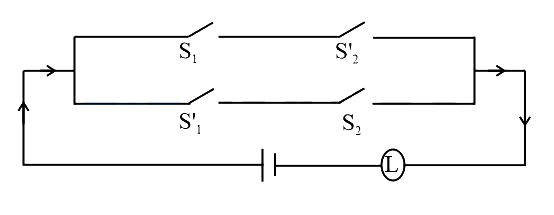 MHT CET 2016 Easy
 - What is the secondary valence of \(\mathrm{Co}^{3+}\) ion according to Werner's theory in \(\left[\mathrm{Co}\left(\mathrm{NH}_{3}\right)_{4} \mathrm{Cl}_{2}\right]^{+}\) ?MHT CET 2020 Easy
- The fundamental frequency of an air column in a pipe closed at one end is . If the same pipe is open at both the ends, the frequencies produced in areMHT CET 2017 Medium
- The joint equation of pair of lines through the origin and making equilateral triangle with the line \(y=4\) isMHT CET 2020 Easy
- A particle starts oscillating simple harmonically from its equilibrium position with time period ' \(\mathrm{T}\) '. At time \(\mathrm{t}=\frac{\mathrm{T}}{12}\), the ratio of its kinetic energy to potential energy is
\(\left[\sin \frac{\pi}{3} \cos \frac{\pi}{6}=\frac{\sqrt{3}}{2}, \sin \frac{\pi}{6}=\cos \frac{\pi}{3}=\frac{1}{2}\right]\)MHT CET 2022 Hard