


MHT CET · Chemistry · Solutions
\(5 \mathrm{~g}\) sucrose (molar mass \(=342\) ) is dissolved in \(100 \mathrm{~g}\) of solvent, decreases the freezing point by \(2.15 \mathrm{~K}\). What is cryoscopic constant of solvent?
- A \(14.7 \mathrm{~K} \mathrm{~kg} \mathrm{~mol}^{-1}\)
- B \(2.15 \mathrm{~K} \mathrm{~kg} \mathrm{~mol}^{-1}\)
- C \(4.30 \mathrm{~K} \mathrm{~kg} \mathrm{~mol}^{-1}\)
- D \(7.35 \mathrm{~K} \mathrm{~kg} \mathrm{~mol}^{-1}\)
Answer & Solution
Correct Answer
(A) \(14.7 \mathrm{~K} \mathrm{~kg} \mathrm{~mol}^{-1}\)
Step-by-step Solution
Detailed explanation
\(\begin{aligned} & \Delta \mathrm{T}_{\mathrm{f}}=\mathrm{K}_{\mathrm{f} \mathrm{m}} \\ & \mathrm{m}=\frac{\text { moles of solute }}{\text { massof solvent }} \times 1000 \\ & \mathrm{~m}=\frac{5 / 342}{100} \times 1000=\frac{50}{342} \\ & \Delta \mathrm{T}_{\mathrm{f}}=\mathrm{kf} \cdot \mathrm{m} \\ & 2.15=\mathrm{kf} \cdot \frac{50}{342} \\ & \mathrm{kf}=\frac{2.15 \times 342}{50}=14.7 \mathrm{~K} \mathrm{~kg} \cdot \mathrm{mol}^{-1}\end{aligned}\)
See the Complete Solution
Get step-by-step explanations for this and 2.5 Lakh+ more JEE, NEET & CET questions.
- Unlock all solutions
- Practice the full chapter
- Track accuracy across PYQs
4.8 rated on Google Play · 14,000+ reviews
More questions from Chemistry
- \(0.2 \mathrm{M}\) aqueous solution of glucose has osmotic pressure \(4.9 \mathrm{~atm}\) at \(300 \mathrm{~K}\). What is the concentration of glucose if it has osmotic pressure \(1.5 \mathrm{~atm}\) at same temperature?MHT CET 2023 Medium
- Which among the following is NOT obtained when bromobenzene treated with bromoethane and sodium in presence of dry ether?MHT CET 2020 Medium
- Which among the following is a simple ketone?MHT CET 2023 Easy
- Which of the following compounds is optically active?MHT CET 2009 Easy
- What is the position of transition elements from \(\mathrm{Sc}\) to \(\mathrm{Zn}\) in long form of periodic table?MHT CET 2023 Easy
- A gas expands isothermally against a constant external pressure of 1 bar from \(10 \mathrm{dm}^3\) to \(20 \mathrm{dm}^3\) by absorbing 800 J of heat from surrounding. Calculate value of \(\Delta \mathrm{U}\).MHT CET 2024 Easy
More PYQs from MHT CET
- Which element from following is the last element of 5d-transition series?MHT CET 2024 Easy
- Three identical capacitors of capacitance ' \(\mathrm{C}\) ' each are connected in series and this connection is connected in parallel with one more such identical capacitor. Then the capacitance of whole combination isMHT CET 2023 Medium
- Identify the reagent used for Rosenmund reduction.MHT CET 2025 Easy
- Let \(\mathrm{f}(x)=\log (\sin x), 0 < x < \pi\) and \(\mathrm{g}(x)=\sin ^{-1}\left(\mathrm{e}^{-x}\right), x \geq 0\).
If \(\alpha\) is a positive real number such that \(a=(f \circ g)^{\prime}(\alpha)\) and \(b=(f \circ g)(\alpha)\), thenMHT CET 2023 Hard - What is the frequency of violet light having wavelength 400 nm ?MHT CET 2024 Easy
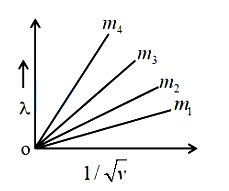
- Graph shows the variation of de-Broglie wavelength \(\lambda\) versus \(\frac{1}{\sqrt{V}}\) where \(V\) is the accelerating potential for four particles, P, Q, R, S carrying same charge but of mass \(m_1, m_2, m_3, m_4\). Which one represents a particle of smaller mass?
 MHT CET 2022 Hard