


MHT CET · Chemistry · Hydrocarbons
2, 2-dichloropropane \(\stackrel{A q . \mathrm{KOH}}{\longrightarrow} A\) \(\frac{\text { Clemmensen }}{\text { . reduction }} B,B\) is
- A propanol
- B propene
- C propane
- D ethane
Answer & Solution
Correct Answer
(C) propane
Step-by-step Solution
Detailed explanation
See the Complete Solution
Get step-by-step explanations for this and 2.5 Lakh+ more JEE, NEET & CET questions.
- Unlock all solutions
- Practice the full chapter
- Track accuracy across PYQs
4.8 rated on Google Play · 14,000+ reviews
More questions from Chemistry
- Which among the following has highest boiling point?MHT CET 2020 Medium
- Which of the following is a Lewis acid but not a Bronsted acid?MHT CET 2022 Medium
- Name the reagent that is used in leaching of gold.MHT CET 2016 Easy
- When a mixture of vapours of phenol and hydrogen is passed over nickel catalyst at \(433 \mathrm{~K}\), the product obtained isMHT CET 2021 Medium
- What is total number of donor atoms in \(\left[\mathrm{Co}\left(\mathrm{H}_2 \mathrm{O}\right)\left(\mathrm{NH}_3\right)_5\right] \mathrm{I}_3\) ?MHT CET 2023 Easy
- Which among the following nitrogen bases of polynucleotides is NOT derived from pyrimidine?MHT CET 2022 Hard
More PYQs from MHT CET
- Calculate the number of atoms present in 1.58 g metal if it form bcc structure \(\left[\varrho \times a^3=1.58 \times 10^{-22} \mathrm{~g}\right]\)MHT CET 2025 Medium
- Chlorine exists in two isotopic forms \({ }^{35} \mathrm{Cl},{ }^{37} \mathrm{Cl}\). If average atomic mass of chlorine is 35.5 , what is the percentage abundance of these isotopes respectively?MHT CET 2024 Medium
- In hydrogen atoms, transition from the state \(n=6\) to \(n=1\) result in ultraviolet radiation.
Infrared radiation will be obtained in the transitionMHT CET 2022 Medium - The major product obtained in the following reaction is
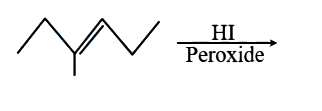 MHT CET 2021 Easy
 - The particular solution of the differential equation \(\frac{d y}{d x}-e^x=y e^x\), when \(x=0\) and \(y=1\) isMHT CET 2022 Easy
- The reaction \(2 \mathrm{~A}+\mathrm{B}+\mathrm{C} \longrightarrow \mathrm{D}+\mathrm{E}\) is found to. be first order in A , second order in B and zero order in C . What is the effect of increasing concentration of all reactants twice?MHT CET 2024 Easy