


MHT CET · BIOLOGY · STD 11 - 15. Excretion and Osmoregulation
Total number of minor calyces is equal to that of
- A column of Bertini
- B major calyces
- C renal pyramids
- D collecting ducts
Answer & Solution
Correct Answer
(C) renal pyramids
Step-by-step Solution
Detailed explanation
See the Complete Solution
Get step-by-step explanations for this and 2.5 Lakh+ more JEE, NEET & CET questions.
- Unlock all solutions
- Practice the full chapter
- Track accuracy across PYQs
4.8 rated on Google Play · 14,000+ reviews
More questions from BIOLOGY
- Select the CORRECT identification group of labelled parts I, II, III
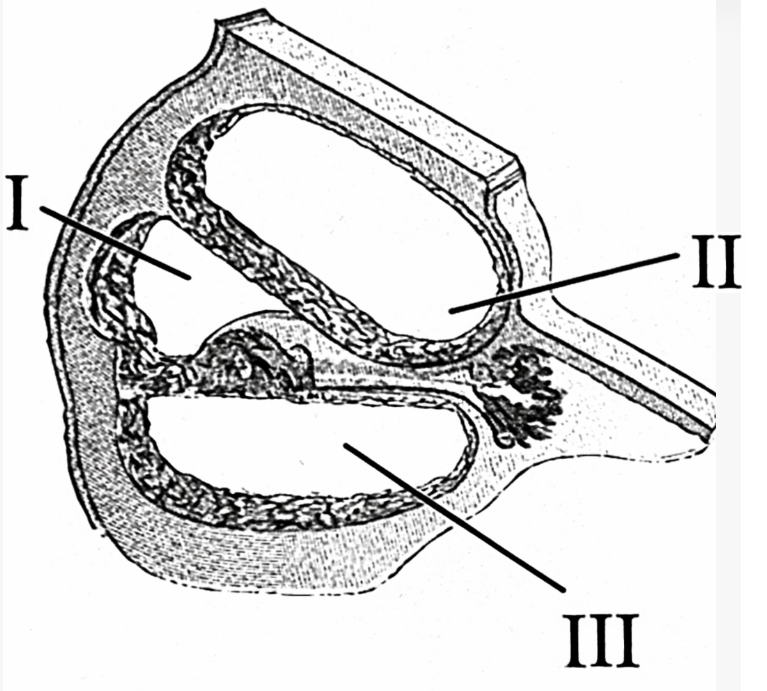 MHT CET 2015 Hard
 - Senescence in plants leads into _______________ of cells.MHT CET 2014 Medium
- The process of expulsion of urine from urinary bladder is calledMHT CET 2006 Medium
- RAAS is regulatory mechanism for osmoregulation. It includes _____ group of hormones.MHT CET 2023 Easy
- Under a particular set of selection pressure, organisms evolve towards the most efficient reproductive strategy. for e.g.
A) Oysters produce a large number of small-sized offsprings.
B) Mammals produce a small number of large sized offsprings.
In the light of above statements choose the correct option.MHT CET 2023 Medium - In haemodialysis, _____ acts as a semipermeable membrane which is immersed in dialysate.MHT CET 2023 Hard
More PYQs from MHT CET
- Which from following is a lanthanoid element?MHT CET 2025 Easy
- Arithmetic growth can be expressed mathematically by the formula Lt = Lo + rt, where Lt stands for ________.MHT CET 2025 Medium
- What is oxidation number of S in \(\mathrm{SO}_3^{2-}\) ?MHT CET 2024 Easy
- Metallic silver has fcc structure. If radius of Ag atom is 144 pm . What is the edge length of unit cell?MHT CET 2024 Easy
- Calculate the density of a metal having molar mass \(197 \mathrm{~g} \mathrm{~mol}^{-1}\) if it forms fcc structure. \(\left[\mathrm{a}^3 \times \mathrm{N}_{\mathrm{A}}=40 \mathrm{~cm}^3 \mathrm{~mol}^{-1}\right]\)MHT CET 2024 Easy
- A hemispherical portion of radius ' \(R\) ' is removed from the bottom of a cylinder of radius ' R '. The volume of the remaining cylinder is ' \(V\) ' and its mass is ' \(M\) '. It is suspended by a string in a liquid of density ' \(\rho\) ' where it stays vertical. The upper surface of the cylinder is at a depth ' \(h\) ' below the liquid surface. The force on the bottom of the liquid isMHT CET 2024 Medium