


KCET · Physics · Ray Optics
The distance between an object and its image produced by a converging lens is \(0.72 \mathrm{~m}\). The magnification is 2 . What will be the magnification when the object is moved by \(0.04 \mathrm{~m}\) towards the lens?
- A 2
- B 4
- C 3
- D 6
Answer & Solution
Correct Answer
(B) 4
Step-by-step Solution
Detailed explanation
Given, \(m=2\) and the image formed is real
\(\therefore\) For a real image \(\frac{1}{f}=\frac{1}{v}+\frac{1}{u} \quad(\because u\) is negative \()\)
\(\begin{array}{ll}
\text { Or } & 1+\frac{1}{m}=\frac{u}{f} \\
\Rightarrow & 1+\frac{1}{2}=\frac{u}{f} \\
\Rightarrow & \frac{3}{2}=\frac{0.72}{f} \\
\text { or } \quad & f=\frac{0.72 \times 2}{3}=0.16 \mathrm{~m}
\end{array}\)
As the object is moved by \(0.04 \mathrm{~m}\) towards the lens, the new
\(u_{1}=0.72-0.04=0.68 \mathrm{~m}\)
Again real image is formed
So, \(1+\frac{1}{m}=\frac{u_{1}}{f}\)
\(\Rightarrow \quad \frac{1}{m}=\frac{0.04}{0.16}\)
\(\Rightarrow \quad m=4\)
\(\therefore\) For a real image \(\frac{1}{f}=\frac{1}{v}+\frac{1}{u} \quad(\because u\) is negative \()\)
\(\begin{array}{ll}
\text { Or } & 1+\frac{1}{m}=\frac{u}{f} \\
\Rightarrow & 1+\frac{1}{2}=\frac{u}{f} \\
\Rightarrow & \frac{3}{2}=\frac{0.72}{f} \\
\text { or } \quad & f=\frac{0.72 \times 2}{3}=0.16 \mathrm{~m}
\end{array}\)
As the object is moved by \(0.04 \mathrm{~m}\) towards the lens, the new
\(u_{1}=0.72-0.04=0.68 \mathrm{~m}\)
Again real image is formed
So, \(1+\frac{1}{m}=\frac{u_{1}}{f}\)
\(\Rightarrow \quad \frac{1}{m}=\frac{0.04}{0.16}\)
\(\Rightarrow \quad m=4\)
See the Complete Solution
Get step-by-step explanations for this and 2.5 Lakh+ more JEE, NEET & CET questions.
- Unlock all solutions
- Practice the full chapter
- Track accuracy across PYQs
4.8 rated on Google Play · 14,000+ reviews
More questions from Physics
- A small conducting sphere of radius is lying concentrically inside a bigger hollow conducting sphere of radius The bigger and smaller spheres are charged with and \((Q>q)\) and are insulated from each other. The potential difference between the spheres will beKCET 2008 Hard
- When a soap bubble is charged?KCET 2020 Medium
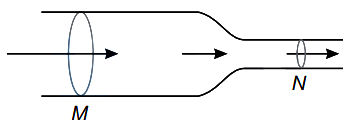
- Horizontal tube of non-uniform corss-section has radii of \(0.1 \mathrm{~m}\) and \(0.05 \mathrm{~m}\) respectively at \(\mathrm{M}\) and N. For a streamline flow of liquid the rate of liquid flow is
 KCET 2009 Easy
 - A pan filled with hot food cools from \( 94^{\circ} \mathrm{C} \) to \( 86^{\circ} \mathrm{C} \) in \( 2 \) minutes. When the room
temperature'is \( 20^{\circ} \mathrm{C} \). How long will it cool from \( 74^{\circ} \mathrm{C} \) to \( 66{ }^{\circ} \mathrm{C} \) ?KCET 2016 Medium - For the constructive interference the path difference between the two interfering waves must be equal toKCET 2009 Easy
- If \(\gamma\) is the ratio of specific heats and \(R\) is the universal gas constant, then the molar specific heat at constant volume \(\mathrm{C}_{\mathrm{V}}\) is given byKCET 2008 Easy
More PYQs from KCET
- A nucleus with mass number 220 initially at rest emits an alpha particle. If the \(Q\) value of reaction is \(5.5 \mathrm{MeV}\). Calculate the value of kinetic energy of alpha particleKCET 2023 Hard
- Stanley Miller simulated the conditions of pre - biotic earth using spark - discharge apparatus. Which organic compounds were observed by him on analysing the end product of his experiment?KCET 2024 Medium
- The function \(f(x)=\frac{\log (1+a x)-\log (1-b x)}{x}\) is not defined at \(\mathrm{x}=0\). The value which should be assigned to \(\mathrm{f}\) at \(\mathrm{x}=0\) so that it is continuous at \(\mathrm{x}=0\) isKCET 2009 Easy
- Which of the following nitrogen bases is found only in DNA?KCET 2019 Easy
- Match the organic compounds listed under Column-I with the explanation given under Column-II. Choose the appropriate option from the given choices.
Column-I Column-II A. Phosphoenol pyruvate (PEP) p. 6-carbon compound B. Ribulose biphosphate (RuBP) q. 2-carbon compound C. Oxaloacetic acid (OAA) r. 4-carbon compound D. Acetyl coenzymeA s. 5-carbon compound t. 3-carbon compound KCET 2014 Medium - \(G=\left\{\left[\begin{array}{ll}x & x \\ x & x\end{array}\right], x\right.\) is a non-zero real number \(\}\) is a group with respect to matrix multiplication.
In this group, the inverse of \(\left[\begin{array}{ll}\frac{1}{3} & \frac{1}{3} \\ \frac{1}{3} & \frac{1}{3}\end{array}\right]\) isKCET 2011 Medium