


KCET · Physics · Ray Optics
A ray of light passes through four transparent media with refractive index \( n_{1}, n_{2}, n_{3} \) and \( n_{4} \) as
shown. The surfaces of all media are parallel
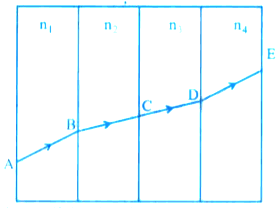
If the emergent ray \( D E \) is parellel to incident ray \( A B \), then
- A \( n_{1}=n_{4} \)
- B \( n_{2}=n_{4} \)
- C \( n_{3}=n_{4} \)
- D \( n_{1}=\frac{n_{2}+n_{3}+n_{4}}{3} \)
Answer & Solution
Correct Answer
(A) \( n_{1}=n_{4} \)
Step-by-step Solution
Detailed explanation
Given, \( 4 \) transparent media \( n_{1}, n_{2}, n_{3} \) and \( n_{4} \) are parallel to each other and a ray of light passes through it.
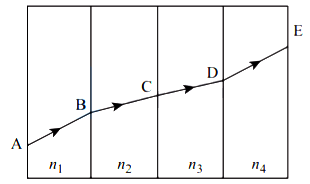
Then by Snell's law for multiple media, we have
\[
n_{1} \sin \theta_{1}=n_{4} \sin \theta_{4}
\]
But \( \theta_{1}=\theta_{4} \)
Therefore, \( n_{1}=n_{4} \)
Then by Snell's law for multiple media, we have
\[
n_{1} \sin \theta_{1}=n_{4} \sin \theta_{4}
\]
But \( \theta_{1}=\theta_{4} \)
Therefore, \( n_{1}=n_{4} \)
See the Complete Solution
Get step-by-step explanations for this and 2.5 Lakh+ more JEE, NEET & CET questions.
- Unlock all solutions
- Practice the full chapter
- Track accuracy across PYQs
4.8 rated on Google Play · 14,000+ reviews
More questions from Physics
- According to Einstein's photoelectric equation, the graph of \(\mathrm{KE}\) of the photoelectron emitted from the metal versus the frequency of the incident radiation gives a straight line graph, whose slopeKCET 2010 Easy
- In determining the refractive index of a glass slab using a travelling microscope, the following readings are tabulated
(a) Reading of travelling microscope for ink mark \(=5.123 \mathrm{~cm}\)
(b) Reading of travelling microscope for ink mark through glass slab \(=6.123 \mathrm{~cm}\)
(c) Reading of travelling microscope for chalk dust on glass slab \(=8.123 \mathrm{~cm}\)
From the data, the refractive index of a glass slab isKCET 2025 Medium - An electric dipole is kept in non-uniform electric field. It generally experiencesKCET 2019 Easy
- \({ }_{92} \mathrm{U}^{235}\) undergoes successive disintegrations with the end product of \({ }_{82} \mathrm{~Pb}^{203}\). The number of \(\alpha\) and \(\beta\) particles emitted areKCET 2008 Easy
- The average power dissipated in A.C. circuit is \( 2 \) watt. If a current flowing through a circuit is \( 2 \)
\( A \) and impedance is \( 1 \Omega \), what is the power factor of the \( A C \) circuit?KCET 2014 Easy - Which one of the following is not correct?KCET 2013 Medium
More PYQs from KCET
- If \((2,3,-1)\) is the foot of the perpendicular from \((4,2,1)\) to a plane, then the equation of the plane isKCET 2023 Easy
- The value of \(\tan 67 \frac{1^{\circ}}{2}+\cot 67 \frac{1^{\circ}}{2}\) isKCET 2008 Medium
- The testes are situated outside the abdominal cavity in scrotum as it helps toKCET 2022 Medium
- The function \( f(x)=x^{2}+2 x-5 \) is strictly increasing in the intervalKCET 2017 Medium
- \(\mathrm{Mg}^{2+}\) is isoelectronic withKCET 2007 Easy
- Reactions in Zeolite catalyst depend on,KCET 2016 Easy