


KCET · Maths · Differentiation
The derivative of \(e^{a x} \cos b x\) with respect \(x\) is \(r^{a x} \cos b x \tan ^{-1} \frac{b}{a}\). When \(a>0, b>0\), then value of \(r\), is
- A \(\sqrt{a^{2}+b^{2}}\)
- B \(\frac{1}{\sqrt{\mathrm{ab}}}\)
- C \(a b\)
- D \(a+b\)
Answer & Solution
Correct Answer
(A) \(\sqrt{a^{2}+b^{2}}\)
Step-by-step Solution
Detailed explanation
Given, \(\frac{\mathrm{d}}{\mathrm{dx}}\left(\mathrm{e}^{\mathrm{ax}} \cos \mathrm{bx}\right)=\mathrm{re}^{\mathrm{ax}} \cos (\mathrm{bx}+\alpha)\), then \(\mathrm{r}=\) ?
Let \(\quad y=e^{a x} \cdot \cos b x\)
\(\frac{d y}{d x}=a e^{a x} \cdot \cos b x-b e^{a x} \cdot \sin b x\)
\(\frac{d y}{d x}=e^{a x}(a \cos b x-b \sin b x)\)
Let \(\left.\quad \begin{array}{l}\mathrm{a}=\mathrm{r} \cos \alpha \\ \mathrm{b}=\mathrm{r} \sin \alpha\end{array}\right\} \quad \text{...(i)}\)
Then, \(\frac{d y}{d x}=e^{a x} \cdot r\{\cos b x \cdot \cos \alpha-\sin b x \cdot \sin \alpha\}\)
\[
\frac{d y}{d x}=e^{a x} \cdot r \cos (b x+\alpha) \quad \text{...(ii)}
\]
Where, \(\tan \alpha=\frac{\mathrm{b}}{\mathrm{a}} \Rightarrow \alpha=\tan ^{-1}\left(\frac{\mathrm{b}}{\mathrm{a}}\right)\) and
\[
\begin{aligned}
\mathrm{r}^{2}\left(\cos ^{2} \alpha+\sin ^{2} \alpha\right) &=\mathrm{a}^{2}+\mathrm{b}^{2} \\
\mathrm{r}^{2} &=\mathrm{a}^{2}+\mathrm{b}^{2} \\
\mathrm{r} &=\sqrt{\mathrm{a}^{2}+\mathrm{b}^{2}}
\end{aligned}
\]
Let \(\quad y=e^{a x} \cdot \cos b x\)
\(\frac{d y}{d x}=a e^{a x} \cdot \cos b x-b e^{a x} \cdot \sin b x\)
\(\frac{d y}{d x}=e^{a x}(a \cos b x-b \sin b x)\)
Let \(\left.\quad \begin{array}{l}\mathrm{a}=\mathrm{r} \cos \alpha \\ \mathrm{b}=\mathrm{r} \sin \alpha\end{array}\right\} \quad \text{...(i)}\)
Then, \(\frac{d y}{d x}=e^{a x} \cdot r\{\cos b x \cdot \cos \alpha-\sin b x \cdot \sin \alpha\}\)
\[
\frac{d y}{d x}=e^{a x} \cdot r \cos (b x+\alpha) \quad \text{...(ii)}
\]
Where, \(\tan \alpha=\frac{\mathrm{b}}{\mathrm{a}} \Rightarrow \alpha=\tan ^{-1}\left(\frac{\mathrm{b}}{\mathrm{a}}\right)\) and
\[
\begin{aligned}
\mathrm{r}^{2}\left(\cos ^{2} \alpha+\sin ^{2} \alpha\right) &=\mathrm{a}^{2}+\mathrm{b}^{2} \\
\mathrm{r}^{2} &=\mathrm{a}^{2}+\mathrm{b}^{2} \\
\mathrm{r} &=\sqrt{\mathrm{a}^{2}+\mathrm{b}^{2}}
\end{aligned}
\]
See the Complete Solution
Get step-by-step explanations for this and 2.5 Lakh+ more JEE, NEET & CET questions.
- Unlock all solutions
- Practice the full chapter
- Track accuracy across PYQs
4.8 rated on Google Play · 14,000+ reviews
More questions from Maths
- If \(A\) is a square matrix such that \(A^2=A\), then \((I-A)^3\) isKCET 2025 Easy
- \(\int \operatorname{cosec}(x-a) \operatorname{cosec} x d x\) is equal toKCET 2009 Hard
- Which of the following is an empty set?KCET 2023 Easy
- For the LPP, maximize \( z=x+4 y \) subject to the constraints \( x+2 y \leq 2, x+2 y \geq 8, x, y \geq 0 \)KCET 2018 Medium
- The order and degree of the differential equation \( y=x \frac{d y}{d x}+\frac{2}{\frac{d y}{d x}} \) isKCET 2014 Easy
- \(\lim _{y \rightarrow 0} \frac{\sqrt{3+y^3}-\sqrt{3}}{y^3}=\)KCET 2022 Easy
More PYQs from KCET
-

' \( R^{\prime} \) isKCET 2014 Easy - DNA, present in the nucleus, was named as 'Nuclein' byKCET 2018 Easy
- Ten chairs are numbered as 1 to 10 . Three women and two men wish to occupy one chair each. First the women choose the chairs marked 1 to 6 , then the men choose the chairs from the remaining. The number of possible ways isKCET 2023 Easy
- The variations of resistivity \(\rho\) with absolute temperature T for three different materials \(\mathrm{X}, \mathrm{Y}\) and Z are shown in the graph below. Identify the materials \(\mathrm{X}, \mathrm{Y}\) and Z .
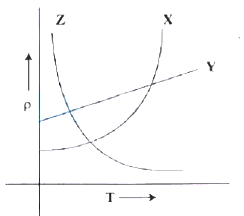 KCET 2025 Medium
 - The 11th term in the expansion of \( \left(x+\frac{1}{\sqrt{x}}\right)^{14} \) isKCET 2016 Easy
- Consider the following statements Statement 1 : \(\lim _{x \rightarrow 1} \frac{a x^{2}+b x+c}{c x^{2}+b x+a}\) is 1 (where \(a+b+c \neq 0\) ).
Statement \(2: \lim _{x \rightarrow 2} \frac{\frac{1}{x}+\frac{1}{2}}{x+2}\) is \(\frac{1}{4}\).KCET 2021 Medium