


KCET · Maths · Differentiation
Let \(a=i+j+k, b=i-j+k\) and \(c=i-j-k\) be three vectors. A vector \(v\) in the plane of a and \(b\), whose projection on \(c\) is \(1 / \sqrt{3}\), is given by
- A \(i-3 j-3 k\)
- B \(-3 i-3 j+k\)
- C \(3 i-j+3 k\)
- D \(i+3 j-3 k\)
Answer & Solution
Correct Answer
(D) \(i+3 j-3 k\)
Step-by-step Solution
Detailed explanation
Given that,
\[
\begin{array}{l}
\vec{a}=\hat{i}+2 \hat{j}+\hat{k} \rightarrow(1) \\
\vec{b}=\hat{i}-\hat{j}+\hat{k} \rightarrow(2) \\
\vec{C}=\hat{i}+\hat{j}-\hat{k} \rightarrow(3)
\end{array}
\]
A vector in the plane of \( \vec{a} \) and \( \vec{b} \) can be written as,
\[
\begin{array}{l}
\vec{r}=m \vec{a}+n \vec{b} \\
=m(\hat{i}+2 \hat{j}+\hat{k})+n(\hat{i}-\hat{j}+\hat{k}) \\
\vec{r}=(m+n) \hat{i}+(2 m-n) \hat{j}+(m+n) \hat{k}
\end{array}
\]
So, projection on \( \vec{C} \) by \( \vec{r} \) is given by
\[
\begin{array}{l}
\frac{\vec{r} \cdot \vec{C}}{|\vec{C}|}=\frac{(m+n)+(2 m-n)-(m+n)}{\sqrt{1+1+1}} \\
\Rightarrow \frac{2 m-n}{\sqrt{3}}=\frac{1}{\sqrt{3}}
\end{array}
\]
As use can see from Eq. (4), the \( ^{\wedge} i \) component and the \( \hat{k} \) component must be equal and \( \hat{j} \) can be either \( -1 \) or \( 1 . \)
Therefore, option (4) is correct, that is \( 4 \hat{i}-\hat{j}+4 \hat{k} \)
\[
\begin{array}{l}
\vec{a}=\hat{i}+2 \hat{j}+\hat{k} \rightarrow(1) \\
\vec{b}=\hat{i}-\hat{j}+\hat{k} \rightarrow(2) \\
\vec{C}=\hat{i}+\hat{j}-\hat{k} \rightarrow(3)
\end{array}
\]
A vector in the plane of \( \vec{a} \) and \( \vec{b} \) can be written as,
\[
\begin{array}{l}
\vec{r}=m \vec{a}+n \vec{b} \\
=m(\hat{i}+2 \hat{j}+\hat{k})+n(\hat{i}-\hat{j}+\hat{k}) \\
\vec{r}=(m+n) \hat{i}+(2 m-n) \hat{j}+(m+n) \hat{k}
\end{array}
\]
So, projection on \( \vec{C} \) by \( \vec{r} \) is given by
\[
\begin{array}{l}
\frac{\vec{r} \cdot \vec{C}}{|\vec{C}|}=\frac{(m+n)+(2 m-n)-(m+n)}{\sqrt{1+1+1}} \\
\Rightarrow \frac{2 m-n}{\sqrt{3}}=\frac{1}{\sqrt{3}}
\end{array}
\]
As use can see from Eq. (4), the \( ^{\wedge} i \) component and the \( \hat{k} \) component must be equal and \( \hat{j} \) can be either \( -1 \) or \( 1 . \)
Therefore, option (4) is correct, that is \( 4 \hat{i}-\hat{j}+4 \hat{k} \)
See the Complete Solution
Get step-by-step explanations for this and 2.5 Lakh+ more JEE, NEET & CET questions.
- Unlock all solutions
- Practice the full chapter
- Track accuracy across PYQs
4.8 rated on Google Play · 14,000+ reviews
More questions from Maths
- If the area of the auxillary circle of the ellipse \(\frac{x^{2}}{a^{2}}+\frac{y^{2}}{b^{2}}=1(\) where, \(a>b)\) is twice the area of the ellipse, then the eccentricity of the ellipse isKCET 2013 Medium
- If \(a,-a, b\) are the roots of \(x^{3}-5 x^{2}-x+5=0\), then \(b\) is a root ofKCET 2010 Easy
- \(\lim _{x \rightarrow a}\left[\frac{\sqrt{a+2 x}-\sqrt{3 x}}{\sqrt{3 a+x}-2 \sqrt{x}}\right]\) is equal toKCET 2011 Medium
- A bag contains \( 17 \) tickets numbered from \( 1 \) to \( 17 \). A ticket is drawn at random, then another
ticket isdrawn without replacing the first one. The probability that both the tickets may show
even numbers isKCET 2018 Easy - \(\frac{d}{d x}\left[\cos ^2\left(\cot ^{-1} \sqrt{\frac{2+x}{2-x}}\right)\right]\) isKCET 2024 Hard
- If the area between \(y=m x^{2}\) and \(x=m y^{2}(m>0)\) is \(1 / 4 \mathrm{sq}\) units, then the value of \(m\) isKCET 2011 Hard
More PYQs from KCET
- If \(x\left[\begin{array}{l}3 \\ 2\end{array}\right]+y\left[\begin{array}{r}1 \\ -1\end{array}\right]=\left[\begin{array}{l}15 \\ 5\end{array}\right]\), then the value of \(x\) and \(y\) areKCET 2023 Easy
- The feasible region of an LPP is shown in the figure. If \( z=3 x+9 y \), then the minimum value of
z occurs at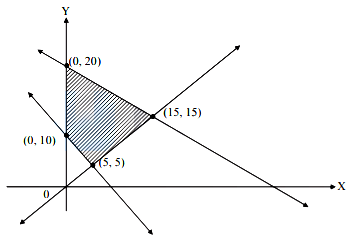 KCET 2018 Easy
 - In which of the following pairs, both the elements do not have \((\mathrm{n}-1) \mathrm{d}^{10} \mathrm{~ns} \mathrm{~s}^2\) configuration?KCET 2025 Medium
- The points \(A(1,2), B(2,4)\) and \(C(4,8)\) form a/anKCET 2011 Easy
- If \( \sin ^{-1} x+\cos ^{-1} y=\frac{2 \pi}{5} \), then \( \cos ^{-1} x+\sin ^{-1} y \) isKCET 2018 Easy
- Alkali metals have negative reduction potential and hence they behave asKCET 2013 Easy