


KCET · Maths · Quadratic Equation
If \(\alpha\) and \(\beta\) are acute angles such that \(\alpha - \beta\) and \(\alpha + \beta\) satisfy the equation \(\tan^2\theta - 4\tan\theta + 1 = 0\), then \(\alpha\) and \(\beta\) are respectively,
- A \(45^\circ, 30^\circ\)
- B \(30^\circ, 45^\circ\)
- C \(30^\circ, 60^\circ\)
- D \(60^\circ, 45^\circ\)
Answer & Solution
Correct Answer
(A) \(45^\circ, 30^\circ\)
Step-by-step Solution
Detailed explanation
The roots of the equation \(\tan^2\theta - 4\tan\theta + 1 = 0\) are \(\tan(\alpha - \beta)\) and \(\tan(\alpha + \beta)\).
Sum of roots: \(\tan(\alpha - \beta) + \tan(\alpha + \beta) = 4\)
Product of roots: \(\tan(\alpha - \beta) \tan(\alpha + \beta) = 1\)
Using the tangent addition formula:
\(\tan(2\alpha) = \tan((\alpha - \beta) + (\alpha + \beta)) = \dfrac{\tan(\alpha - \beta) + \tan(\alpha + \beta)}{1 - \tan(\alpha - \beta) \tan(\alpha + \beta)}\)
Substituting the sum and product of roots:
\(\tan(2\alpha) = \dfrac{4}{1 - 1} \rightarrow \infty\)
Since \(\alpha\) is an acute angle, \(2\alpha = 90^\circ \Rightarrow \alpha = 45^\circ\).
Now, substituting \(\alpha = 45^\circ\) into the sum of roots equation:
\(\tan(45^\circ - \beta) + \tan(45^\circ + \beta) = 4\)
\(\dfrac{1 - \tan\beta}{1 + \tan\beta} + \dfrac{1 + \tan\beta}{1 - \tan\beta} = 4\)
\(\dfrac{(1 - \tan\beta)^2 + (1 + \tan\beta)^2}{1 - \tan^2\beta} = 4\)
\(\dfrac{2(1 + \tan^2\beta)}{1 - \tan^2\beta} = 4\)
\(1 + \tan^2\beta = 2 - 2\tan^2\beta\)
\(3\tan^2\beta = 1 \Rightarrow \tan\beta = \dfrac{1}{\sqrt{3}}\) (since \(\beta\) is acute)
Thus, \(\beta = 30^\circ\).
Answer: \(45^\circ, 30^\circ\)
Sum of roots: \(\tan(\alpha - \beta) + \tan(\alpha + \beta) = 4\)
Product of roots: \(\tan(\alpha - \beta) \tan(\alpha + \beta) = 1\)
Using the tangent addition formula:
\(\tan(2\alpha) = \tan((\alpha - \beta) + (\alpha + \beta)) = \dfrac{\tan(\alpha - \beta) + \tan(\alpha + \beta)}{1 - \tan(\alpha - \beta) \tan(\alpha + \beta)}\)
Substituting the sum and product of roots:
\(\tan(2\alpha) = \dfrac{4}{1 - 1} \rightarrow \infty\)
Since \(\alpha\) is an acute angle, \(2\alpha = 90^\circ \Rightarrow \alpha = 45^\circ\).
Now, substituting \(\alpha = 45^\circ\) into the sum of roots equation:
\(\tan(45^\circ - \beta) + \tan(45^\circ + \beta) = 4\)
\(\dfrac{1 - \tan\beta}{1 + \tan\beta} + \dfrac{1 + \tan\beta}{1 - \tan\beta} = 4\)
\(\dfrac{(1 - \tan\beta)^2 + (1 + \tan\beta)^2}{1 - \tan^2\beta} = 4\)
\(\dfrac{2(1 + \tan^2\beta)}{1 - \tan^2\beta} = 4\)
\(1 + \tan^2\beta = 2 - 2\tan^2\beta\)
\(3\tan^2\beta = 1 \Rightarrow \tan\beta = \dfrac{1}{\sqrt{3}}\) (since \(\beta\) is acute)
Thus, \(\beta = 30^\circ\).
Answer: \(45^\circ, 30^\circ\)
See the Complete Solution
Get step-by-step explanations for this and 2.5 Lakh+ more JEE, NEET & CET questions.
- Unlock all solutions
- Practice the full chapter
- Track accuracy across PYQs
4.8 rated on Google Play · 14,000+ reviews
More questions from Maths
- \(2 \cos ^{-1} x=\sin ^{-1}\left(2 x \sqrt{1-x^{2}}\right)\) is valid for all values of \(x\) satisfyingKCET 2012 Medium
- The second order derivative of \(\cos^{-1}(4x^3 - 3x)\) with respect to \(\cos^{-1}(2x^2 - 1)\), where \(\dfrac{1}{2} < x < 1\) isKCET 2026 Medium
- Evaluate \( \left|\begin{array}{cc}\cos 15 & \sin 15 \\ \sin 75 & \cos 75\end{array}\right| \)KCET 2015 Medium
- \(\frac{3 x^{2}+1}{x^{2}-6 x+8}\) is equal toKCET 2007 Hard
- If \( A \) and \( B \) are two events of a sample space \( S \) such that \( P(A)=0.2, P(B)=0.6 \) and \( P(A \mid B)= \)
\( 0.5 \) then \( P\left(A^{\prime} \mid B\right)= \)KCET 2019 Medium - If \(\alpha, \beta\) and \(\gamma\) are roots of \(x^{3}-2 x+1=0\), then the value of \(\sum\left(\frac{1}{\alpha+\beta-\gamma}\right)\) isKCET 2011 Medium
More PYQs from KCET
- The corner points of the feasible region determined by the system of linear constraints are \((0, 10), (5, 5), (15, 15), (0, 20)\). Let \(z = px + qy\) where \(p, q > 0\). The relation between \(p\) and \(q\), so that the maximum \(z\) occurs at both points \((15, 15)\) and \((0, 20)\) isKCET 2026 Medium
- A balloon which always remains spherical is being inflated by pumping in \( 10 \) cubic centimeters
of gas per second. Find the rate at which the radius of the balloon is increasing when the
radius is \( 15 \mathrm{cms} \).KCET 2015 Medium - In this circuit, when certain current flows, the heat produced in \(5 \Omega\) is \(4.05 \mathrm{~J}\) in a time t. The heat produced in \(2 \Omega\) coil in the same time interval is
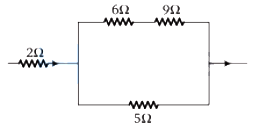 KCET 2012 Easy
 - If \(|\vec{a}|=10,|\vec{b}|=2\) and \(\vec{a} \cdot \vec{b}=12\), then the value of \(|\vec{a} \times \vec{b}|\) isKCET 2025 Easy
- In case of Fraunhoffer diffraction at a single slit, the diffraction pattern on the screen is correct for which of the following statements?KCET 2022 Easy
- Select the option from the following which is not a major characteristic feature of biodiversity hotspots.KCET 2018 Hard