


KCET · Maths · Matrices
If \(A=\left[\begin{array}{rr}\cos \theta & \sin \theta \\ -\sin \theta & \cos \theta\end{array}\right]\), then \(A \cdot A^{\prime}\) is
- A \(I\)
- B \(A\)
- C \(-A\)
- D \(A^{2}\)
Answer & Solution
Correct Answer
(A) \(I\)
Step-by-step Solution
Detailed explanation
\[
\text { Given, } \begin{aligned}
A &=\left[\begin{array}{rr}
\cos 0 & \sin \theta \\
-\sin \theta & \cos \theta
\end{array}\right] \\
A^{\prime} &=\left[\begin{array}{cc}
\cos \theta & -\sin \theta \\
\sin \theta & \cos \theta
\end{array}\right] \\
A A^{\prime} &=\left[\begin{array}{rr}
\cos \theta & \sin \theta \\
-\sin \theta & \cos \theta
\end{array}\right]\left[\begin{array}{cc}
\cos \theta & -\sin \theta \\
+\sin \theta & \cos \theta
\end{array}\right] \\
&=\left[\begin{array}{cc}
\cos ^{2} \theta+\sin ^{2} \theta & -\sin \theta \cdot \cos \theta \\
-\sin \theta \cdot \cos \theta & \sin ^{2} \theta+\cos ^{2} \theta
\end{array}\right] \\
+\cos \theta \cdot \sin \theta & \cos \theta \\
A A^{\prime} &=\left[\begin{array}{cc}
1 & 0 \\
0 & 1
\end{array}\right]=I \text { (unit matrix) }
\end{aligned}
\]
Hence, \(A A^{\prime}=I\), which is called an orthogonal matrix.
\text { Given, } \begin{aligned}
A &=\left[\begin{array}{rr}
\cos 0 & \sin \theta \\
-\sin \theta & \cos \theta
\end{array}\right] \\
A^{\prime} &=\left[\begin{array}{cc}
\cos \theta & -\sin \theta \\
\sin \theta & \cos \theta
\end{array}\right] \\
A A^{\prime} &=\left[\begin{array}{rr}
\cos \theta & \sin \theta \\
-\sin \theta & \cos \theta
\end{array}\right]\left[\begin{array}{cc}
\cos \theta & -\sin \theta \\
+\sin \theta & \cos \theta
\end{array}\right] \\
&=\left[\begin{array}{cc}
\cos ^{2} \theta+\sin ^{2} \theta & -\sin \theta \cdot \cos \theta \\
-\sin \theta \cdot \cos \theta & \sin ^{2} \theta+\cos ^{2} \theta
\end{array}\right] \\
+\cos \theta \cdot \sin \theta & \cos \theta \\
A A^{\prime} &=\left[\begin{array}{cc}
1 & 0 \\
0 & 1
\end{array}\right]=I \text { (unit matrix) }
\end{aligned}
\]
Hence, \(A A^{\prime}=I\), which is called an orthogonal matrix.
See the Complete Solution
Get step-by-step explanations for this and 2.5 Lakh+ more JEE, NEET & CET questions.
- Unlock all solutions
- Practice the full chapter
- Track accuracy across PYQs
4.8 rated on Google Play · 14,000+ reviews
More questions from Maths
- The maximum value of \(\sin\left(x + \dfrac{\pi}{6}\right) + \cos\left(x + \dfrac{\pi}{6}\right)\) is attained at \(x = \)KCET 2026 Medium
- The modulus of the complex number
\(\frac{(1+i)^2(1+3 i)}{(2-6 i)(2-2 i)}\) isKCET 2023 Easy - \( 3.5 \)
\( \int_{0.2}[x] d x \) is equal toKCET 2017 Hard - If \( A=\left[\begin{array}{ll}1 & 3 \\ 4 & 2\end{array}\right], B=\left[\begin{array}{cc}2 & -1 \\ 1 & 2\end{array}\right] \) then \( \left|A B B^{\prime}\right|= \)KCET 2019 Medium
- The value of \(C\) in \((0,2)\) satisfying the mean value theorem for the function
\(f(x)=x(x-1)^2, x \in[0,2]\) is equal toKCET 2024 Easy - A line cuts off equal intercepts on the co-ordinate axes. The angle made by this line with the
positive direction of \( X \)-axis isKCET 2019 Easy
More PYQs from KCET
- A proton and an \( \alpha \) particle are accelerated through the same potential difference \( V \). The ratio of
their de-Broglie's wavelength isKCET 2018 Easy - Identify the Phylum X.
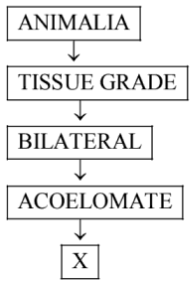 KCET 2015 Medium
 - The equivalent resistance between the points \(A\) and \(B\) in the following circuit is
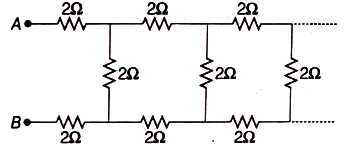 KCET 2023 Easy
 - Column I lists the parts of the human brain and column II lists the functions. Match the two columns and identify the correct choice from those given.
Column-I Column-II A. Cerebrum p. controls the pituitary B. Cerebellum q. controls vision and hearing C. Hypothalamus r. controls the rate of heart D. Midbrain s. seat of intelligence t. maintains body posture KCET 2005 Easy - Down's syndrome is an example forKCET 2014 Medium
- Continued self pollination results inKCET 2015 Medium