


KCET · Chemistry · d and f Block Elements
One mole of ammonia was completely absorbed in one litre solution each of
(a) \( 1 \mathrm{M} \mathrm{HCl} \),
(b) \( 1 \mathrm{M} \mathrm{CH}_{3} \mathrm{COOH} \) and
(c) \( 1 \mathrm{M} \mathrm{H}_{2} \mathrm{SO}_{4} \) at \( 298 \mathrm{~K} \).
The decreasing order for the \( \mathrm{pH} \) of the resulting solutions is
(Given \( \mathrm{K}_{b}\left(\mathrm{NH}_{3}\right)=4.74 \) )
- A \( a>b>c \)
- B \( c>b>a \)
- C \( b>c>a \)
- D \( b>a>c \)
Answer & Solution
Correct Answer
(D) \( b>a>c \)
Step-by-step Solution
Detailed explanation
The reactions involved are as follows:
(I) \(\mathrm{HCl}+\mathrm{NH}_{3}(\mathrm{aq}) \rightarrow \mathrm{NH}_{4} \mathrm{Cl}\)
(II) \(\mathrm{CH}_{3} \mathrm{COOH}+\mathrm{NH}_{3}(\mathrm{aq}) \rightarrow \mathrm{CH}_{3} \mathrm{COONH}_{4}\)
(III) \(\mathrm{H}_{2} \mathrm{SO}_{4}+2 \mathrm{NH}_{3}(\mathrm{aq}) \rightarrow\left(\mathrm{NH}_{4}\right)_{2} \mathrm{SO}_{4}\)
Now, according to \(\mathrm{Henderson}\) Haselbach equation
\(p \mathrm{H}=p \mathrm{~K}_{a}+\log \left(\frac{\left[\mathrm{A}^{-}\right]}{[\mathrm{HA}]}\right)\)
\(=14-\mathrm{pK}_{b}+\log \left(\frac{\left[\mathrm{A}^{-}\right]}{[\mathrm{HA}]}\right)\)
\(=9.26+\log \left(\frac{\left[\mathrm{A}^{-}\right]}{[\mathrm{HA}]}\right)\)
Thus, \(\mathrm{pH}\) depends on the strength of conjugate acid. The order acid strength of the reactants is as follows:
\(\mathrm{CH}_{3} \mathrm{COOH} < \mathrm{HCl} < \mathrm{H}_{2} \mathrm{SO}_{4}\). Also \(\mathrm{NH}_{3}\) (aq) is a strong base. As conjugate base of weak acid is strongly acidic, we
have the acidic strength of products as
\(\mathrm{CH}_{3} \mathrm{COONH}_{4}>\mathrm{NH}_{4} \mathrm{Cl} < \left(\mathrm{NH}_{4}\right)_{2} \mathrm{SO}_{4}\)
That is, (II) \(>(\mathrm{I})>(\mathrm{III})\).
(I) \(\mathrm{HCl}+\mathrm{NH}_{3}(\mathrm{aq}) \rightarrow \mathrm{NH}_{4} \mathrm{Cl}\)
(II) \(\mathrm{CH}_{3} \mathrm{COOH}+\mathrm{NH}_{3}(\mathrm{aq}) \rightarrow \mathrm{CH}_{3} \mathrm{COONH}_{4}\)
(III) \(\mathrm{H}_{2} \mathrm{SO}_{4}+2 \mathrm{NH}_{3}(\mathrm{aq}) \rightarrow\left(\mathrm{NH}_{4}\right)_{2} \mathrm{SO}_{4}\)
Now, according to \(\mathrm{Henderson}\) Haselbach equation
\(p \mathrm{H}=p \mathrm{~K}_{a}+\log \left(\frac{\left[\mathrm{A}^{-}\right]}{[\mathrm{HA}]}\right)\)
\(=14-\mathrm{pK}_{b}+\log \left(\frac{\left[\mathrm{A}^{-}\right]}{[\mathrm{HA}]}\right)\)
\(=9.26+\log \left(\frac{\left[\mathrm{A}^{-}\right]}{[\mathrm{HA}]}\right)\)
Thus, \(\mathrm{pH}\) depends on the strength of conjugate acid. The order acid strength of the reactants is as follows:
\(\mathrm{CH}_{3} \mathrm{COOH} < \mathrm{HCl} < \mathrm{H}_{2} \mathrm{SO}_{4}\). Also \(\mathrm{NH}_{3}\) (aq) is a strong base. As conjugate base of weak acid is strongly acidic, we
have the acidic strength of products as
\(\mathrm{CH}_{3} \mathrm{COONH}_{4}>\mathrm{NH}_{4} \mathrm{Cl} < \left(\mathrm{NH}_{4}\right)_{2} \mathrm{SO}_{4}\)
That is, (II) \(>(\mathrm{I})>(\mathrm{III})\).
See the Complete Solution
Get step-by-step explanations for this and 2.5 Lakh+ more JEE, NEET & CET questions.
- Unlock all solutions
- Practice the full chapter
- Track accuracy across PYQs
4.8 rated on Google Play · 14,000+ reviews
More questions from Chemistry
- \( \mathrm{H}_{2} \mathrm{O}_{2} \) isKCET 2018 Medium
- In the following sequence of reactions

The final product \( C \) isKCET 2017 Hard - \( 0.30 \mathrm{~g} \) of an organic compound containing \( \mathrm{C}, \mathrm{H} \) and Oxygen on combustion yields \( 0.44 \mathrm{~g} \mathrm{CO}_{2} \)
and \( 0.18 \mathrm{~g} \mathrm{H}_{2} \mathrm{O} \). If one mol of compound weighs \( 60 \), then molecular formula of the compound
isKCET 2015 Hard - An element with atomic number 21 is aKCET 2008 Medium
- \(\left(\mathrm{NH}_4\right)_2 \mathrm{Cr}_2 \mathrm{O}_7\) on heating liberates a gas. The same gas will be obtained byKCET 2022 Hard
- The metal extracted by leaching with a cyanide isKCET 2017 Medium
More PYQs from KCET
- The number of photons falling per second on a completely darkened plate to produce a force
of \( 6.62 \times 10^{-5} \mathrm{~N} \) is ' \( n \) '. If the wavelength of the light falling is \( 5 \times 10^{-7} \mathrm{~m} \), then \( n= \)
\( \times 10^{22} \).
\( \left(h=6.62 \times 10^{-34}\right) \mathrm{J}_{\mathrm{S}} \)KCET 2018 Medium - The function \( f(x)=[x] \), where \( [x] \) denotes greatest integer function is continuous atKCET 2015 Easy
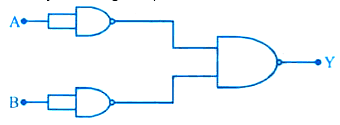
- Identify the logic operation carried out by the following circuit.
 KCET 2016 Easy
 - Given below are two statements:
Statement-I: The resistivity of a conductor is independent of its temperature.
Statement-II: The resistivity of a semiconductor decreases with increase in temperature.
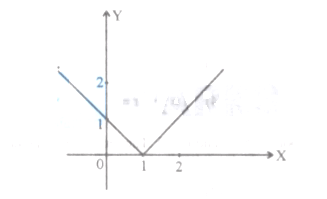
Select the correct option.KCET 2026 Medium - The function represented by the following graph is,
 KCET 2014 Hard
 - In castor and maize plant __________KCET 2014 Easy