


KCET · Chemistry · Coordination Compounds
On treating 100 mL of 0.1 M aqueous solution of the complex \(\mathrm{CrCl}_3 \cdot 6 \mathrm{H}_2 \mathrm{O}\) with excess of \(\mathrm{AgNO}_3, 2.86 \mathrm{~g}\) of AgCl was obtained. The complex is
- A \(\left[\mathrm{Cr}\left(\mathrm{H}_2 \mathrm{O}\right)_3 \mathrm{Cl}_3\right] \cdot 3 \mathrm{H}_2 \mathrm{O}\)
- B \(\left[\mathrm{Cr}\left(\mathrm{H}_2 \mathrm{O}\right)_4 \mathrm{Cl}_2\right] \mathrm{Cl} \cdot 2 \mathrm{H}_2 \mathrm{O}\)
- C \(\left[\mathrm{Cr}\left(\mathrm{H}_2 \mathrm{O}\right)_5 \mathrm{Cl}^{-}\right] \mathrm{Cl}_2 \cdot \mathrm{H}_2 \mathrm{O}\)
- D \(\left[\mathrm{Cr}\left(\mathrm{H}_2 \mathrm{O}\right)_6 \mathrm{Cl}_3\right]\)
Answer & Solution
Correct Answer
(C) \(\left[\mathrm{Cr}\left(\mathrm{H}_2 \mathrm{O}\right)_5 \mathrm{Cl}^{-}\right] \mathrm{Cl}_2 \cdot \mathrm{H}_2 \mathrm{O}\)
Step-by-step Solution
Detailed explanation
Given, Molarity of the complex \(=0.1 \mathrm{M}\)
Volume of the complex \(=100 \mathrm{~mL}\)
Mass of AgCl obtained \(=2.86 \mathrm{~g}\)
Now, no. of moles in \(\mathrm{CrCl}_3 \cdot 6 \mathrm{H}_2 \mathrm{O}\)
\(=\frac{\text { molarity } \times \text { volume }}{1000}=\frac{0.1 \times 100}{1000}=0.01 \mathrm{moles}\)
No. of moles of \(\mathrm{AgCl}=\frac{2.86}{143}=0.02\) moles
Number of \(\mathrm{Cl}^{-}\)ions present in the ionisation sphere
\(=\frac{\text { Moles of ions precipitated with excess } \mathrm{AgNO}_3}{\text { Moles of complex }}\)
\(=\frac{0.02}{0.01}=2\)
It means two chlorine ions must be present in the solution. So, the complex will be
\(\left[\mathrm{Cr}\left(\mathrm{H}_2 \mathrm{O}\right)_5 \mathrm{Cl}^{-}\right] \mathrm{Cl}_2 \cdot \mathrm{H}_2 \mathrm{O}\)
Volume of the complex \(=100 \mathrm{~mL}\)
Mass of AgCl obtained \(=2.86 \mathrm{~g}\)
Now, no. of moles in \(\mathrm{CrCl}_3 \cdot 6 \mathrm{H}_2 \mathrm{O}\)
\(=\frac{\text { molarity } \times \text { volume }}{1000}=\frac{0.1 \times 100}{1000}=0.01 \mathrm{moles}\)
No. of moles of \(\mathrm{AgCl}=\frac{2.86}{143}=0.02\) moles
Number of \(\mathrm{Cl}^{-}\)ions present in the ionisation sphere
\(=\frac{\text { Moles of ions precipitated with excess } \mathrm{AgNO}_3}{\text { Moles of complex }}\)
\(=\frac{0.02}{0.01}=2\)
It means two chlorine ions must be present in the solution. So, the complex will be
\(\left[\mathrm{Cr}\left(\mathrm{H}_2 \mathrm{O}\right)_5 \mathrm{Cl}^{-}\right] \mathrm{Cl}_2 \cdot \mathrm{H}_2 \mathrm{O}\)
See the Complete Solution
Get step-by-step explanations for this and 2.5 Lakh+ more JEE, NEET & CET questions.
- Unlock all solutions
- Practice the full chapter
- Track accuracy across PYQs
4.8 rated on Google Play · 14,000+ reviews
More questions from Chemistry
- \( M n^{2+} \) compounds are more stable than \( F e^{2+} \) compounds towards oxidation to their \( +3 \) state,
becauseKCET 2016 Easy - Out of the given two compounds, the vapour pressure of \(B\) at a particular temperature is
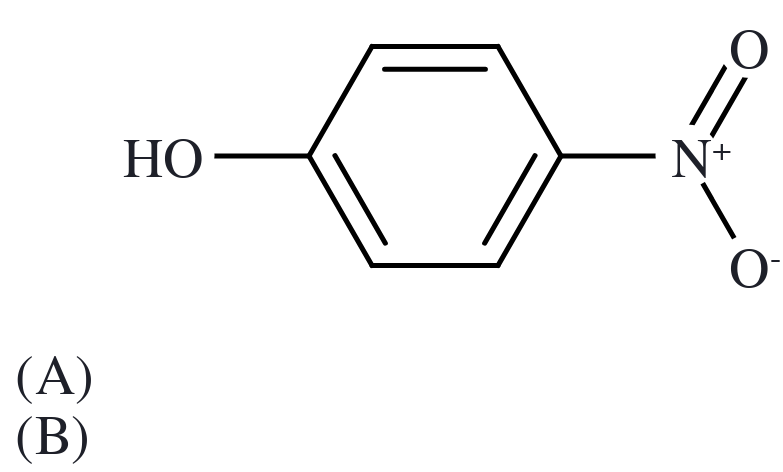 KCET 2011 Hard
 - Which of the following will not act as an oxidising agent?KCET 2026 Medium
- The plot of \( t_{1 / 2} \mathrm{v} / \mathrm{s}[R]_{0} \) for a reaction is a straight-line parallel to \( \mathrm{x} \)-axis. The unit for the rate
constant of this reaction isKCET 2019 Medium - For the reaction \(2 \mathrm{~N}_2 \mathrm{O}_{5_{(8)}} \rightarrow 4 \mathrm{NO}_{2_{(\mathrm{g})}}+\mathrm{O}_{2_{(8)}}\) initial concentration of \(\mathrm{N}_2 \mathrm{O}_5\) is \(2.0 \mathrm{molL}^{-1}\) and after 300 \(\min\), it is reduced to \(1.4 \mathrm{molL}^{-1}\). The rate of production of \(\mathrm{NO}_2\left(\right.\) in \(\mathrm{molL}^{-1} \mathrm{~min}^{-1}\) ) isKCET 2025 Medium
- Which one of the following conversions involve change in both hybridisation and shape?KCET 2010 Easy
More PYQs from KCET
- If \(\alpha\) and \(\beta\) are the roots of \(x^{2}+x+1=0\), then \(\alpha^{16}+\beta^{16}\) is equal toKCET 2009 Easy
- Two monochromatic light waves of amplitudes \(3 \mathrm{~A}\) and \(2 \mathrm{~A}\) interfering at a point have a phase difference of \(60^{\circ}\). The intensity at that point will be proportional toKCET 2011 Medium
- The statement that is NOT correct isKCET 2014 Easy
- \( \sim[(-p) \wedge q] \) is logically equivalent toKCET 2015 Easy
- The shaded region in the figure is the solution set of the inequations
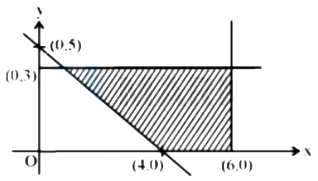 KCET 2017 Medium
 - The kind of coelom reprensented in the diagram given below is characteristic of
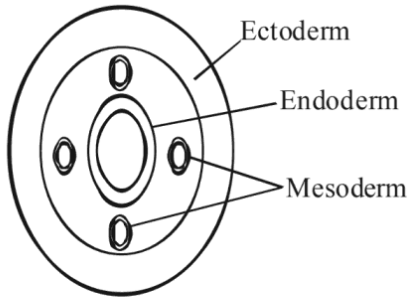 KCET 2014 Hard