


KCET · Chemistry · General Organic Chemistry
Carboxylic acids are more acidic than phenols because
- A Formation of dimers
- B Intermolecular hydrogen bonding
- C More covalent nature
- D More resonance stabilisation of their conjugate base
Answer & Solution
Correct Answer
(D) More resonance stabilisation of their conjugate base
Step-by-step Solution
Detailed explanation
Carboxylic acids dissociate in water to form a carboxylate ion and a proton. The carboxylate ion is highly stabilized by resonance, as the negative charge is delocalized equally over two highly electronegative oxygen atoms, resulting in two equivalent resonance structures.
Phenols dissociate to form a phenoxide ion and a proton. Although the phenoxide ion is also resonance stabilized, the negative charge is delocalized over one oxygen atom and the less electronegative carbon atoms of the benzene ring, resulting in non-equivalent resonance structures.
Since equivalent resonance structures provide greater stability than non-equivalent ones, the carboxylate ion (conjugate base of carboxylic acid) is more resonance stabilized than the phenoxide ion (conjugate base of phenol). Therefore, carboxylic acids are more acidic than phenols.
Answer: More resonance stabilisation of their conjugate base
Phenols dissociate to form a phenoxide ion and a proton. Although the phenoxide ion is also resonance stabilized, the negative charge is delocalized over one oxygen atom and the less electronegative carbon atoms of the benzene ring, resulting in non-equivalent resonance structures.
Since equivalent resonance structures provide greater stability than non-equivalent ones, the carboxylate ion (conjugate base of carboxylic acid) is more resonance stabilized than the phenoxide ion (conjugate base of phenol). Therefore, carboxylic acids are more acidic than phenols.
Answer: More resonance stabilisation of their conjugate base
See the Complete Solution
Get step-by-step explanations for this and 2.5 Lakh+ more JEE, NEET & CET questions.
- Unlock all solutions
- Practice the full chapter
- Track accuracy across PYQs
4.8 rated on Google Play · 14,000+ reviews
More questions from Chemistry
- Which of the following is an organometallic compound?KCET 2023 Easy
- Which one of the following noble gas has an unusual property of diffusing through the
materials such as rubber, glass or plastic ?KCET 2017 Easy - For a cell reaction involving two electron changes, \( E_{\text {cell }}^{\circ}=0.3 \mathrm{~V} \) at \( 25^{\circ} \mathrm{C} \). The cell equilibrium
constant of the reaction isKCET 2018 Medium - For spontaneity of a cell, which is correct?KCET 2022 Easy
- The contribution of particle at the edge centre to a particular unit cell isKCET 2016 Medium
- The ore that is concentrated by froth floatation process isKCET 2009 Medium
More PYQs from KCET
- The nourishing cells in the seminiferous tubules areKCET 2019 Hard
- The electrophile involved in the sulphonation of benzene isKCET 2009 Easy
- In acetylene molecule, between the carbon atoms there areKCET 2007 Medium
- The volume of air inspired or expired by a healthy man per minute isKCET 2017 Easy
- \(\tan ^{-1}\left[\frac{1}{\sqrt{3}} \sin \frac{5 \pi}{2}\right] +\sin ^{-1}\left[\cos \left(\sin ^{-} \frac{\sqrt{3}}{2}\right)\right]\) is equal toKCET 2021 Easy
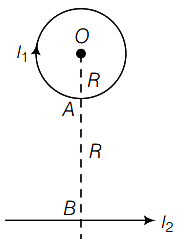
- In the diagram, \(I_{1}, I_{2}\) are the strength of the currents in the loop and straight conductors respectively. \(O A=A B=R\). The net magnetic field at the centre \(O\) is zero. Then the ratio of the currents in the loop and the straight conductos is
 KCET 2013 Hard