


KCET · Chemistry · Some Basic Concepts of Chemistry
A pure compound contains \(2.4 \mathrm{~g}\) of \(C\), \(1.2 \times 10^{23}\) atoms of \(\mathrm{H}, 0.2\) moles of oxygen atoms. Its empirical formula is
- A \(\mathrm{C}_{2} \mathrm{HO}\)
- B \(\mathrm{C}_{2} \mathrm{H}_{2} \mathrm{O}_{2}\)
- C \(\mathrm{CH}_{2} \mathrm{O}\)
- D \(\mathrm{CHO}\)
Answer & Solution
Correct Answer
(D) \(\mathrm{CHO}\)
Step-by-step Solution
Detailed explanation
Moles of carbon \(=\frac{w}{M}=\frac{2.4}{12}=0.2 \mathrm{~mol}\)
Moles of \(\mathrm{H}\) in \(1.2 \times 10^{23}\) atoms of \(\mathrm{H}=\frac{1.2 \times 10^{23}}{6 \times 10^{23}}\)
\(=0.2 \mathrm{~mol}\)
Moles of oxygen atoms \(=0.2\) moles
Now, simplest ratio of the moles of \(\mathrm{C}, \mathrm{H}\) and \(\mathrm{O}\) is as follows
\(\begin{aligned}
&=\mathrm{C}: \mathrm{H}: \mathrm{O} \\
&=0.2: 0.2: 0.2=\mathrm{CHO}
\end{aligned}\)
Thus, the empirical formula of the compound is CHO.
Moles of \(\mathrm{H}\) in \(1.2 \times 10^{23}\) atoms of \(\mathrm{H}=\frac{1.2 \times 10^{23}}{6 \times 10^{23}}\)
\(=0.2 \mathrm{~mol}\)
Moles of oxygen atoms \(=0.2\) moles
Now, simplest ratio of the moles of \(\mathrm{C}, \mathrm{H}\) and \(\mathrm{O}\) is as follows
\(\begin{aligned}
&=\mathrm{C}: \mathrm{H}: \mathrm{O} \\
&=0.2: 0.2: 0.2=\mathrm{CHO}
\end{aligned}\)
Thus, the empirical formula of the compound is CHO.
See the Complete Solution
Get step-by-step explanations for this and 2.5 Lakh+ more JEE, NEET & CET questions.
- Unlock all solutions
- Practice the full chapter
- Track accuracy across PYQs
4.8 rated on Google Play · 14,000+ reviews
More questions from Chemistry
- The correct sequence of reactions to be performed to convert benzene into m-bromoaniline isKCET 2014 Easy
- For the reaction \(\mathrm{Fe}_{2} \mathrm{O}_{3}+3 \mathrm{CO} \longrightarrow 2 \mathrm{Fe}+3 \mathrm{CO}_{2}\), the volume of carbon monoxide required to reduce one mole of ferric oxide isKCET 2008 Medium
- The electrolyte having maximum flocculation value for \( A g l / A g^{+} \)sol. isKCET 2015 Easy
- The ore that is concentrated by froth floatation process isKCET 2009 Medium
- Statement I: Staggered conformation of ethane is more stable than the eclipsed conformation.
Statement II: The torsional strain in staggered conformation is more.
Read the above statements and choose the correct answer from the options given below.KCET 2026 Easy - A ligand is aKCET 2012 Easy
More PYQs from KCET
- If \(\frac{3 x+1}{(x-1)(x+3)}=\frac{A}{x-1}+\frac{B}{x+3}\), then \(\sin ^{-1} \frac{A}{B}\) is equal toKCET 2012 Easy
- If \( x=c t \) and \( y=\frac{c}{t} \), find \( \frac{d y}{d t} \) at \( t=2 \)KCET 2015 Hard
- A thermodynamic system undergoes a cyclic process \( A B C \) as shown in the diagram. The work done by the system per cycle is
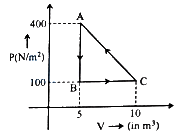 KCET 2019 Medium
 - The value of \(\mid \frac{1+i \sqrt{3}}{\left(1+\frac{1}{i+1}\right)^{2}}\) isKCET 2011 Medium
- According to the hypothesis proposed by environmental biologists, a relatively constant environment in tropics promotesKCET 2024 Easy
- Which compounds were used by Miller in his experiment for obtaining amino acids and other organic substances?KCET 2014 Easy