


KCET · BIOLOGY · STD 12 - 6. Evolution
According to Darwin, evolution is __________
- A a sudeen but discontinuous process
- B a slow, gradual and continuous process
- C a slow, sudden and discontinuous process
- D a slow and discontinuous process
Answer & Solution
Correct Answer
(C) a slow, sudden and discontinuous process
Step-by-step Solution
Detailed explanation
(C) a slow, gradual and continuous process,
According to Darwin, evolution is (b) a slow, gradual and continuous process. Darwin proposed that evolution occurs gradually over long periods, with small changes accumulating over time, leading to the gradual development of new species.
According to Darwin, evolution is (b) a slow, gradual and continuous process. Darwin proposed that evolution occurs gradually over long periods, with small changes accumulating over time, leading to the gradual development of new species.
See the Complete Solution
Get step-by-step explanations for this and 2.5 Lakh+ more JEE, NEET & CET questions.
- Unlock all solutions
- Practice the full chapter
- Track accuracy across PYQs
4.8 rated on Google Play · 14,000+ reviews
More questions from BIOLOGY
- The ovule of angiosperm is technically known asKCET 2022 Medium
- Read the following statements:
Statement I: Morphine is obtained by acetylation of Heroin.
Statement II: Cannabinoids are known for their effect on cardiovascular system
Which of the following options is correct with reference to these statements?KCET 2014 Easy - Which of the following events would occur in 'Lac operon' of E. coli when the growth medium has high concentration of lactose?KCET 2014 Medium
- Which one of the following reactions is an example of oxidative decarboxylation?KCET 2011 Medium
- Kranz anatomy can be seen inKCET 2022 Hard
- In the following diagrammatic representation of a standard ECG, the 'T' represents.
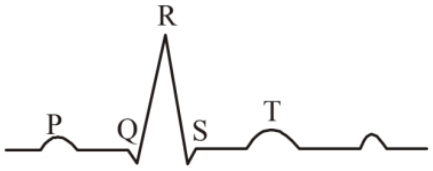 KCET 2017 Hard
More PYQs from KCET
- The enzyme that is not found is \(C _3\) plants isKCET 2021 Easy
- Find the co-ordinates of the foot of the perpendicular drawn from the origin to the plane \( 5 y+8 \)
\( =0 \) :KCET 2016 Hard - If \(f(x)=\left|\begin{array}{ccc}x^{3}-x & a+x & b+x \\ x-a & x^{2}-x & c+x \\ x-b & x-c & 0\end{array}\right|\), thenKCET 2020 Medium
- Match the Column-I with Column-II and choose the correct option:
Column-1
(characteristics of vascular bundle)Column-II
(Transverse section)A. Radial, tetrarch, cambial ring between xylem and phloem at later stages i. T.S of monocot stem B. Conjoint, open and endarch ii. T.S of dicot root C. Radial, Polyarch, large pith without cambial ring iii. T.S of monocot root D. Conjoint, closed with sclerenchymatous bundle sheath iv. T.S of dicot stem KCET 2025 Medium - Two point charges \( A=+3 \mathrm{nC} \) and \( B=+1 \mathrm{nC} \) are placed \( 5 \mathrm{~cm} \) apart in air. The work done to
move charge \( B \) towards \( A \) by \( 1 \mathrm{~cm} \) isKCET 2017 Easy - \( 0.30 \mathrm{~g} \) of an organic compound containing \( \mathrm{C}, \mathrm{H} \) and Oxygen on combustion yields \( 0.44 \mathrm{~g} \mathrm{CO}_{2} \)
and \( 0.18 \mathrm{~g} \mathrm{H}_{2} \mathrm{O} \). If one mol of compound weighs \( 60 \), then molecular formula of the compound
isKCET 2015 Hard