


JEE Mains · Chemistry · STD 12 - 6. Haloalkanes and Haloarenes
Where \(Nu =\) Nucleophile Find out the correct statement from the options given below for the above \(2\) reactions.
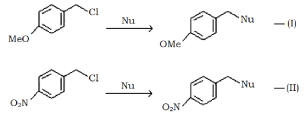
- A Reaction \((I)\) is of \(2^{\text {nd }}\) order and reaction \((II)\) is of \(1^{\text {st }}\) order
- B Reaction \((I)\) and \((II)\) both are of \(2^{\text {nd }}\) order
- C Reaction \((I)\) is of \(1^{\text {st }}\) order and reaction \((II)\) is of \(2^{\text {nd }}\) order
- D Reactions \((I)\) and \((II)\) both are of \(1^{\text {st }}\) order
Answer & Solution
Correct Answer
(C) Reaction \((I)\) is of \(1^{\text {st }}\) order and reaction \((II)\) is of \(2^{\text {nd }}\) order
Step-by-step Solution
Detailed explanation
See the Complete Solution
Get step-by-step explanations for this and 2.5 Lakh+ more JEE, NEET & CET questions.
- Unlock all solutions
- Practice the full chapter
- Track accuracy across PYQs
4.8 rated on Google Play · 14,000+ reviews
More questions from Chemistry
- Which statement is not true with respect to nitrate ion test ?JEE Mains 2022 Easy
- The major product obtained from \(E _{2}\) \(-\)elimination of \(3\) \(-\)bromo\(-\) \(2-\)fluoropentane isJEE Mains 2020 Medium
- The rate of a certain biochemical reaction at physiological temperature \((T)\) occurs \(10^{6}\) times faster with enzyme than without. The change in the activation energy upon adding enzyme isJEE Mains 2020 Hard
- The correct sequential addition of reagents in the preparation of \(3 -\)nitrobenzoic acid from benzene is:JEE Mains 2021 Hard
- 500 J of energy is transferred as heat to 0.5 mol of Argon gas at 298 K and 1.00 atm. The final temperature and the change in internal energy respectively are:
Given : \(\mathrm{R}=8.3 \mathrm{~J} \mathrm{~K}^{-1} \mathrm{~mol}^{-1}\)JEE Mains 2025 Easy -
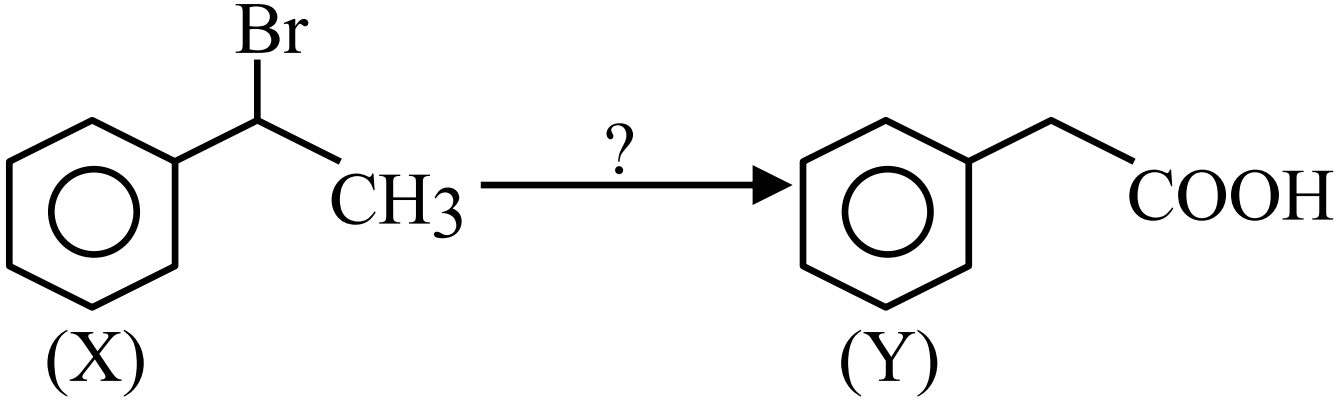
The correct sequence of reagents for the conversion of X to Y is :JEE Mains 2026 Easy
More PYQs from JEE Mains
- Given below are two statements: one is labelled as Assertion \(A\) and the other is labelled as Reason \(R\). Assertion \(A :\) Dipole-dipole interactions are the only non-covalent interactions, resulting in hydrogen bond formation. Reason \(R\) : Fluorine is the most electronegative element and hydrogen bonds in \(HF\) are symmetrical. In the light of the above statements, choose the most appropriate answer from the options given below.JEE Mains 2021 Easy
- Let \(P\) be the relation defined on the set of all real numbers such that \(P = \left\{ {\left( {a,b} \right):{{\sec }^2}\,a - {{\tan }^2}\,b = 1\,} \right\}\). Then \(P\) isJEE Mains 2014 Hard
- A concave mirror of focal length \(f\) in air is dipped in a liquid of refractive index \(\mu\). Its focal length in the liquid will be:JEE Mains 2025 Medium
- The thermodynamic process, in which internal energy of the system remains constant is ...........JEE Mains 2023 Easy
- Two blocks of the same metal having same mass and at temperature \(T_1\) and \(T_2\) respectively, are brought in contact with each other and allowed to attain thermal equilibrium at constant pressure. The change in entropy, \(\Delta S,\) for this process isJEE Mains 2019 Hard
- If \(\sum_{\mathrm{r}=1}^9\left(\frac{\mathrm{r}+3}{2^{\mathrm{r}}}\right) .{ }^9 \mathrm{C}_{\mathrm{r}}=\alpha\left(\frac{3}{2}\right)^9-\beta, \quad \alpha, \beta \in \mathrm{N}, \quad\) then \((\alpha+\beta)^2\) is equal toJEE Mains 2025 Medium