


JEE Mains · Chemistry · STD 12 - 9. Amines
The correct sequence of reagents used in the preparation of \(4 -\)bromo\(-2-\)nitroethyl benzene from benzene is :
- A \(HNO _{3} / H _{2} SO _{4}, Br _{2} / AlCl _{3}, CH _{3} COCl / AlCl _{3},Zn - Hg / HCl\)
- B \(Br _{2} / AlBr _{3}, CH _{3} COCl / AlCl _{3}, HNO _{3} / H _{2} SO _{4},Zn / HCl\)
- C \(CH _{3} COCl / AlCl _{3}, Br _{2} / AlBr _{3}, HNO _{3} / H _{2} SO _{4},Zn / HCl\)
- D \(CH _{3} COCl / AlCl _{3}, Zn - Hg / HCl , Br _{2} / AlBr _{3},HNO _{3} / H _{2} SO _{4}\)
Answer & Solution
Correct Answer
(D) \(CH _{3} COCl / AlCl _{3}, Zn - Hg / HCl , Br _{2} / AlBr _{3},HNO _{3} / H _{2} SO _{4}\)
Step-by-step Solution
Detailed explanation
See the Complete Solution
Get step-by-step explanations for this and 2.5 Lakh+ more JEE, NEET & CET questions.
- Unlock all solutions
- Practice the full chapter
- Track accuracy across PYQs
4.8 rated on Google Play · 14,000+ reviews
More questions from Chemistry
- Given below are two statements :
Statement (I) : According to the Law of Octaves, the elements were arranged in the increasing order of their atomic number.
Statement (II) : Meyer observed a periodically repeated pattern upon plotting physical properties of certain elements against their respective atomic numbers.
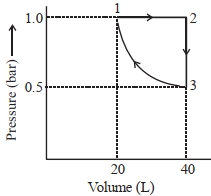
In the light of the above statements, choose the correct answer from the options given below :JEE Mains 2025 Easy - One mole of an ideal monoatomic gas is subjected to changes as shown in the graph. The magnitude of the work done (by the system or on the system) is \(...........J\) (nearest integer). Given : \(\log 2=0.3, \ln 10=2.3\)
 JEE Mains 2023 Medium
 - \(20 \%\) of acetic acid is dissociated when its \(5\,g\) is added to \(500\,mL\) of water. The depression in freezing point of such water is \(.....\times 10^{-3} \;{ }^{\circ} C\). Atomic mass of \(C , H\) and \(O\) are \(12,1\) and \(16\,a.m.u.\) respectively. [Given : Molal depression constant and density of water are \(1.86\, K\, kg\, mol^{-1}\) and \(1\, g\, cm^{-3}\) respectively.]JEE Mains 2023 Medium
- The gas phase reaction \(2NO_2(g) \rightleftharpoons N_2O_4 (g)\) is an exothermic reaction. The decomposition of \(N_2O_4,\) in equilibrium mixutre of \(NO_2(g)\) and \(N_2O_4(g),\) can be increased byJEE Mains 2018 Medium
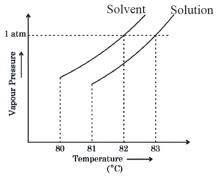
- `The vapour pressure vs. temperature curve for a solution solvent system is shown below.The boiling point of the solvent is \(........\,{ }^{\circ} C\)
 JEE Mains 2023 Medium
 - The wave numbers of three spectral lines of H atom are considered. Identify the set of spectral lines belonging to Balmer series. (R = Rydberg constant)JEE Mains 2026 Medium
More PYQs from JEE Mains
- If the velocity of light \(c\), universal gravitational constant \(G\) and planck's constant \(h\) are chosen as fundamental quantities. The dimensions of mass in the new system isJEE Mains 2023 Hard
- The octahedral diamagnetic low spin complex among the following isJEE Mains 2023 Medium
- The stopping potential \(V_0\) (in \(volt\)) as a function of frequency \((v)\) for a sodium emitter, is shown in the figure. The work function of sodium, from the data plotted in the figure, will be : ................. \(eV\) (Given : Planck's constant \((h) = 6.63 \times 10^{-34}\, Js\), electron charge \(e = 1.6 \times 10^{-19}\, C\))
 JEE Mains 2019 Medium
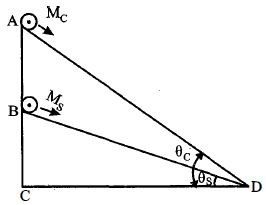
 - A cylinder of mass \(M_c\) and sphere of mass \(M_s\) are placed at points \(A\) and \(B\) of two inclines, respectively (See Figure). If they roll on the incline without sipping such that their accelerations are the same, then the ratio \(\frac{{\sin \,{\theta _c}}}{{\sin \,{\theta _s}}}\) is
 JEE Mains 2014 Hard
 - A simple pendulum of length \(1\, m\) is oscillating with an angular frequency \(10\, rad/s\). The support of the pendulum starts oscillating up and down with a small angular frequency of \(1\, rad/s\) and an amplitude of \(10^{-2}\, m\). The relative change in the angular frequency of the pendulum is best given byJEE Mains 2019 Medium
- Let \(g(x)=f(x)+f(1-x)\) and \(f^{\prime \prime}(x) > 0, x \in(0,1)\). If \(g\) is decreasing in the interval \((0, \alpha)\) and increasing in the interval \((\alpha, 1)\), then \(\tan ^1(2 \alpha)+\tan ^{-1}\left(\frac{1}{\alpha}\right)+\tan ^{-1}\left(\frac{\alpha+1}{\alpha}\right)\) is equal to :JEE Mains 2023 Hard