


JEE Mains · Chemistry · STD 11 - 9. Hydricarbon
The correct sequence of correct reagents for the following transformation is
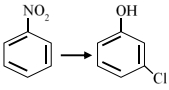
- A \((i)\) \(\mathrm{Fe}, \mathrm{HCl}\,\,(\mathrm{ii}) \mathrm{NaNO}_{2}, \mathrm{HCl}, 0^{\circ} \mathrm{C}\,\,(\mathrm{iii}) \mathrm{H}_{2} \mathrm{O} / \mathrm{H}^{+}\,\,(\mathrm{iv}) \mathrm{Cl}_{2}, \mathrm{FeCl}_{3}\)
- B \((i)\) \(\mathrm{Cl}_{2}, \mathrm{FeCl}_{3}\,\,(\mathrm{ii}) \mathrm{NaNO}_{2}, \mathrm{HCl}, 0^{\circ} \mathrm{C}\,\,(\mathrm{iii}) \mathrm{Fe}, \mathrm{HCl}\,\,(\mathrm{iv}) \mathrm{H}_{2} \mathrm{O} / \mathrm{H}^{+}\)
- C \((i)\) \(\mathrm{Fe}, \mathrm{HCl}\,\,(\mathrm{ii}) \mathrm{Cl}_{2}, \mathrm{HCl}\,\,(\mathrm{iii}) \mathrm{NaNO}_{2}, \mathrm{HCl}, 0^{\circ} \mathrm{C}\,\,(\mathrm{iv}) \mathrm{H}_{2} \mathrm{O} / \mathrm{H}^{+}\)
- D \((i)\) \(\mathrm{Cl}_{2}, \mathrm{FeCl}_{3}\,\,(\mathrm{ii}) \mathrm{Fe}, \mathrm{HCl}\,\,(\mathrm{iii}) \mathrm{NaNO}_{2}, \mathrm{HCl}, 0^{\circ} \mathrm{C}\,\,(\mathrm{iv}) \mathrm{H}_{2} \mathrm{O} / \mathrm{H}^{+}\)
Answer & Solution
Correct Answer
(D) \((i)\) \(\mathrm{Cl}_{2}, \mathrm{FeCl}_{3}\,\,(\mathrm{ii}) \mathrm{Fe}, \mathrm{HCl}\,\,(\mathrm{iii}) \mathrm{NaNO}_{2}, \mathrm{HCl}, 0^{\circ} \mathrm{C}\,\,(\mathrm{iv}) \mathrm{H}_{2} \mathrm{O} / \mathrm{H}^{+}\)
Step-by-step Solution
Detailed explanation
See the Complete Solution
Get step-by-step explanations for this and 2.5 Lakh+ more JEE, NEET & CET questions.
- Unlock all solutions
- Practice the full chapter
- Track accuracy across PYQs
4.8 rated on Google Play · 14,000+ reviews
More questions from Chemistry
- In the given reactions identify the reagent \(A\) and reagent \(B\).
 JEE Mains 2024 Hard
 - Select the compound from the following that will show intramolecular hydrogen bonding.JEE Mains 2024 Hard
- If \(p\) is the momentum of the fastest electron ejected from a metal surface after the irradiation of light having wavelength \(\lambda \), then for \(1.5\, p\) momentum of the photoelectron, the wavelength of the light should be: (Assume kinetic energy of ejected photoelectron to be very high in comparison to work function)JEE Mains 2019 Hard
- The increasing order of \(pK_b\) for the following compounds will be
 JEE Mains 2020 Hard
 - Consider the following \(Zn^{2+} + 2e^-\) \(\longrightarrow\) \(Zn (s) ; E^o = -0.76\,V\) \(Ca^{2+} + 2e^-\) \(\longrightarrow\) \(Ca (s) ; E^o = -2.87\,V\) \(Mg^{2+} + 2e^-\) \(\longrightarrow\) \(Mg (s) ; E^o = -2.36\,V\) \(Ni^{2+} + 2e^-\) \(\longrightarrow\) \(Ni (s) ; E^o = -0.25\,V\) The reducing power of the metals increases in the orderJEE Mains 2019 Hard
- The correct order of ligands arranged in increasing field strength :JEE Mains 2024 Medium
More PYQs from JEE Mains
- Given below are two statements. One is labelled as Assertion (A) and the other is labelled as Reason (R).
Assertion (A) :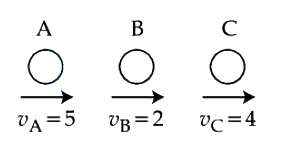
Three identical spheres of same mass undergo one dimensional motion as shown in figure with initial velocities \(v_{\mathrm{A}}=5 \mathrm{~m} / \mathrm{s}, v_{\mathrm{B}}=2 \mathrm{~m} / \mathrm{s}, v_{\mathrm{C}}=4 \mathrm{~m} / \mathrm{s}\). If we wait sufficiently long for elastic collision to happen, then \(v_{\mathrm{A}}=4 \mathrm{~m} / \mathrm{s}, v_{\mathrm{B}}=2 \mathrm{~m} / \mathrm{s}\), \(v_{\mathrm{C}}=5 \mathrm{~m} / \mathrm{s}\) will be the final velocities.
Reason (R): In an elastic collision between identical masses, two objects exchange their velocities.
In the light of the above statements, choose the correct answer from the options given below :JEE Mains 2025 Easy - The area of the region (in sq. units), in the first quadrant bounded by the parabola \(y = 9x^2\) and the lines \(x = 0,y = 1\) and \(y = 4,\) isJEE Mains 2013 Hard
- Let for a differentiable function \(f:(0, \infty) \rightarrow R\), \(f(x)-f(y) \geq \log _e\left(\frac{x}{y}\right)+x-y, \forall x, y \in(0, \infty) \text {. }\) Then \(\sum_{\mathrm{n}=1}^{20} \mathrm{f}^{\prime}\left(\frac{1}{\mathrm{n}^2}\right)\) is equal toJEE Mains 2024 Hard
- \(\lim\limits_{x \rightarrow 0} \frac{\int\limits_{0}^{x} t \sin (10 t) d t}{x}\) is equal toJEE Mains 2020 Hard
- Given below are two statements: Statement \(I\) : The correct order of first ionization enthalpy values of \(\mathrm{Li}, \mathrm{Na}, \mathrm{F}\) and \(\mathrm{Cl}\) is \(\mathrm{Na}<\mathrm{Li}<\mathrm{Cl}<\mathrm{F}\). Statement \(II\) : The correct order of negative electron gain enthalpy values of \(\mathrm{Li}, \mathrm{Na}, \mathrm{F}\) and \(\mathrm{Cl}\) is \(\mathrm{Na}<\mathrm{Li}<\mathrm{F}<\mathrm{Cl}\) In the light of the above statements, choose the correct answer from the options given below :JEE Mains 2024 Medium
- A thin convex lens made from crown glass \(\left( {\mu = \frac{3}{2}} \right)\) has focal length \(f\). When it is measured in two different liquids having refractive indices \(\frac{4}{3}\) and \(\frac{5}{3}\) it has the focal lengths \(f_1\) and \(f_2\) respectively. The correct relation between the focal lengths is:JEE Mains 2014 Medium