


JEE Mains · Chemistry · STD 12 -8.1. Aldehydes and ketones
The compound \(A\) in the following reaction is : \(A\xrightarrow[{(ii)\,\,Conc.\,{H_2}S{O_4}/\Delta }]{{{\text{(i)}}\,{\text{C}}{{\text{H}}_3}MgBr/{H_2}O}}\) \(B\xrightarrow[{(ii)\,Zn/{H_2}O}]{{(i)\,{O_3}}}C + D\) \(D\xrightarrow[\Delta ]{{Ba\left( {OH} \right)}}\begin{array}{*{20}{c}} {\,\,\,\,\,\,\,\,\,\,\,\,\,\,\,\,\,\,\,\,\,\,\,\,C{H_3}} \\ {\,\,\,\,\,\,\,\,\,\,\,\,\,\,\,\,|} \\ {{H_3}C - C} \end{array}\)\(\begin{array}{*{20}{c}} {\,\,\,\,\,\,\,O} \\ {\,\,\,\,\,||} \\ { = CH - C - C{H_3}} \end{array}\)

- B \(\begin{array}{*{20}{c}} {O\,\,\,\,\,\,\,} \\ {||\,\,\,\,\,\,\,\,} \\ {{C_6}{H_5} - C - C{H_2}C{H_3}} \end{array}\)
- C \(\begin{array}{*{20}{c}} {\,\,\,\,\,\,\,\,\,\,\,\,\,\,\,\,\,\,\,\,\,\,\,\,O\,} \\ {\,\,\,\,\,\,\,\,\,\,\,\,\,\,\,\,\,\,\,\,\,||} \\ {{C_6}{H_5} - C{H_2} - C - C{H_3}} \end{array}\)
- D \(\begin{array}{*{20}{c}} {\,\,\,\,\,O\,} \\ {\,\,||} \\ {{C_6}{H_5} - C - C{H_3}} \end{array}\)
Answer & Solution
Correct Answer
(C) \(\begin{array}{*{20}{c}} {\,\,\,\,\,\,\,\,\,\,\,\,\,\,\,\,\,\,\,\,\,\,\,\,O\,} \\ {\,\,\,\,\,\,\,\,\,\,\,\,\,\,\,\,\,\,\,\,\,||} \\ {{C_6}{H_5} - C{H_2} - C - C{H_3}} \end{array}\)
Step-by-step Solution
Detailed explanation
See the Complete Solution
Get step-by-step explanations for this and 2.5 Lakh+ more JEE, NEET & CET questions.
- Unlock all solutions
- Practice the full chapter
- Track accuracy across PYQs
4.8 rated on Google Play · 14,000+ reviews
More questions from Chemistry
- Increasing order of electron withdrawing power of following functional groups is:
a. \(-CN\)
b. \(-COOH\)
c. \(-NO_2\)
d. \(-I\)JEE Mains 2026 Easy - Consider the following reactions. From these reactions which reaction will give carboxylic acid
as a major product ?
(A) \(\mathrm{R}-\mathrm{C} \equiv \mathrm{N} \xrightarrow[\text { mild condition }]{\text { (i) } \mathrm{H}^{+} / \mathrm{H}_2 \mathrm{O}}\)
(B) \(\mathrm{R}-\mathrm{MgX} \xrightarrow[\text { (ii) } \mathrm{H}_3 \mathrm{O}^{+}]{\text {(i) } \mathrm{CO}_2}\)
(C) \(\mathrm{R}-\mathrm{C} \equiv \mathrm{N} \xrightarrow[\text { (ii) } \mathrm{H}_3 \mathrm{O}^{+}]{\text {(i) } \mathrm{SnCl}_2 / \mathrm{HCl}}\)
(D) \(\mathrm{R} \cdot \mathrm{CH}_2 \cdot \mathrm{OH} \xrightarrow{\mathrm{PCC}}\)
(E)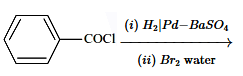
Choose the correct answer from the options given below:JEE Mains 2025 Easy - Class \(XII\) students were asked to prepare one litre of buffer solution of \(pH\,8.26\) by their chemistry teacher. The amount of ammonium chloride to be dissolved by the student in \(0.2\,M\) ammonia solution to make one litre of the buffer is \(.....\,g\) (Given \(pK _{ b }\left( NH _{3}\right)=4.74\); Molar mass of \(NH _{3}=17\,g\,mol ^{-}\) ; Molar mass of \(NH _{4} Cl =53.5\,g\,mol ^{-1}\) )JEE Mains 2022 Medium
- Given below are two statements :
Statement \((I)\) : \(p-\)nitrophenol is more acidic than \(m-\)nitrophenol and \(o-\)nitrophenol.
Statement \((II)\) : Ethanol will give immediate turbidity with Lucas reagent.
In the light of the above statements, choose the correct answer from the options given below :JEE Mains 2024 Hard - Match List \(I\) with List \(II\).
Choose the correct answer from the options given below :List-\(I\) (Compound) List-\(II\) (Colour) \((A)\) \(\mathrm{Fe}_4\left[\mathrm{Fe}(\mathrm{CN})_6\right]_3 \cdot \mathrm{xH}_2 \mathrm{O}\) \((I)\) Violet \((B)\)\(\left[\mathrm{Fe}(\mathrm{CN})_5 \mathrm{NOS}\right]^{4-}\) \((II)\) Blood Red \((C)\)\([\mathrm{Fe}(\mathrm{SCN})]^{2+}\) \((III)\)Prussian Blue \((D)\)\(\left(\mathrm{NH}_4\right)_3 \mathrm{PO}_4 \cdot 12 \mathrm{MoO}_3\) \((IV)\) Yellow JEE Mains 2024 Medium - Which among the following molecules is (a) involved in \(\mathrm{sp}^3 \mathrm{~d}\) hybridization, (b) has different bond lengths and (c) has lone pair of electrons on the central atom?JEE Mains 2025 Easy
More PYQs from JEE Mains
- The equilibrium constant \(K_{c}\) at \(298\, \mathrm{~K}\) for the reaction \(\mathrm{A}+\mathrm{B} \rightleftharpoons \mathrm{C}+\mathrm{D}\) is \(100 .\) Starting with an equimolar solution with concentrations of \(\mathrm{A}, \mathrm{B}, \mathrm{C}\) and \(\mathrm{D}\) all equal to \(1\, \mathrm{M}\), the equilibrium concentration of \(D\) is \(.......\times 10^{-2}\) M. (Nearest integer)JEE Mains 2021 Medium
- If \(f (\alpha)=\int_{1}^{\alpha} \frac{\log _{10} t}{1+t} d t, \alpha>0\), then \(f \left( e ^{3}\right)+ f \left( e ^{-3}\right)\) is equal to.JEE Mains 2022 Hard
- Amongst the following, the linear species is:JEE Mains 2021 Medium
- Let PQR be a triangle such that \(\overrightarrow{PQ}=-2\hat{i}-\hat{j}+2\hat{k}\) and \(\overrightarrow{PR}=a\hat{i}+b\hat{j}-4\hat{k}\), \(a, b\in\mathbb{Z}.\) Let S be the point on QR, which is equidistant from the lines PQ and PR. If \({|\overrightarrow{PR}|}=9\) and \(\overrightarrow{PS}=\hat{i}-7\hat{j}+2\hat{k}\), then the value of \(3a-4b\) is ___ .JEE Mains 2026 Medium
- Let a triangle be bounded by the lines \(L _{1}: 2 x +5 y =10\); \(L _{2}:-4 x +3 y =12\) and the line \(L _{3}\), which passes through the point \(P (2,3)\), intersect \(L _{2}\) at \(A\) and \(L _{1}\) at \(B\). If the point \(P\) divides the line-segment \(A B\), internally in the ratio \(1: 3\), then the area of the triangle is equal toJEE Mains 2022 Hard
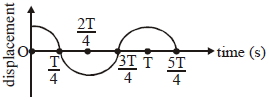
- The displacement time graph of a particle executing \(S.H.M.\) is given in figure: (sketch is schematic and not to scale) Which of the following statements is are true for this motion? \((A)\) The force is zero \(t=\frac{3 T}{4}\) \((B)\) The acceleration is maximum at \(t=T\) \((C)\) The speed is maximum at \(t =\frac{ T }{4}\) \((D)\) The \(P.E.\) is equal to \(K.E.\) of the oscillation at \(t=\frac{T}{2}\)
 JEE Mains 2020 Hard