


JEE Mains · Chemistry · STD 12 - 5. Co-ordination chemistry
Nickel \((Z\, = 28)\) combines with a uninegative monodentate ligand to form a diamagnetic complex \([NiL_4]^{2-}\). The hybridisation involved and the number of unpaired electrons present in the complex are respectively
- A \(sp^3\), two
- B \(dsp^2\), zero
- C \(dsp^2\), one
- D \(sp^3\), zero
Answer & Solution
Correct Answer
(A) \(sp^3\), two
Step-by-step Solution
Detailed explanation
See the Complete Solution
Get step-by-step explanations for this and 2.5 Lakh+ more JEE, NEET & CET questions.
- Unlock all solutions
- Practice the full chapter
- Track accuracy across PYQs
4.8 rated on Google Play · 14,000+ reviews
More questions from Chemistry
- The reaction occurs in which of the following galvanic cell?
 JEE Mains 2024 Medium
 - Given below are two statement: one is labelled as Assertion \(A\) and the other is labelled as Reason \(R\) Assertion \(A:\) \(5 f\) electrons can participate in bonding to a far greater extent than \(4 f\) electrons Reason \(R:\) \(5 f\) orbitals are not as buried as \(4 f\) orbitals In the light of the above statements, choose the correct answer from the options given belowJEE Mains 2023 Hard
- Consider the following sequence of reactions.
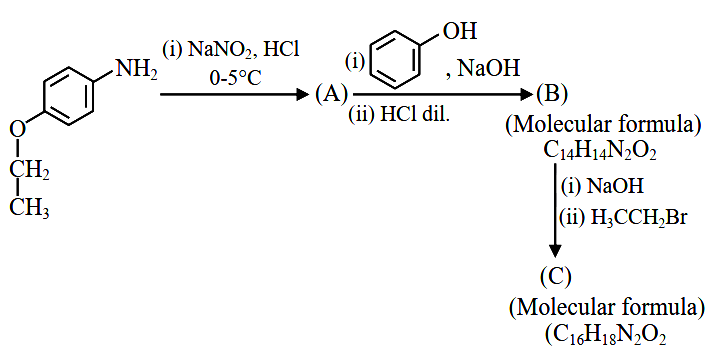
Total number of \(\mathrm{sp}^3\) hybridised carbon atoms in the major product C formed is ________.JEE Mains 2025 Hard - According to Bohr's atomic theory :- \((A)\) Kinetic energy of electron is \(\propto \frac{ Z ^{2}}{ n ^{2}}\). \((B)\) The product of velocity (v) of electron and principal quantum number (n), 'vn' \(\propto Z ^{2}\). \((C)\) Frequency of revolution of electron in an orbit is \(\propto \frac{ Z ^{3}}{ n ^{3}}\). \((D)\) Coulombic force of attraction on the electron is \(\propto \frac{ Z ^{3}}{ n ^{4}}\). Choose the most appropriate answer from the options given below :JEE Mains 2021 Easy
- Reaction \(\mathrm{A}(\mathrm{g}) \rightarrow 2 \mathrm{~B}(\mathrm{~g})+\mathrm{C}(\mathrm{g})\) is a first order reaction. It was started with pure A
t / min Pressure of system
at time t / mm Hg10 160 ∞ 240
Which of the following option is incorrect?JEE Mains 2025 Easy - The electronic spectrum of \(\left[ Ti \left( H _{2} O \right)_{6}\right]^{3+}\) shows a single broad peak with a maximum at \(20,300\, cm ^{-1} .\) The crystal field stabilization energy \((CFSE)\) of the complex ion, in \(kJ\, mol ^{-1}\), is :JEE Mains 2020 Medium
More PYQs from JEE Mains
- The major product of the following reaction is \(C{H_3}CH = CHC{O_2}C{H_3}\,\xrightarrow{{LiAl{H_4}}}\)JEE Mains 2019 Hard
- Let \(f(x)\) be a function satisfying \(f(x)+f(\pi-x)=\) \(\pi^2, \forall x \in R\). Then \(\int \limits_0^\pi f(x) \sin x d x\) is equal to \(...........\).JEE Mains 2023 Hard
- A sample of gas with \(\gamma=1.5\) is taken through an adiabatic process in which the volume is compressed from \(1200\, {cm}^{3}\) to \(300\, {cm}^{3}\). If the initial pressure is \(200\, {kPa}\). The absolute value of the workdone by the gas in the process \(= \,..... J.\)JEE Mains 2021 Hard
- Statement \(-1\) : The system of linear equations \(x + \left( {\sin \,\alpha } \right)y + \left( {\cos \,\alpha } \right)z = 0\) \(x + \left( {\cos \,\alpha } \right)y + \left( {\sin \alpha } \right)z = 0\) \(x - \left( {\sin \,\alpha } \right)y - \left( {\cos \alpha } \right)z = 0\) has a non-trivial solution for only one value of \(\alpha \) lying in the interval \(\left( {0\,,\,\frac{\pi }{2}} \right)\) Statement \(-2\) : The equation in \(\alpha \) \(\left| {\begin{array}{*{20}{c}}
{\cos {\mkern 1mu} \alpha }&{\sin {\mkern 1mu} \alpha }&{\cos {\mkern 1mu} \alpha } \\
{\sin {\mkern 1mu} \alpha }&{\cos {\mkern 1mu} \alpha }&{\sin {\mkern 1mu} \alpha } \\
{\cos {\mkern 1mu} \alpha }&{ - \sin {\mkern 1mu} \alpha }&{ - \cos {\mkern 1mu} \alpha }
\end{array}} \right| = 0\) has only one solution lying in the interval \(\left( {0\,,\,\frac{\pi }{2}} \right)\)JEE Mains 2013 Hard - Which of the following statement is correct for paper chromatography ?JEE Mains 2023 Hard
- If \(\int\left(\frac{1}{x}+\frac{1}{x^3}\right) \left(\sqrt[23]{3 x^{-24}+x^{-26}}\right) d x \) \( =-\frac{\alpha}{3(\alpha+1)}\left(3 x^\beta+x^\gamma\right)^{\frac{\alpha+1}{\alpha}}+C, x \gt 0,\) \((\alpha, \beta, \gamma \in Z)\), where \(C\) is the constant of integration, then \(\alpha+\beta+\gamma\) is equal to ________ .JEE Mains 2025 Medium