


JEE Mains · Chemistry · STD 12 -8.1. Aldehydes and ketones
Match List\(-I\) with List\(-II :\)
| List\(-I\) (Chemical Reaction) | List\(-II\) (Reagent used) |
| \((a)\) \(\mathrm{CH}_{3} \mathrm{COOCH}_{2} \mathrm{CH}_{3} \rightarrow \mathrm{CH}_{3} \mathrm{CH}_{2} \mathrm{OH}\) | \((i)\) \(\mathrm{CH}_{3} \mathrm{MgBr} / \mathrm{H}_{3} \mathrm{O}^{+}\) \((1 .\) equivalent \()\) |
| \((b)\) \(\mathrm{CH}_{3} \mathrm{COOCH}_{3} \rightarrow \mathrm{CH}_{3} \mathrm{CHO}\) | \((ii)\) \(\mathrm{H}_{2} \mathrm{SO}_{4} / \mathrm{H}_{2} \mathrm{O}\) |
| \((c)\) \(\mathrm{CH}_{3} \mathrm{C} \equiv \mathrm{N} \rightarrow \mathrm{CH}_{3} \mathrm{CHO}\) | \((iii)\) \(\mathrm{DIBAL}-\mathrm{H} / \mathrm{H}_{2} \mathrm{O}\) |
| \((d)\) \(\mathrm{CH}_{3} \mathrm{C} \equiv \mathrm{N} \rightarrow \mathrm{CH}_{3}CO\mathrm{CH}_{3}\) | \((iv)\) \(\mathrm{SnCl}_{2}, \mathrm{HCl} / \mathrm{H}_{2} \mathrm{O}\) |
- A \(a-ii, b-iv, c-iii, d-i\)
- B \(a-i v, b-ii, c-iii, d-i\)
- C \(a-ii, b-iii, c-iv, d-i\)
- D \(a-iii, b-ii, c-i, d-iv\)
Answer & Solution
Correct Answer
(C) \(a-ii, b-iii, c-iv, d-i\)
Step-by-step Solution
Detailed explanation
See the Complete Solution
Get step-by-step explanations for this and 2.5 Lakh+ more JEE, NEET & CET questions.
- Unlock all solutions
- Practice the full chapter
- Track accuracy across PYQs
4.8 rated on Google Play · 14,000+ reviews
More questions from Chemistry
- Number of compounds from the following which cannot undergo Friedel-Crafts reactions is _______.
[toluene, nitrobenzene, xylene, cumene, anline, chlorobenzene, \(m\)-nitroaniline, \(m\)-dinitrobenzene]JEE Mains 2024 Medium - Total number of unpaired electrons in the complex ion \(\left[\mathrm{Co}\left(\mathrm{NH}_3\right)_6\right]^{3+}\) and \(\left[\mathrm{NiCl}_4\right]^{2-}\) is _______.JEE Mains 2024 Medium
- For the following gas phase equilibrium reaction at constant temperature,
\(NH_3(g) \rightleftharpoons \frac{1}{2} N_2(g)+\frac{3}{2} H_2(g)\)
If the total pressure is \(\sqrt{3} \) atm and the pressure equilibrium constant \(\left( K _{ p }\right)\) is 9 atm , then the degree of dissociation is given as \(\left(x \times 10^{-2}\right)^{-1 / 2}\).
The value of \(x\) is __________ (Nearest integer)JEE Mains 2026 Easy - The hydrogen electrode is dipped in a solution of \(\mathrm{pH}=3\) at \(25^{\circ} \mathrm{C}\). The potential of the electrode will be_________ \(\times 10^{-2} \mathrm{~V}\).\(\left(\frac{2.303 \mathrm{RT}}{\mathrm{F}}=0.059 \mathrm{~V}\right)\)JEE Mains 2024 Hard
- The solubility of \(AgCl\) will be maximum in which of the following?JEE Mains 2022 Medium
- The correct order of catenation isJEE Mains 2019 Hard
More PYQs from JEE Mains
- Which of the following complex ions has electrons that are symmetrically filled in both \(t_{2g}\), and \(e_g\) orbitals ?JEE Mains 2015 Hard
- For the circuit shown below, the current through the Zener diode is......\(mA\)
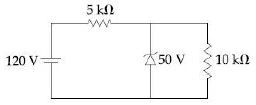 JEE Mains 2019 Medium
 - The binding energy for the following nuclear reactions are expressed in MeV .
\({ }_2 He ^3+{ }_0 n ^1 \rightarrow{ }_2 He ^4+20 MeV\)
\({ }_2 He ^4+{ }_0 n ^1 \rightarrow{ }_2 He ^5-0.9 MeV\)
If \(X _3, X _4, X _5\) denote the stability of \({ }_2 He ^3,{ }_2 He ^4\) and \({ }_2 He ^5\), respectively, then the correct order is :JEE Mains 2026 Medium - For the first order reaction \(A \rightarrow 2 B, 1\) \(mole\) of reactant \(A\) gives \(0.2\) moles of \(B\) after \(100\, minutes.\) The half life of the reaction is \(.....\,min\) [Use \(: \ln 2=0.69, \ln 10=2.3\) Properties of logar \(\ln \left(\frac{\mathrm{x}}{\mathrm{y}}\right)=\ln \mathrm{x}-\ln \mathrm{y}\)JEE Mains 2021 Hard
- Distance between object and its image \(\left( \text{magnified by } -\frac{1}{3}\right)\) is 30 cm. The focal length of the mirror used is \(\left(\frac{x}{4}\right) \mathrm{cm}\),
where magnitude of value of \(x\) is _________.JEE Mains 2025 Medium - Identify correct statement/s :
(A) \(-\mathrm{OCH}_3\) and \(-\mathrm{NHCOCH}_3\) are activating group.
(B) -CN and -OH are meta directing group.
(C) -CN and \(-\mathrm{SO}_3 \mathrm{H}\) are meta directing group.
(D) Activating groups act as ortho - and para directing groups.
(E) Halides are activating groups.
Choose the correct answer from the options given below :JEE Mains 2025 Easy