


JEE Mains · Chemistry · STD 12 - 6. Haloalkanes and Haloarenes
Consider the following reactions \((a)\;\left(\mathrm{CH}_{3}\right)_{3} \mathrm{CCH}(\mathrm{OH}) \mathrm{CH}_{3} \stackrel{\mathrm{conc.H}, \mathrm{SO}_{4}}{\longrightarrow}\) \((b)\;\left(\mathrm{CH}_{3}\right)_{2} \mathrm{CHCH}(\mathrm{Br}) \mathrm{CH}_{3} \stackrel{\text { alc.KOH }}{\longrightarrow}\) \((c)\;\left(\mathrm{CH}_{3}\right)_{2} \mathrm{CHCH}(\mathrm{Br}) \mathrm{CH}_{3} \xrightarrow[\text { It should be }\left(\mathrm{CH}_{3}\right)_{3} \mathrm{CO}^{-} \mathrm{K}^{+}]{\text { given by } \mathrm{NTA}\left(\mathrm{CH}_{3}\right)_{3} \mathrm{O}^{-} \mathrm{K}^{+}}\) \((d)\;\begin{array}{*{20}{c}}
{{{(C{H_3})}_2}C - C{H_2} - CHO} \\
{|\,\,\,\,\,\,\,\,\,\,\,\,\,\,\,\,\,\,} \\
{OH\,\,\,\,\,\,\,\,\,\,\,\,\,\,}
\end{array}\xrightarrow{\Delta }\) Which of these reaction(s) will not produce Saytzeff product ?
- A \((c)\) only
- B \((a), (c)\) and \((d)\)
- C \((d)\) only
- D \((b)\) and \((d)\)
Answer & Solution
Correct Answer
(A) \((c)\) only
Step-by-step Solution
Detailed explanation
See the Complete Solution
Get step-by-step explanations for this and 2.5 Lakh+ more JEE, NEET & CET questions.
- Unlock all solutions
- Practice the full chapter
- Track accuracy across PYQs
4.8 rated on Google Play · 14,000+ reviews
More questions from Chemistry
- The Azimuthal quantum number for the valence electrons of \(\mathrm{Ga}^{+}\)ion is \(.....\) (Atomic number of \(\mathrm{Ga}=31\) )JEE Mains 2021 Medium
- For a reaction \(X + Y \rightleftharpoons 2\, Z , 1.0 mol\) of \(X , 1.5\) mol of \(Y\) and \(0.5\, mol\) of \(Z\) were taken in a \(1\) \(L\) vessel and allowed to react. At equilibrium, the concentration of \(Z\) was \(1.0\, mol\, L ^{-1}\). The equilibrium constant of the reaction is \(-\frac{x}{15} .\) The value of \(x\) is........JEE Mains 2020 Hard
- The correct order of electron gain enthalpy isJEE Mains 2021 Easy
- The Gibbs energy for the decomposition of \(Al_2O_3\) at \(500\,^oC\) is as follows \(\frac{2}{3}A{l_2}{O_3} \to \frac{4}{3}Al + {O_2},{\Delta _r}G = + 940\,kJ\,mo{l^{ - 1}}\) The potential difference needed for the electrolytic reduction of aluminium oxide ............... \(\mathrm{V}\)JEE Mains 2013 Hard
- Lithium aluminium hydride reacts with silicon tetrachloride to formJEE Mains 2018 Hard
- \(Nd ^{2+}=\)JEE Mains 2023 Medium
More PYQs from JEE Mains
- The current \(i\) in the network is.....\(A\)
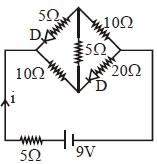 JEE Mains 2020 Medium
 - If the plane \(2x -y + 2z + 3 = 0\) has the distances \(\frac {1}{3}\) and \(\frac {2}{3}\) units from the planes \(4x -2y + 4z + \lambda = 0\) and \(2x -y + 2z + \mu = 0,\) respectively, then the maximum value of \(\lambda + \mu \) us equal toJEE Mains 2019 Hard
- Given below are two statements: one is labelled as Assertion A and the other is labelled as Reason \(\mathbf{R}\)
Assertion A: A sound wave has higher speed in solids than gases.
Reason R: Gases have higher value of Bulk modulus than solids.
In the light of the above statements, choose the correct answer from the options given belowJEE Mains 2025 Easy - Glycerine of density \(1.25 \times 10^3\,kg\,m ^{-3}\) is flowing through the conical section of pipe. The area of cross-section of the pipe at its ends is \(10\,cm ^2\) and \(5\,cm ^2\) and pressure drop across its length is \(3\,Nm ^{-2}\). The rate of flow of glycerine through the pipe is \(x \times 10^{-5} m ^3 s ^{-1}\). The value of \(x\) is \(..............\).
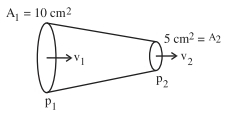 JEE Mains 2023 Hard
 - The integral \(\int\limits_0^{\frac{1}{2}} {\frac{{\ln \,\left( {1 + 2x} \right)}}{{1 + 4{x^2}}}} dx\) , equalsJEE Mains 2014 Hard
- The temperature of an ideal gas in \(3-\)dimensions is \(300\, {K}\). The corresponding de-Broglie wavelength of the electron approximately at \(300\,{K}\), is \(....\,nm\) \(\left\lfloor{m}_{e}=\text { mass of electron }=9 \times 10^{-31} \,{kg}\right.\) \({h}=\text { Planck constant }=6.6 \times 10^{-34} {Js}\) \(\left.{k}_{{B}}=\text { Boltzmann constant }=1.38 \times 10^{-23}\, {JK}^{-1}\right]\)JEE Mains 2021 Medium