


JEE Mains · Chemistry · STD 12 - 7. Alcohol, phenol and ethers
Consider the following reaction : The product \('P'\) gives positive ceric ammonium nitrate test. This is because of the presence of which of these \(-OH\) group(s)\(?\)

- A \((c)\) and \((d)\)
- B \((b)\) only
- C \((d)\) only
- D \((b)\) and \((d)\)
Answer & Solution
Correct Answer
(B) \((b)\) only
Step-by-step Solution
Detailed explanation
See the Complete Solution
Get step-by-step explanations for this and 2.5 Lakh+ more JEE, NEET & CET questions.
- Unlock all solutions
- Practice the full chapter
- Track accuracy across PYQs
4.8 rated on Google Play · 14,000+ reviews
More questions from Chemistry
- For the following reactions.....\(kJ/mol\) \(\mathrm{A} \stackrel{700 \mathrm{K}}{\rightarrow}\) Product \(\mathrm{A}\xrightarrow[\text { catalyst }]{500 \mathrm{K}} \) Product it was found that \(\mathrm{E}_{\mathrm{a}}\) is decreased by \(30 \;\mathrm{kJ} / \mathrm{mol}\) in the presence of catalyst. If the rate remains unchanged, the activation energy for catalysed reaction is (Assume pre exponential factor is same \():\)JEE Mains 2020 Hard
- A sample of \(NaClO_3\) is converted by heat to \(NaCl\) with a loss of \(0.16\, g\) of oxygen. The residue is dissolved in water and precipitated as \(AgCl\). The mass of \(AgCl\) (in \(g\)) obtained will be (Given: Molar mass of \(AgCl = 143.5\, g\,mol^{-1}\) )JEE Mains 2018 Hard
- The correct statements about metal carbonyls are
A. The metal-carbon bonds in metal carbonyls possess both \(\sigma\) and \(\pi\)-character.
B. Due to synergic bonding interactions between metal and CO ligand, the metal-carbon bond becomes weak.
C. The metal-carbon \(\sigma\) bond is formed by the donation of lone pair of electrons on the carbonyl carbon into a vacant orbital of metal.
D. The metal-carbon \(\pi\) bond is formed by the donation of electrons from filled d-orbital of metal into vacant \(\pi^*\) orbital of CO.
Choose the correct answer from the options given below:JEE Mains 2026 Medium - \(\underset{\raise0.3em\hbox{\)\smash{\scriptscriptstyle-}\(}}{A} \xrightarrow{{4\,KO{H_1}{O_2}}}\mathop {2\underset{\raise0.3em\hbox{\)\smash{\scriptscriptstyle-}\(}}{B} }\limits_{(Green)} + 2{H_2}O\) \(3\underset{\raise0.3em\hbox{\)\smash{\scriptscriptstyle-}\(}}{B} \xrightarrow{{4\,HCl}}\mathop {2C}\limits_{(Purple)} + Mn{O_2} + 2{H_2}O\) \(3\underset{\raise0.3em\hbox{\)\smash{\scriptscriptstyle-}\(}}{C} \xrightarrow{{{H_2}O,KI}}2\underset{\raise0.3em\hbox{\)\smash{\scriptscriptstyle-}\(}}{A} + 2KOH + \underset{\raise0.3em\hbox{\)\smash{\scriptscriptstyle-}\(}}{D} \) In the above sequence of reactions, \(\underset{\raise0.3em\hbox{\)\smash{\scriptscriptstyle-}\(}}{A}\) and \(\underset{\raise0.3em\hbox{\)\smash{\scriptscriptstyle-}\(}}{D} \) , respectively areJEE Mains 2019 Hard
- Match List-I with List-II.
List-I (Purification technique) List-II (Mixture of organic compounds) (A) Distillation (simple) (I) Diesel + Petrol (B) Fractional distillation (II) Aniline + Water (C) Distillation under reduced pressure (III) Chloroform + Aniline (D) Steam distillation (IV) Glycerol + Spent-lye
Choose the correct answer from the options given below :JEE Mains 2025 Medium - Given below are two statements for the following reaction sequence.
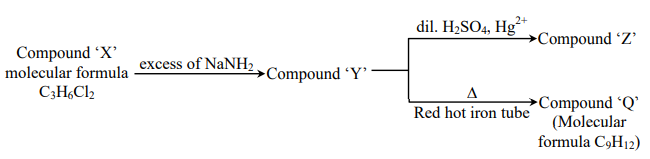
Statement I: Compound 'Z' will give yellow precipitate with NaOI.
Statement II: Compound 'Q' has two different types of 'H' atoms (aromatic : aliphatic) in the ratio 1 : 3.
In the light of the above statements, choose the correct answer from the option given below:JEE Mains 2026 Hard
More PYQs from JEE Mains
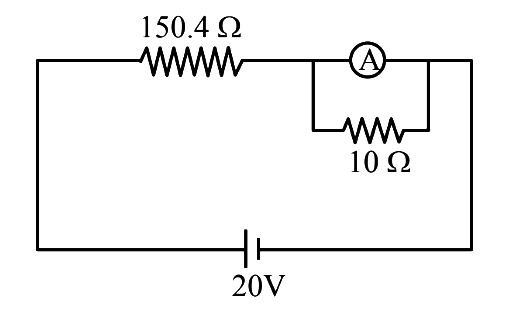
- In the figure shown below, a resistance of \(150.4 \Omega\) is connected in series to an ammeter A of resistance \(240 \Omega\). A shunt resistance of \(10 \Omega\) is connected in parallel with the ammeter. The reading of the ammeter is _____ mA.
 JEE Mains 2025 Medium
 - Suppose the vectors \(x_{1}, x_{2}\) and \(x_{3}\) are the solutions of the system of linear equations, \(Ax = b\) when the vector \(b\) on the right side is equal to \(b _{1}, b _{2}\) and \(b _{3}\) respectively. If \(x =\left[\begin{array}{l}1 \\ 1 \\ 1\end{array}\right], x _{2}=\left[\begin{array}{l}0 \\ 2 \\ 1\end{array}\right], x _{3}=\left[\begin{array}{l}0 \\ 0 \\ 1\end{array}\right], b _{1}=\left[\begin{array}{l}1 \\ 0 \\ 0\end{array}\right]\) \(b _{2}=\left[\begin{array}{l}0 \\ 2 \\ 0\end{array}\right]\) and \(b _{3}=\left[\begin{array}{l}0 \\ 0 \\ 2\end{array}\right],\) then the determinant of \(A\) is equal toJEE Mains 2020 Hard
- If \(S = \left\{\theta \in [-\pi, \pi] : \cos\theta \cos\dfrac{5\theta}{2} = \cos 7\theta \cos\dfrac{7\theta}{2}\right\}\), then \(n(S)\) is equal to _______.JEE Mains 2026 Hard
- Given below are two statements:
Statement-I: The gas liberated on warming a salt with dil \(H _2 SO _4\), turns a piece of paper dipped in lead acetate into black, it is a confirmatory test for sulphide ion.
Statement-II: In statement-I the colour of paper turns black because of formation of lead sulphite. In the light of the above statements, choose the most appropriate answer from the options given below:JEE Mains 2024 Medium - The wave number of the first emission line in the Balmer series of \(H-\) Spectrum is ( \(R =\) Rydberg constant)JEE Mains 2013 Medium
- Consider the reaction \(\mathrm{X}_2 \mathrm{Y}(\mathrm{~g})=\mathrm{X}_2(\mathrm{~g})+\frac{1}{2} \mathrm{Y}_2(\mathrm{~g})\)
The equation representing correct relationship between the degree of dissociation (x) of \(\mathrm{X}_2 \mathrm{Y}(\mathrm{g})\) with its equilibrium constant Kp is ______ .
Assume \(x\) to be very very small.JEE Mains 2025 Medium