


JEE Advanced · Physics · 13. Thermodynamics
Paragraph :
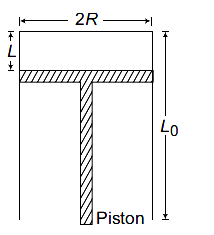
\(P_{14-16}\) : Paragraph for Questions Nos. 14 to 16 A fixed thermally conducting cylinder has a radius \(R\) and height \(L_0\). The cylinder is open at its bottom and has a small hole at its top. A piston of mass \(M\) is held at a distance \(L\) from the top surface as shown in the figure. The atmospheric pressure is \(p_0\).
Question :
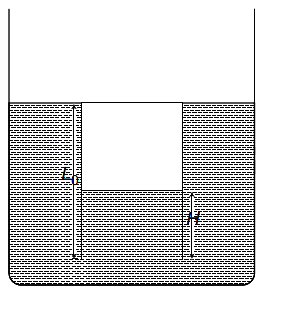
The piston is taken completely out of the cylinder. The hole at the top is sealed. A water tank is brought below the cylinder and put in a position so that the water surface in the tank is at the same level as the top of the cylinder as shown in the figure. The density of the water is \(\rho\). In equilibrium, the height \(H\) of the water column in the cylinder satisfies
- A \(\rho g\left(L_0-H\right)^2+p_0\left(L_0-H\right)+L_0 p_0=0\)
- B \(\rho g\left(L_0-H\right)^2-p_0\left(L_0-H\right)-L_0 p_0=0\)
- C \(\rho g\left(L_0-H\right)^2+p_0\left(L_0-H\right)-L_0 p_0=0\)
- D \(\rho g\left(L_0-H\right)^2-p_0\left(L_0-H\right)+L_0 p_0=0\)
Answer & Solution
Correct Answer
(C) \(\rho g\left(L_0-H\right)^2+p_0\left(L_0-H\right)-L_0 p_0=0\)
Step-by-step Solution
Detailed explanation
\(
\begin{gathered}
p_1=p_2 \\
p_0+\rho g\left(L_0-H\right)=p
\end{gathered}
\)
Now, applying \(p_1 V_1=p_2 V_2\)
for the air inside the cylinder, we have
\(
p_0\left(L_0\right)=p\left(L_0-H\right)
\)
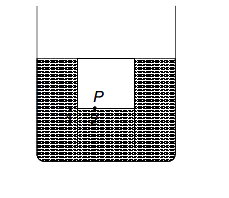
\(\therefore \quad p=\frac{p_0 L_0}{L_0-H}\)
Substituting in Eq. (i), we have
\(
p_0+\rho g\left(L_0-H\right)=\frac{p_0 L_0}{L_0-H}
\)
or \(\rho g\left(L_0-H\right)^2+p_0\left(L_0-H\right)-p_0 L_0=0\)
\(\therefore\) Option (c) is correct.
\begin{gathered}
p_1=p_2 \\
p_0+\rho g\left(L_0-H\right)=p
\end{gathered}
\)
Now, applying \(p_1 V_1=p_2 V_2\)
for the air inside the cylinder, we have
\(
p_0\left(L_0\right)=p\left(L_0-H\right)
\)
\(\therefore \quad p=\frac{p_0 L_0}{L_0-H}\)
Substituting in Eq. (i), we have
\(
p_0+\rho g\left(L_0-H\right)=\frac{p_0 L_0}{L_0-H}
\)
or \(\rho g\left(L_0-H\right)^2+p_0\left(L_0-H\right)-p_0 L_0=0\)
\(\therefore\) Option (c) is correct.
See the Complete Solution
Get step-by-step explanations for this and 2.5 Lakh+ more JEE, NEET & CET questions.
- Unlock all solutions
- Practice the full chapter
- Track accuracy across PYQs
4.8 rated on Google Play · 14,000+ reviews
More questions from Physics
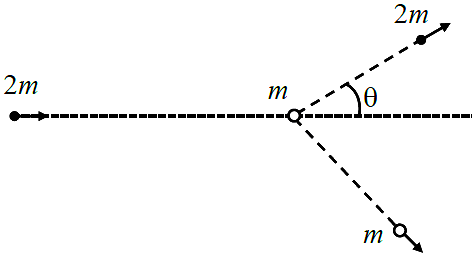
- In a scattering experiment, a particle of mass \(2 m\) collides with another particle of mass \(m\), which is initially at rest. Assuming the collision to be perfectly elastic, the maximum angular deviation \(\theta\) of the heavier particle, as shown in the figure, in radians is:
 JEE Advanced 2025 Hard
 - An electric dipole is formed by two charges and located in -plane at and , respectively, as shown in the figure. The electric potential at point due to the dipole is . The charges and are then moved to the points and , respectively. What is the value of electric potential atJEE Advanced 2023 Medium
- A container has a base of and height , as shown in the figure. It has two parallel electrically conducting walls each of area . The remaining walls of the container are thin and non-conducting. The container is being filled with a liquid of dielectric constant at a uniform rate of . What is the value of the capacitance of the container after seconds?
[Given: Permittivity of free space , the effects of the non-conducting walls on the capacitance are negligible]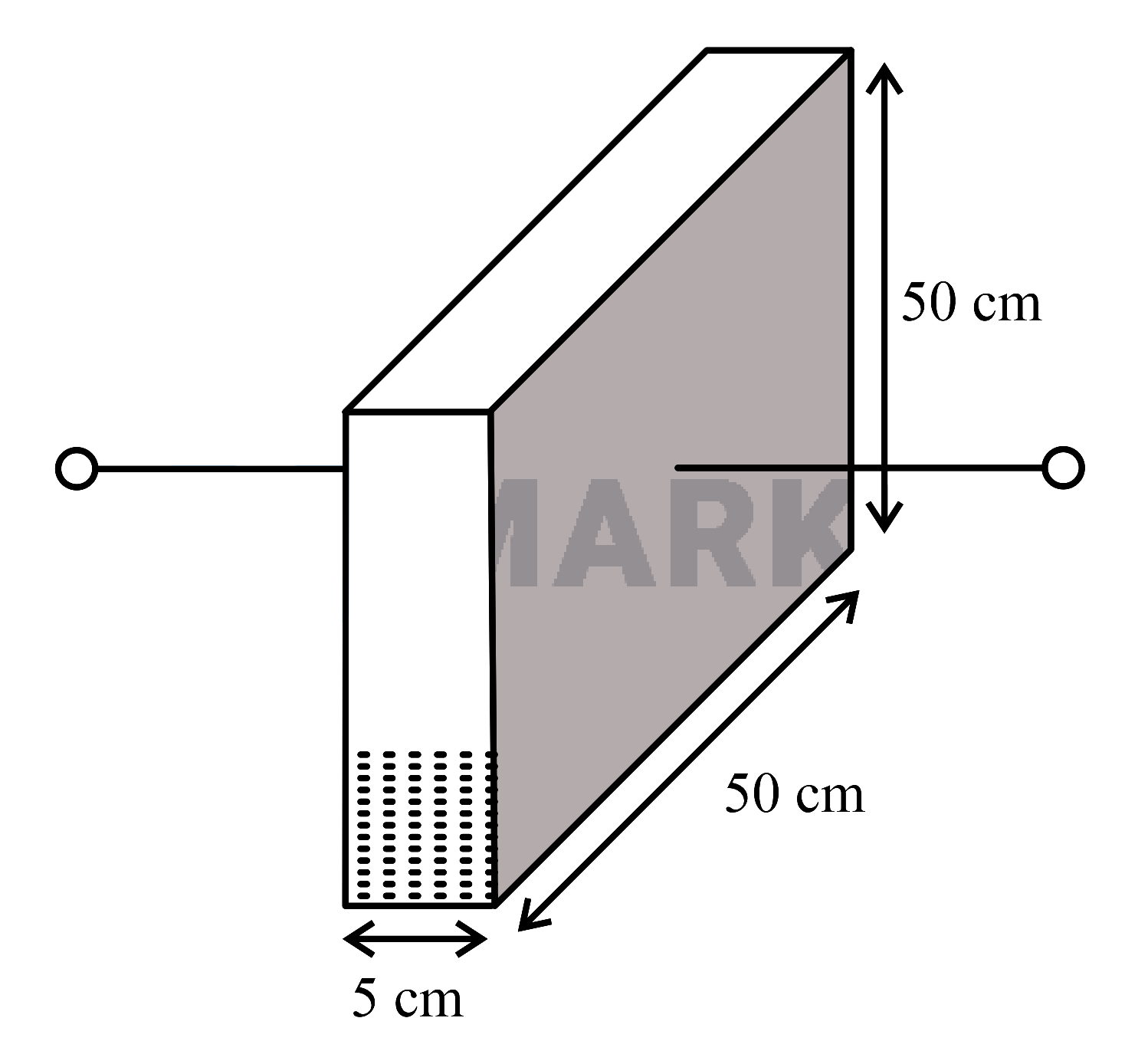 JEE Advanced 2023 Medium
 - On a frictionless horizontal plane, a bob of mass is attached to a spring with natural length . The spring constant is when the length of the spring and is when . Initially the bob is released from . Assume that Hooke's law remains valid throughout the motion. If the time period of the full oscillation is , then the integer closest to is _______.JEE Advanced 2022 Easy
- A police car with a siren of frequency \(8 \mathrm{kHz}\) is moving with uniform velocity \(36 \mathrm{~km} / \mathrm{h}\) towards a tall building which reflects the sound waves. The speed of sound in air is \(320 \mathrm{~m} / \mathrm{s}\). The frequency of the siren heard by the car driver isJEE Advanced 2011 Easy
- A geostationary satellite above the equator is orbiting around the earth at a fixed distance \(r_1\) from the center of the earth. A second satellite is orbiting in the equatorial plane in the opposite direction to the earth's rotation, at a distance \(r_2\) from the center of the earth, such that \(r_1=1.21 r_2\). The time period of the second satellite as measured from the geostationary satellite is \(\frac{24}{p}\) hours. The value of \(p\) isJEE Advanced 2025 Hard
More PYQs from JEE Advanced
- For any complex number , let , where . Let and be real numbers such that for all complex numbers satisfying , the ordered pair lies on the circle
Then which of the following statements is(are) TRUE?JEE Advanced 2021 Hard - Three concentric metallic spherical shells of radii \(R, 2 R, 3 R\) are given charges \(Q_1, Q_2, Q_3\), respectively. It is found that the surface charge densities on the outer surfaces of the shells are equal. Then, the ratio of the charges given to the shells, \(Q_1: Q_2: Q_3\), isJEE Advanced 2009 Easy
- Among \(\mathrm{V}(\mathrm{CO})_6, \mathrm{Cr}(\mathrm{CO})_5, \mathrm{Cu}(\mathrm{CO})_3,\)\(\operatorname{Mn}(\mathrm{CO})_5, \mathrm{Fe}(\mathrm{CO})_5,\left[\mathrm{Co}(\mathrm{CO})_3\right]^{3-},\left[\mathrm{Cr}(\mathrm{CO})_4\right]^{4-}\), and \(\operatorname{Ir}(\mathrm{CO})_3\), the total number of species isoelectronic with \(\mathrm{Ni}(\mathrm{CO})_4\) is ________.
[Given, atomic number:\(\mathrm{V}=23, \mathrm{Cr}=24, \mathrm{Mn}=25,\) \(\mathrm{Fe}=26, \mathrm{Co}=27, \mathrm{Ni}=28, \mathrm{Cu}=29,\) \(\mathrm{Ir}=77\)]JEE Advanced 2024 Easy - Let m and n be two positive integers greater than 1. If then the value of isJEE Advanced 2015 Medium
- Five persons and are seated in a circular arrangement. If each of them is given a hat of one of the three colours red, blue and green, then the number of ways of distributing the hats such that the persons seated in adjacent seats get different coloured hats isJEE Advanced 2019 Easy
- Two particles of mass \(m\) each are tied at the ends of a light string of length \(2 a\). The whole system is kept on a frictionless horizontal surface with the string held tight so that each mass is at a distance \(a\) from the centre \(P\) (as shown in the figure). Now, the mid-point of the string is pulled vertically upwards with a small but constant force \(F\). As a result, the particles move towards each other on the surface.
The magnitude of acceleration, when the separation between them becomes \(2 x\), is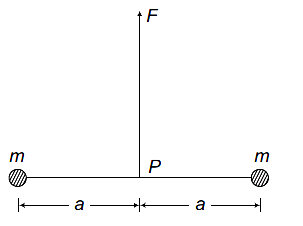 JEE Advanced 2007 Hard