


CUET · PHYSICS · PYQ PAPER 2023
What is the effect on the focal length of a convex lens when it is immersed in a liquid whose refractive index is equal to refractive index of the lens ?
- A Focal length will become infinity
- B Focal length will become zero
- C Focal length will reduce but not become zero
- D Focal length remains unchanged
Answer & Solution
Correct Answer
(A) Focal length will become infinity
Step-by-step Solution
Detailed explanation
\( \frac{1}{f} = \left( \frac{n_{lens}}{n_{medium}} - 1 \right) \left( \frac{1}{R_1} - \frac{1}{R_2} \right) \) \( n_{lens} = n_{medium} \implies \frac{n_{lens}}{n_{medium}} = 1 \) \( \frac{1}{f} = (1 - 1) \left( \frac{1}{R_1} - \frac{1}{R_2} \right) = 0 \) \( f = \infty \)
See the Complete Solution
Get step-by-step explanations for this and 2.5 Lakh+ more JEE, NEET & CET questions.
- Unlock all solutions
- Practice the full chapter
- Track accuracy across PYQs
4.8 rated on Google Play · 14,000+ reviews
More questions from PHYSICS
- A convex lens of focal length 40 cm is placed in contact with a concave lens of focal length 20 cm. If an object is placed at 40 cm in front of the combination, the position of the image formed by the combination isCUET 2025 Medium
- A series LCR circuit is connected to a 230 V, 50 rad/s source. Given L = 5 H, C = 80 \( \mu \)F and R = 40 \( \Omega \). Impedance of the circuit isCUET 2025 Medium
- A transformer has 4000 turns in primary and 100 turns in secondary coils. The primary coil in connected to a 240 V and secondary to a bulb of 1.2 \(\Omega\) resistance. The current in the bulb is :CUET 2023 Easy
- The radii of curvature of the two surfaces of a concave lens are 20 cm each. The refractive index of the material of the lens is 1.5. The power of the lens would be -CUET 2025 Easy
- A wire of length 10 m and diameter 0.4 mm has a resistance of \( 2 \, \Omega \). The resistivity of the wire isCUET 2025 Medium
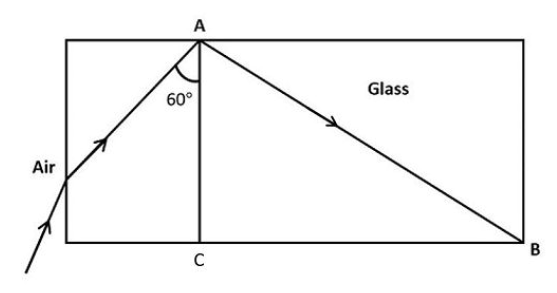
- A light ray from air is incident on a glass slab (\( \mu = 1.5 \)) as shown in the figure. It undergoes a total internal reflection and travels along AB. The thickness AC of the glass slab is 20 cm. The time taken by light to cross the glass slab after reflection is
 CUET 2025 Easy
More PYQs from CUET
- Read the given passage and answer the following questions:
Secondary treatment or biological treatment: The primary effluent is passed into large tanks where air is pumped into it. This allows vigorous growth of aerobic microbes. While growing, these microbes consume the major part of the organic matter in the effluent. This significantly change the BOD (biochemical oxygen demand) of the effluent. The effluent in then passed into a tank a small part of the sludge is pumped back into the aeration tank to serve as the inoculum. The remaining major part of the sludge is pumped into large tanks called sludge digesters. Here, other kinds of bacteria grow anaerobically in the sludge. The biogas produced can be used source of energy as it is inflammable. The effluent from the secondary treatment plant is generally released into natural water bodies like rivers and streams.
Steps in primary treatment does not include:CUET 2023 Hard - A proton, an electron, a neutron and an alpha particle have the same energy. Their de Broglie's wavelengths are given below:
(A) \( \lambda_{proton} \)
(B) \( \lambda_{electron} \)
(C) \( \lambda_{neutron} \)
(D) \( \lambda_{alpha} \)
Arrange these wavelengths in decreasing order. Choose the correct answer from the options given below:CUET 2025 Medium - A short bar magnet of magnetic moment \(m =0.45 J / T\) is placed in a uniform magnetic field of 0.22 T . If the bar is free to rotate in the plane of the field, what is the potential energy of the magnet in stable and unstable equilibrium respectively?CUET 2023 Easy
- Function \(f(x)=x^x, x>0\) decreases on the intervalCUET 2025 Medium
- Read the passage carefully and answer the Questions
Carbonyl compounds such as aldehydes, ketones, and carboxylic acids play an important role in the biochemical process of plants and animal kingdom.
Many aldehydes and ketones find applications in dye, perfumery and other industries.
The carbonyl carbon atom is \(s p^2\)-hybridized forming three sigma and one pi-bond with oxygen.
C-O bonds are polar bond due to high electronegativity of oxygen than carbon.
Hence the carbonyl carbon behaves as an electrophilic center and oxygen as a nucleophilic centre.
Primary and secondary alcohols yield aldehydes and ketones respectively upon oxidation with variety of oxidizing agents.
The boiling points of aldehydes and ketones differ from hydrocarbons and ethers.
Aldehydes and ketones undergo nucleophilic addition reaction due to presence of electrophilic carbonyl carbon.
Nucleophile and a proton add across the carbon oxygen double bond.
The alcohol which cannot be used to prepare carbonyl compound through oxidation isCUET 2023 Hard - The function of the soft iron core in the moving coil galvanometer is:CUET 2023 Easy