


CUET · PHYSICS · PYQ PAPER 2023
Two thin lenses of focal lengths \( f_1 \) and \( f_2 \) are in contact and coaxial. The power of the combination is:
- A \( \sqrt{\frac{f_1}{f_2}} \)
- B \( \sqrt{\frac{f_2}{f_1}} \)
- C \( \frac{f_1 - f_2}{f_1 f_2} \)
- D \( \frac{f_1 + f_2}{f_1 f_2} \)
Answer & Solution
Correct Answer
(D) \( \frac{f_1 + f_2}{f_1 f_2} \)
Step-by-step Solution
Detailed explanation
\( P = P_1 + P_2 \) \( P = \frac{1}{f_1} + \frac{1}{f_2} \) \( P = \frac{f_1 + f_2}{f_1 f_2} \)
See the Complete Solution
Get step-by-step explanations for this and 2.5 Lakh+ more JEE, NEET & CET questions.
- Unlock all solutions
- Practice the full chapter
- Track accuracy across PYQs
4.8 rated on Google Play · 14,000+ reviews
More questions from PHYSICS
- Two sources are producing waves as given in the options below. Which two sources are called coherent ?CUET 2023 Medium
- If light of wavelength 412.5 nm is incident on each of the metals given below, which ones will show photoelectric emission ?
Metal Work Function (eV) Na 1.92 K 2.15 Ca 3.20 Mo 4.17
Choose the correct answer from the options given below:CUET 2025 Hard - Match List I with List - II.
List I List II (A) Zener diode (I) operates under forward bias (B) LED (II) operates under reverse bias (C) Solar cell (III) operates under reverse bias in break down region (D) Photo diode (IV) no biasing is applied
Choose the correct answer from the options given below :CUET 2023 Medium - A ray is incident normally on the face of an equilateral prism of refracting angle \(60^{\circ}\).
The refractive index of the prism is \(\frac{2}{\sqrt{3}}\).
The angle of deviation will be:CUET 2023 Medium - In the given figure, the ratio of electric fluxes through surfaces \( S_1 \) and \( S_2 \) is
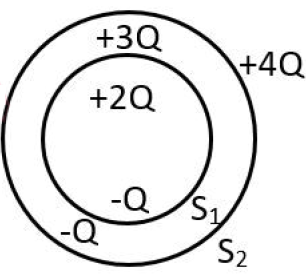 CUET 2025 Medium
 - Identify the correct statement(s) from the following Resistivity (\( \rho \)) versus Temperature (T) graphs :
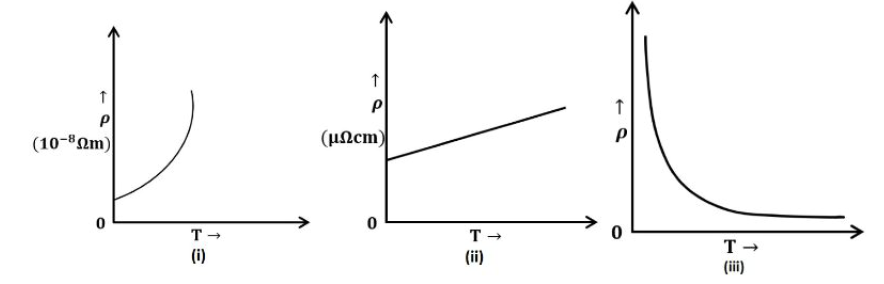
(A) Graph (i), shows \(\rho\) versus \(T\) variation for Copper
(B) Graph (ii), shows \(\rho\) versus \(T\) variation for Silicon
(C) Graph (iii), shows \(\rho\) versus \(T\) variation for semiconductor
(D) Graph (iii), shows \(\rho\) versus T variation for Nichrome
Choose the correct answer from the options given below :CUET 2025 Hard
More PYQs from CUET
- Match List-I with List-II
List-I (Solute) List-II (Van't Hoff factor) (A) Benzoic acid in benzene (I) 3 (B) \(K _2 SO _4( aq )\) (II) 2 (C) Urea (aq) (III) 0.5 (D) \(KOH ( aq )\) (IV) 1
Choose the correct answer from the options given below:CUET 2025 Hard - In Young's double slit experiment, two slits are made 4 mm apart and the screen is placed 3 m away from slits. The fringe width when light of wavelength 600 nm is used will be:CUET 2023 Hard
- The phase difference between two points A and B on a given wavefront separated by distance \(\lambda\) is :CUET 2023 Easy
- Read the passage carefully and answer
Carbohydrates are essential for both plants and animals. Some common examples of carbohydrates are glucose, fructose, sucrose, glycogen, cellulose and starch. They form a major portion of our food. Honey has been used for a long time as an instant source of energy in Ayurvedic medicine. Carbohydrates are used as storage molecules in both plants and animals. The cell wall of bacteria and plants is made of cellulose. We use cellulose in the form of wood for making furniture and as cotton fiber for clothing. They also provide raw material for textiles, paper, lacquers, and breweries. Carbohydrates are classified as Monosaccharides, Oligosaccharides and Polysaccharides on the basis of their behavior towards hydrolysis.
Monosaccharides cannot be hydrolyzed further to simpler units whereas oligosaccharides can yield 2-10 units of monosaccharides on hydrolysis. Polysaccharides, which are non-sugars yield a large number of monosaccharide units on hydrolysis.
Answer the following questions about carbohydrates:
Identify a component of starch from among the following.CUET 2025 Hard - Genes which code for a pair of contrasting traits are knows as:CUET 2023 Easy
- A body oscillate with SHM according to equation (SI unit),
\( x = 10 \cos(2\pi t + \pi/4) \)
at t= 1.5 s, calculate the speed of the body.CUET 2023 Easy