


CUET · PHYSICS · PYQ PAPER 2025
The ratio of total energy to the kinetic energy of an electron in a Bohr orbit of the hydrogen atom is
- A 1 : 1
- B 1 : -2
- C -1 : 1
- D 2 : -1
Answer & Solution
Correct Answer
(C) -1 : 1
Step-by-step Solution
Detailed explanation
Total Energy (TE) \( = -\) Kinetic Energy (KE) \( \frac{TE}{KE} = \frac{-KE}{KE} = -1 \) Ratio \( TE : KE = -1 : 1 \)
See the Complete Solution
Get step-by-step explanations for this and 2.5 Lakh+ more JEE, NEET & CET questions.
- Unlock all solutions
- Practice the full chapter
- Track accuracy across PYQs
4.8 rated on Google Play · 14,000+ reviews
More questions from PHYSICS
- A monochromatic source emitting light of wavelength 300 nm has a power output of 33 W.
Calculate the number of photons emitted by this source in 2 minutes. (\( h = 6.62 \times 10^{-34} \text{ J s} \))CUET 2023 Easy - The following statements are given related to Wheatstone Bridge:
1. when Wheatstone Bridge is balanced, no current flows through the galvanometer arm.
2. Wheatstone Bridge works on the principle of Kirchhoff's law.
3. Being a null method based experiment, the result is free from the effect of extra resistances (cell resistance) of the circuit
4. Wheatstone Bridge is most sensitive when all the four resistances are nearly of the same magnitude.
Choose the correct answer from the options given below:CUET 2025 Hard - Rainbow is a phenomenon due to the combined effect of
(A) Interference
(B) Dispersion
(C) Reflection
(D) Refraction
(E) Scattering
Choose the correct answer from the options given below:CUET 2025 Medium - A resistor connected to a battery is heated due to the current. The quantity which does not change isCUET 2025 Hard
- If the intensity of incident radiation on metal is doubled, the kinetic energy of electrons emitted would beCUET 2025 Hard
- A convex lens of focal length 30 cm is in contact with a concave lens of focal length 20 cm. Is the system working as a converging or diverging lens. What is the focal length of the combinationCUET 2023 Medium
More PYQs from CUET
- The random variable X has a probability distribution \(P(X=r)=\left\{\begin{array}{ll}r k, & \text { if } r \leq 2, \\ (r-1) k, & \text { if } 2 < r \leq 4, \text { where } r \in N \cup\{0\} \text { and } k \in R . \\ 0, & \text { otherwise },\end{array}\right.\), where \(n\) is the set of natural numbers
(A) \(k=\frac{1}{9}\)
(B) \(P(2 \leq X \leq 3)=\frac{1}{2}\)
(C) \(P(X=4)=\frac{1}{3}\)
(D) \(P(X>1)=\frac{7}{8}\)
Choose the correct answer from the options given below:CUET 2025 Medium - Study the human pedigree chart given below and choose the correct
conclusion.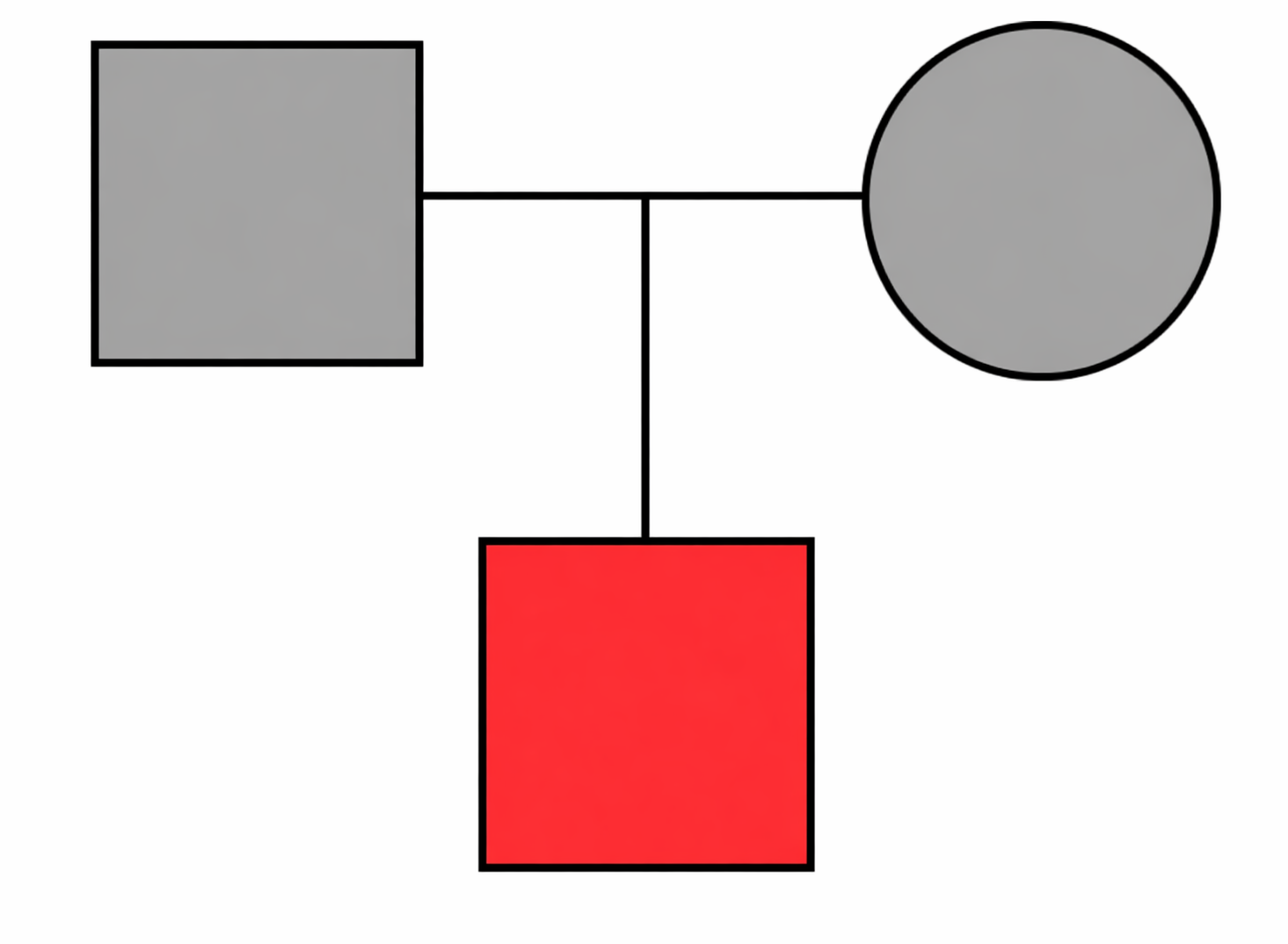 CUET 2025 Hard
 - If \( \mu_0 \) is the permeability and \( \epsilon_0 \) is the permittivity of free space, then the velocity of light (c) is:CUET 2025 Easy
- The correct relation between the transistor parameters \(\alpha\) and \(\beta\) is -CUET 2023 Easy
- In sewage treatment, flocs are:CUET 2024 Medium
- The kinetic energy of an electron in the H-atom in the second excited state is k units. Its total energy and potential energy, respectively, in the ground state will beCUET 2025 Hard