


CUET · PHYSICS · PYQ PAPER 2023
The electric field of an electric dipole at a large distance is proportional to :
- A \(1 / r\)
- B \(1 / r^2\)
- C \(1 / r^3\)
- D \(1 / r^4\)
Answer & Solution
Correct Answer
(C) \(1 / r^3\)
Step-by-step Solution
Detailed explanation
The electric field of an electric dipole at a large distance is proportional to \(1 / r^3\).
See the Complete Solution
Get step-by-step explanations for this and 2.5 Lakh+ more JEE, NEET & CET questions.
- Unlock all solutions
- Practice the full chapter
- Track accuracy across PYQs
4.8 rated on Google Play · 14,000+ reviews
More questions from PHYSICS
- The de-Broglie wavelength associated with an electron accelerated through a potential difference V is \( \lambda \). The new de Broglie wavelength of electron when potential difference is increased to 9V will be:CUET 2023 Easy
- If we double the number of turns in a moving coil galvanometer, the voltage sensitivity of the galvanometerCUET 2025 Medium
- Match List-I with List-II
List-I List-II (A) Low mass number nuclei (I) Medium penetrating power (B) Electron microscope (II) Nuclear reactor (C) Beta decay (III) Diffracted electron (D) \( {}^{235}_{92}\text{U} \) (IV) Fusion
Choose the correct answer from the options given below :CUET 2023 Medium - A charged particle is moving in a cyclotron. What is the effect on time for one revolution of this charged particle, when its radius of the orbit is doubled?CUET 2023 Easy
- "The nucleus \( ^{23}_{10}\text{Ne} \) decays by \(\beta\)- emission. The maximum kinetic energy of the emitted electrons is :
Given that : \( m(^{23}_{10}\text{Ne}) = 22.994466 \text{ u} \), \( m(^{23}_{11}\text{Na}) = 22.989770 \text{ u} \) and \( 1 \text{ u} = 931 \text{ MeV/c}^2 \)CUET 2025 Easy - You are sitting in a parked car and you notice a boy running towards the car in the side view mirror of the car. If the boy is running at a constant speed towards you, which option according to you is correctCUET 2025 Medium
More PYQs from CUET
- match List - I with List - II
Choose the correct answert from the option given below :List - I (Differential Equation) List - II (Degree) (A) \(x y \frac{d^2 y}{d x^2}+x\left(\frac{d y}{d x}\right)^2-y \frac{d y}{d x}=0\) (I) 3 (B) \(\frac{d^2 y}{d x^2}+\log \left(\frac{d y}{d x}\right)=0\) (II) 1 (C) \(\left(\frac{d^2 y}{d x^2}\right)^2+\left(\frac{d y}{d x}\right)^3+\frac{d y}{d x}+1=0\) (III) not defined (D) \(2 x^2\left(\frac{d^2 y}{d x^2}\right)^3-5\left(\frac{d y}{d x}\right)^2+y=0\) (IV) 2 CUET 2025 Hard - In the given figure, shaded region represents the feasible solution to a LPP problem. The constraint represented by AD is:
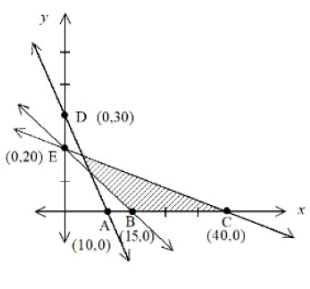 CUET 2023 Easy
 - Which of the following component was not the part of S.L. Miller's experiment?CUET 2023 Easy
- If \(f(x)=|2 x+5|\), then \(f(x)\) is :CUET 2023 Hard
- Area bounded by the curve \(|x|+|y|=1\) is:CUET 2023 Hard
- In humans, mammary gland is divided into _________ lobes.CUET 2024 Hard