


CUET · PHYSICS · PYQ PAPER 2025
One student has to make an electromagnet using a coil of copper wire. He needs a ferromagnetic material to make its core. This core material should have
- A Low permeability, low retentivity
- B High permeability, high retentivity
- C Low permeability, high retentivity
- D High permeability, low retentivity
Answer & Solution
Correct Answer
(D) High permeability, low retentivity
Step-by-step Solution
Detailed explanation
For an electromagnet, the core material must be able to generate a strong magnetic field and then lose its magnetism almost instantly when the current is switched off. This requires high permeability to easily magnetize and low retentivity so it doesn't stay magnetized.
See the Complete Solution
Get step-by-step explanations for this and 2.5 Lakh+ more JEE, NEET & CET questions.
- Unlock all solutions
- Practice the full chapter
- Track accuracy across PYQs
4.8 rated on Google Play · 14,000+ reviews
More questions from PHYSICS
- Time period of oscillation of a bar magnet in a uniform magnetic field is \( T_o \). The magnet is cut into 3 equal parts transverse to its length. The new time period of oscillation of one part will be :CUET 2023 Hard
- In Young's double slits experiment, if the ratio of the width of the two slits is 25 : 1, what is the ratio of intensity at the maxima and minima in the interference pattern?CUET 2023 Medium
- In a feedback amplifier, if the feedback voltage is in opposite phase, the gain is less than 1. Then it will:CUET 2023 Easy
- The given graph shows the variation of terminal potential difference V, across the combination of three identical cells in series to an external resistor versus the current i in the circuit. The internal resistance of each cell is :
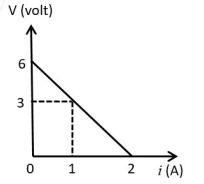 CUET 2025 Easy
 - An electric dipole consists of charges \( \pm 2 \times 10^{-6} \, \text{C} \), separated by a distance of 2 mm. It is placed on the right side near a long line charge of density \( 4 \times 10^{-4} \, \text{C m}^{-1} \). The negative charge of dipole is at a distance of 2 cm from the line charge as shown in figure. A positive charge (+2q) is placed on the left at 2 cm at point C. Given \( q = 2 \times 10^{-8} \, \text{C} \).
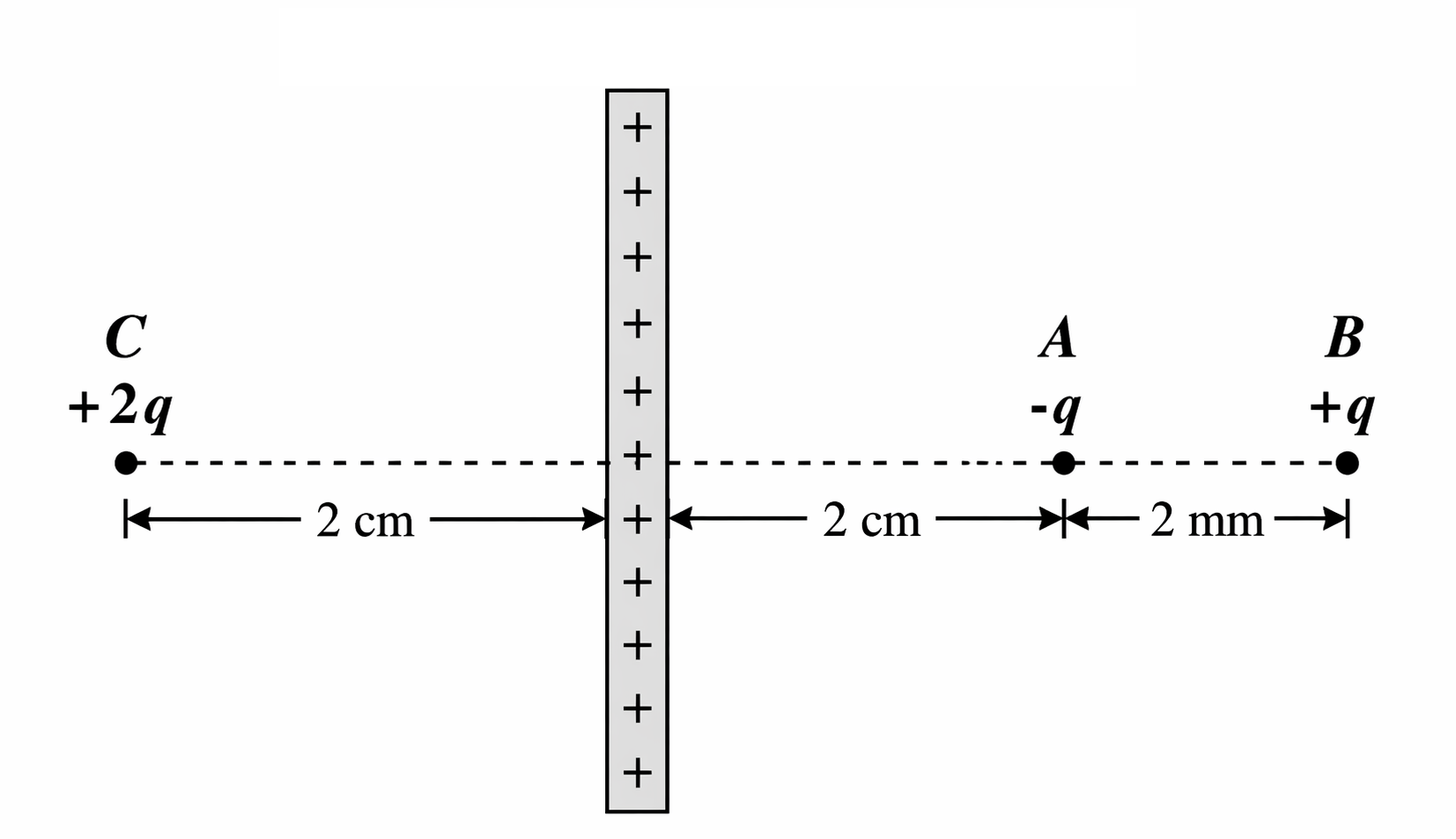
(A) Force \( |F_A| \) exerted on negative charge at point A due to line charge
(B) Force \( |F_B| \) exerted on positive charge at point B due to line charge
(C) Net force on the dipole \( |F_{net}| \) due to line charge
(D) Force \( |F_C| \) exerted on charge +2q at point C due to line charge
If the forces \( |F_A|, |F_B|, |F_C|, |F_{net}| \) are arranged in decreasing order, then:
Choose the correct answer from the options given below:CUET 2025 Hard - The current and voltage in an ac circuit are given by \( I = 5 \sin(100t - \pi/2) \text{ A} \) and \( V = 200 \sin(100t) \text{ V} \). The power dissipated in the circuit isCUET 2023 Easy
More PYQs from CUET
- Question based on following passage :
Adsorption is the process of attracting and retaining the adsorbate molecules on the surface of adsorbent. It is of two types i.e. Physisrption and chemisorption. To increase the rate of reaction, the substance called 'catalyst' is added. Promotors enhance the activity of catalyst while poison decrease the catalyst activity. Solutions may be true solution, suspension and colloids. Colloids are heterogenous but quite stable. On the basis of nature of interaction, colloids may be Lyophilic or Lyophobic. On the basis of type of dispersed phase particles, there may be multimolecular colloids, macromlecular colloids and associated colloids. The congulation of colloids may be done by boiling, dialysis or by mixing oppositely charged sols.
Reason for the stability of colloidal solution is :CUET 2023 Hard - An annuity in which the periodic payment begin on a fixed date and continue forever is called:CUET 2025 Hard
- Who popularised the term 'Biodiversity'?CUET 2025 Easy
- For the L.P.P. Maximize \(z=10 x+6 y\) subjected to
\(3 x+y \leq 12\)
\(2 x+5 y \leq 34\)
\(x, y \geq 0\)
Then the feasible region represented by system of inequalities isCUET 2025 Easy - Answer the question on the basis of passage given below :
Aldehydes and ketones represent two essential classes of organic compounds
which are extensively used in the synthesis of a wide variety of other organic molecules.
Due to the inherent polarity of the central carbonyl group, these substances readily undergo nucleophilic addition reactions.
Broadly speaking, these addition reactions can be categorized into two types:
one in which simple addition of the nucleophilic reagent occurs across the \(> C = O\) bond, and the second type where the initial addition is subsequently followed by the elimination of a water molecule.
A variety of ammonia derivatives, including hydroxylamine, hydrazine, phenylhydrazine,
2, 4-dinitroplhenylhdrazine, and semicarbagide, all belong to this second category of reactions.
These specific derivatives are fundamentally used for the identification and definitive characterization of aldehydes and ketones. Significantly, both types of nucleophilic addition reactions are strongly influenced by both steric and electronic factors.
As a general rule, aliphatic aldehydes exhibit higher reactivity compared to aromatic aldehydes.
The aliphatic aldehydes demonstrate the ability to reduce both Fehling's solution and Tollen's reagent, whereas aromatic aldehydes are limited to reducing only Tollen's reagent.
In a similar manner to aldehydes, aromatic ketones are observed to be less reactive than aliphatic ketones towards all nucleophilic addition reactions.
In a separate context, phenols and carboxylic acids both exhibit acidic properties in nature.
Both classes of compounds readily dissolve in NaOH solution and cause blue litmus to turn red.
However, carboxylic acids stand out as much stronger acids than phenols and thus can decompose sodium bicarbonate \(\left( NaHCO _3\right)\) with the distinct evolution of \(CO _2\) gas, a reaction which phenols do not undergo.
It is important to note that both electron- donating and electron- withdrawing substituents significantly influence the acid strength of both aliphatic as well as aromatic carboxylic acids.
Furthermore, unlike all other common aliphatic acids, formic acid uniquely possesses reducing properties and simultaneously does not display the typical reactions characteristic of the alkyl group.
Fehling Solution A and B respectively, are :CUET 2023 Hard - Let \(R =\left\{\left(L_1, L_2\right) : L_1 \perp L_2\right.\) where \(L_1, L_2 \in L\) (set of straight line in a plane), thenCUET 2025 Medium