


CUET · PHYSICS · PYQ PAPER 2025
Carbon, silicon and germanium have four valence electrons each. Their valence and conduction bands are separated by energy gap \( E_g \). If we represent \( (E_g)_C, (E_g)_{Si} \) and \( (E_g)_{Ge} \) as their respective energy gaps, then which of the following is true
- A \( (E_g)_C = (E_g)_{Si} = (E_g)_{Ge} \)
- B \( (E_g)_C > (E_g)_{Si} > (E_g)_{Ge} \)
- C \( (E_g)_C < (E_g)_{Si} < (E_g)_{Ge} \)
- D \( (E_g)_C > (E_g)_{Ge} > (E_g)_{Si} \)
Answer & Solution
Correct Answer
(B) \( (E_g)_C > (E_g)_{Si} > (E_g)_{Ge} \)
Step-by-step Solution
Detailed explanation
\( (E_g)_C > (E_g)_{Si} > (E_g)_{Ge} \) Carbon (Diamond): Has the smallest atomic radius. The valence electrons are very tightly bound to the nucleus, resulting in a large energy gap (approx. 5.4 eV ), making it an insulator. Silicon: Has a larger atomic radius than Carbon. The…
See the Complete Solution
Get step-by-step explanations for this and 2.5 Lakh+ more JEE, NEET & CET questions.
- Unlock all solutions
- Practice the full chapter
- Track accuracy across PYQs
4.8 rated on Google Play · 14,000+ reviews
More questions from PHYSICS
- The desirable properties of materials for making permanent magnets are:CUET 2023 Easy
- Using the given information, calculate the mass defect of the \({ }_8^{16} O\) nucleus in \(MeV / c ^2\).
Mass of electron, \(m_e=0.00055 u\)
Mass of proton, \(m_p=1.00727 u\)
Mass of neutron, \(m_n=1.00866 u\)
Experimental mass of nucleus \(=15.99053 u\)
\(1 u=931.5 MeV / c^2\)
Choose the correct answer from the options given below:CUET 2023 Easy - In an AC circuit, the instantaneous values of emf and current are \( E = 100 \sin(314t) \) V and \( I = \sin(314t + \pi/3) \) A. The average power consumed in the circuit is:CUET 2025 Hard
- Two identical circular loops P and Q each of radius R and carrying current I are kept in perpendicular planes such that they have a common centre as shown in figure. The magnitude of the net magnetic field at the common centre is :
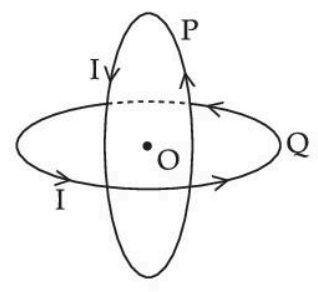 CUET 2023 Medium
 - The kinetic energy of an electron in the 2nd excited state in a hydrogen atom, if its ground state energy is \(-13.6 \text{ eV}\), will be:CUET 2025 Hard
- For a glass prism \( (\mu = \sqrt{3}) \), the angle of minimum deviation is equal to the angle of prism. What is the angle of prism?CUET 2023 Hard
More PYQs from CUET
- For an endothermic reaction, energy of activation is \(E_a\) and enthalpy of reaction is \(\Delta H\)
(both of these are in \(kJ'\) mol\(^{-1}\)), minimum value of \(E_a\) will be :CUET 2023 Easy - Question based on following passage :
Adsorption is the process of attracting and retaining the adsorbate molecules on the surface of adsorbent. It is of two types i.e. Physisrption and chemisorption. To increase the rate of reaction, the substance called 'catalyst' is added. Promotors enhance the activity of catalyst while poison decrease the catalyst activity. Solutions may be true solution, suspension and colloids. Colloids are heterogenous but quite stable. On the basis of nature of interaction, colloids may be Lyophilic or Lyophobic. On the basis of type of dispersed phase particles, there may be multimolecular colloids, macromlecular colloids and associated colloids. The congulation of colloids may be done by boiling, dialysis or by mixing oppositely charged sols.
The best coagulating agent for \(Fe(OH)_3\) solution is :CUET 2023 Medium - Who proposed the "Embryological support for Evolution"?CUET 2025 Easy
- If \(y=\log _e\left(\sec \left(e^{x^2}\right)\right)\), then \(\frac{d y}{d x}=\)CUET 2025 Medium
- A die is rolled in such a way that an even number is twice likely to occur as an odd number.
If the die is rolled twice, then the mean of the number of perfect squares in two tosses is :CUET 2025 Easy - If the lines \(\frac{x+3}{k-5}=\frac{y-1}{1}=\frac{5-z}{-2 k-1}\) and \(\frac{x+2}{-1}=\frac{2-y}{-k}=\frac{z}{5}\) are perpendicular, then the value of \(k\) isCUET 2023 Medium