


CUET · PHYSICS · PYQ PAPER 2025
A planoconvex lens has the radius of curvature of its curved surface 50 cm and the refractive index of its material is 1.5. Its focal length will be
- A 1 m
- B 0.5 m
- C 2 m
- D 0.25 m
Answer & Solution
Correct Answer
(A) 1 m
Step-by-step Solution
Detailed explanation
\( \frac{1}{f} = (n - 1) \left( \frac{1}{R_1} - \frac{1}{R_2} \right) \) \( \frac{1}{f} = (1.5 - 1) \left( \frac{1}{0.5 \text{ m}} - \frac{1}{\infty} \right) \) \( \frac{1}{f} = 0.5 \left( \frac{1}{0.5 \text{ m}} \right) = 1 \text{ m}^{-1} \) \( f = 1 \text{ m} \)
See the Complete Solution
Get step-by-step explanations for this and 2.5 Lakh+ more JEE, NEET & CET questions.
- Unlock all solutions
- Practice the full chapter
- Track accuracy across PYQs
4.8 rated on Google Play · 14,000+ reviews
More questions from PHYSICS
- What uniform magnetic field applied perpendicular to a beam of electrons moving at \( 1.3 \times 10^6 \text{ m/s} \) is required to make the electrons travel in a circular arc of radius 0.35 m?CUET 2023 Medium
- The nuclear force is:CUET 2023 Hard
- The equivalent resistance between P and Q is:
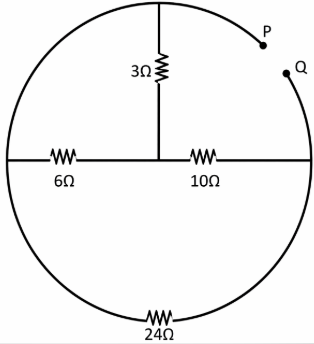 CUET 2025 Medium
 - A steady current flows in a metallic conductor of non-uniform cross-section. The quantity that is constant along the length isCUET 2025 Medium
- The condition for observing diffraction from a single slit is that the light wavefront incident on the slit should beCUET 2023 Hard
- Match List I with List - II.,
List - I List - II (A) TV Transmission (I) Short wave bands (B) Long distance radio broadcasts (II) Microwave (C) RADAR (III) Infrared rays (D) TV Remote (IV) Satellite
Choose the correct answer from the options given below :CUET 2023 Medium
More PYQs from CUET
- The angle between the straight lines \(\frac{x+4}{2}=\frac{y+5}{5}=\frac{z+6}{3}\) and \(\frac{x-4}{10}=\frac{y-5}{2}=\frac{z-6}{-10}\) is:CUET 2023 Hard
- 0.04 F of charge will liberate how much of oxygen gas (at STP) from acidified water?CUET 2023 Easy
- Read the passage carefully and answer
The crystal field theory (CFT) is an electrostatic model which considers the metal-ligand bond to be ionic arising purely from electrostatic interactions between the metal ion and the ligand. Ligands are treated as point charges in case of anions or dipoles in case of neutral molecules. The five d orbitals in an isolated gaseous metal atom/ion have same energy, i.e., they are degenerate. This degeneracy is maintained if a spherically symmetrical field of negative charges surrounds the metal atom/ion. However, when this negative field is due to ligands (either anions or the negative ends of dipolar molecules like NH3 and H2O) in a complex, it becomes asymmetrical and the degeneracy of the dorbitals is lifted. It results in splitting of the d orbitals. The pattern of splitting depends upon the nature of the crystal field.
The colour of coordination compounds is attributed toCUET 2025 Medium - If \(\left|\begin{array}{ccc}-a^2 & a b & a c \\ a b & -b^2 & b c \\ a c & b c & -c^2\end{array}\right|=\lambda a^2 b^2 c^2\), then the value of \(\lambda\) is:CUET 2023 Medium
- A part of an infinitely long current carrying wire is bent into a circular shape as shown in the diagram. The magnetic field at the centre of the circle is
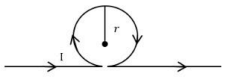 CUET 2025 Hard
 - Van Arkel Method is used for -CUET 2023 Medium