


CUET · PHYSICS · PYQ PAPER 2023
A bar magnet when suspended horizontally and perpendicular to earth's field experiences a torque of \( 3 \times 10^{-4} \text{ N m} \). The Magnetic moment of the magnet would be: (take horizontal component of Earth's magnetic field at the place \( 0.4 \times 10^{-4} \text{ T} \))
- A \( 7.5 \text{ J T}^{-1} \)
- B \( 5.7 \text{ J T}^{-1} \)
- C \( 0.75 \text{ J T}^{-1} \)
- D \( 0.57 \text{ J T}^{-1} \)
Answer & Solution
Correct Answer
(A) \( 7.5 \text{ J T}^{-1} \)
Step-by-step Solution
Detailed explanation
\( M = \frac{\tau}{B_H \sin \theta} \) \( M = \frac{3 \times 10^{-4} \text{ N m}}{0.4 \times 10^{-4} \text{ T} \times \sin 90^\circ} = 7.5 \text{ J T}^{-1} \)
See the Complete Solution
Get step-by-step explanations for this and 2.5 Lakh+ more JEE, NEET & CET questions.
- Unlock all solutions
- Practice the full chapter
- Track accuracy across PYQs
4.8 rated on Google Play · 14,000+ reviews
More questions from PHYSICS
- Identify the correct statements among the following:
(A) The gravitational force is much stronger than the Coulomb force.
(B) The nuclear force between two nucleons falls rapidly to zero as their distance is more than a few femtometers.
(C) The nuclear force depends on the electric charge.
(D) The nuclear force is much stronger than the coulomb force.
Choose the correct answer from the options given below:CUET 2025 Easy - Rainbow is a phenomenon due to the combined effect of
(A) Interference
(B) Dispersion
(C) Reflection
(D) Refraction
(E) Scattering
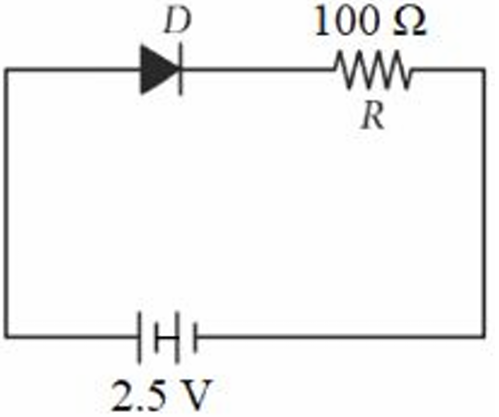
Choose the correct answer from the options given below:CUET 2025 Medium - In the given figure, a diode D is connected to an external resistance R = 100 \( \Omega \) and an emf of 2.5 V. During forward bias, if the barrier potential developed across the diode is 0.6 V, the current in the circuit will be
 CUET 2025 Medium
 - An earthed conductor is placed near another positively charged conductor. The net charge acquired by the earthed conductor will be :CUET 2025 Medium
- The mutual inductance of a pair of solenoid depends :
(A) on their separation
(B) on their relative orientation
(C) on the current flowing
(D) on the number of turns in the solenoids
Choose the correct answer from the options given below:CUET 2023 Hard - A nucleus with mass number 240 and binding energy per nucleon 7.6 MeV splits into two fragments each of mass number 120 with binding energy per nucleon 8.5 MeV. The amount of energy released in this process will be :CUET 2025 Medium
More PYQs from CUET
- The production of beta-galactosidase by the lac operon is started when:CUET 2025 Easy
- Read the passage carefully and answer the Questions
Aldehydes, carboxylic acids and ketones are widespread in the animal and plant kingdoms.
They play a pivotal role in various biochemical processes of life. Their presence in nature adds fragrance and flavor. These compounds are widely used in food products, pharmaceuticals, paints, resins and other important product industries. These compounds are prepared by various laboratory methods, which mainly include oxidation, formylation, acylation and reduction. Due to the polar nature of the carbonyl group in aldehydes and ketones, they can exhibit different reactions like nucleophilic addition. They do exhibit redox and various condensation reactions which lead to the formation of various important compounds. On the other hand, the carboxylic acids are mainly prepared by oxidation and hydrolysis of different compounds. The carboxylic acid consists of a carbonyl group and the hydroxy group (attached to the carbonyl carbon atom). This makes it possible for the carboxylic acid to participate in various chemical reactions which involve cleavage of the C-OH bond and the O_H bond along with the reactions involving the complete -COOH group.
Arrange the following in the increasing order of their pKa values:
(A) CF3-COOH
(B) O2N-CH2-COOH
(C) NC-CH2-COOH
(D) H-COOH
Choose the correct answer from the options given below :CUET 2025 Hard - For the cell represented by the following reaction :
\(Mg ( s )+2 Ag ^{+}(0.0001 M ) \rightarrow Mg ^{2+}(0.2 M )+2 Ag ( s )\)
If \(E_{\text {cell }}^{\circ}=3.17 V\), its \(E_{\text {cell }}\) at 298 K will be:
(Given: \(\log _{10} 2=0.301\) )CUET 2025 Easy - If \(\sin ^{-1} x+\sin ^{-1} y=\frac{2 \pi}{3}\), then the value of \(\cos ^{-1} x+\cos ^{-1} y\) is:CUET 2023 Easy
- Let \(|\vec{a}|=5,|\vec{b}|=2\) and \(\vec{a} \cdot \vec{b}=6\), then the value of \(|\vec{a} \times \vec{b}|\) is equal toCUET 2025 Hard
- Read the passage given below and answer the question.
The transition elements which give the greatest number of oxidation states occur in or near the middle of the series. Manganese, for example, exhibits all the oxidation states from +2 to +7 . The lesser number of oxidation states at extreme ends stems from either too few electrons to lose or share (Sc, Ti) on too many d-electrons (hence fewer orbitals available in which to share electrons with others) for higher valence \(( Cu , Zn )\). Thus early in the series scandium (II) is virtually unknown and titanium (IV) is more stable than Ti (III) or Ti (II). At the other end, the only oxidation state of zinc is \(+ 2\) (no d electrons are involved). The maximum oxidation states of reasonable stability correspond in value to the sum of the s - and d-electrons upto manganese ( \(Ti ^{I V} O _2, V^V O _2^{+}, Cr ^{V I} O _4^{2-}\), \(Mn ^{\text {VII }} O _4\) ) followed by a rather abrupt decrease in stability of higher oxidation states, so that the typical species to follow are \(Fe ^{I I, I I I}, Co ^{I I, I I I}, Ni ^{I I}, Cu ^{I, I I}, Zn ^{I I}\).
The variability of oxidation states, a characteristic of transition elements, arises out of incomplete filling of d-orbitals in such a way that their oxidation states differ from each other by unity, e.g. \(V ^{I I}, V^{I I I}, V^{I V}, V^V\). This is in contrast with the variability of oxidation states of non transition elements where oxidation states normally differ by a unit of two.
An interesting feature in the variability of oxidation states of the d-block elements is noticed among the groups (groups 4 through 10). Although in the p-block, the lower oxidation states are favoured by the heavier members (due to inert pair effect), the opposite is true in the groups of dblock. For example, in group 6, \(Mo ( VI )\) and \(W ( VI )\) are found to be more stable than \(Cr ( VI )\). The \(Cr ( VI )\) in the form of dichromate in acidic medium is a strong oxidising agent, whereas \(MoO _3\) and \(WO _3\) are not.
Low oxidation states are found when a complex compound has ligands capable of \(\pi\)-acceptor character in addition to the \(\sigma\)-bonding. For example, in \(Ni ( CO )_4\) and \(Fe ( CO )_5\), the oxidation state of nickel and iron is zero.
Which amongst the following is a better oxidising agent than other ?CUET 2023 Medium