


CUET · MATHS · PYQ PAPER 2025
Which of the region shown in the given figures represents the feasible region bounded by the following constraint?
\(4 x+y \geq 80,2 x+y \geq 60, x+y \leq 80, x \geq 0, y \geq 0\)
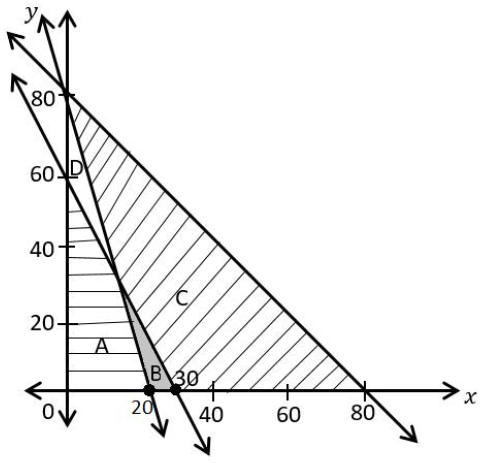
- A region A
- B region B
- C region C
- D region D
Answer & Solution
Correct Answer
(A) region A
Step-by-step Solution
Detailed explanation
The feasible region must satisfy: \(4x+y \geq 80\): above or to the right of the line through \((20,0)\) and \((0,80)\). \(2x+y \geq 60\): above or to the right of the line through \((30,0)\) and \((0,60)\). \(x+y \leq 80\): below or to the left of the line through \((80,0)\)…
See the Complete Solution
Get step-by-step explanations for this and 2.5 Lakh+ more JEE, NEET & CET questions.
- Unlock all solutions
- Practice the full chapter
- Track accuracy across PYQs
4.8 rated on Google Play · 14,000+ reviews
More questions from MATHS
- Match List-l with List-ll
Choose the correct answer from the options given below:List-I List-II (A) The measurable characteristic of a population is called (I) sample (B) The measurable characteristics of a sample is called (II) Alternative hypothesis (C) A smaller group of a population selected to represent a population is caller (III) Parameter (D) The assumption made opposite to the null hypothesis is called (IV) statistic CUET 2025 Easy - Evaluate \(\int_1^{\sqrt{3}} \frac{1}{1+x^2} d x\)CUET 2025 Easy
- A die is tossed once. If the random variable X is defined as \(\mathbf{X}=\left\{\begin{array}{ll}1, & \text { if the die result in an odd number } \\ -1, & \text { if the die result in an even number }\end{array}\right.\) then the variance of X isCUET 2025 Easy
- If \(x y=e^{(x-y)}\), then \(\frac{d y}{d x}\) is equal to:CUET 2025 Hard
- If \(\int \frac{2 x}{x^2+3 x+2} d x=m \log |x+2|+n \log |x+1|+C\), then the values of m and n are:CUET 2023 Medium
- The solution of the differential equation \(\frac{d y}{d x}=1+x+y^2+x y^2\) is:CUET 2023 Medium
More PYQs from CUET
- Select the seeds with perisperm from the following options.CUET 2025 Easy
- A galvanometer of resistance G is converted into a voltmeter to measure upto V volts by connecting a resistance \( R_1 \) in series with the coil. If a resistance \( R_2 \) is connected in series with it, then it can measure the \( \frac{V}{3} \) volts. Find the resistance \( R_3 \) in terms of \( R_1 \) and \( R_2 \) required to be connected to convert it into a voltmeter that can read upto 3V volts :CUET 2023 Easy
- In the method of least squares, we find trend values using:CUET 2023 Hard
- The probability that a plant \(A\) survives is \(\frac{3}{4}\) and the probability that another plant \(B\) survives is \(\frac{1}{3}\).
The probability that only one of them survives is :CUET 2023 Hard - Which of the following gives the correct expression for potential gradient in terms of the resistivity ( \(\rho\) ) of the wire?CUET 2023 Hard
- Match List - I with List - II
List - I (Laws/properties) List - II (Statements) (A) Colligative properties (I) for a solution of volatile liquids, the partial vapour pressure of each component of the solution is directly proportional to its mole fraction present in the solution. (B) Henry's law (II) the total pressure over the solution phase in the container will be the sum of the partial pressures of all the components of the solution. (C) Raoult's law (III) depends on the number of solute particles, irrespective of their nature. (D) Dalton's law of partial pressures (IV) at a constant temperature, the solubility of a gas in a liquid is directly proportional to the partial pressure of the gas present above the surface of a liquid or solution.
Choose the correct answer from the options given below:CUET 2025 Easy