


CUET · MATHS · PYQ PAPER 2025
The rate of change of area of a circle with respect to its circumference when radius is \(4\) cm , is:
- A \(2 cm^2 / cm\)
- B \(4 cm^2 / cm\)
- C \(8 cm^2 / cm\)
- D \(16 cm^2 / cm\)
Answer & Solution
Correct Answer
(B) \(4 cm^2 / cm\)
Step-by-step Solution
Detailed explanation
\(A = \pi r^2, C = 2 \pi r\) \(\frac{dA}{dr} = 2 \pi r\) \(\frac{dC}{dr} = 2 \pi\) \(\frac{dA}{dC} = \frac{dA/dr}{dC/dr} = \frac{2 \pi r}{2 \pi} = r\) \(r = 4\) cm \(\frac{dA}{dC} = 4\) cm\(^2\) / cm
See the Complete Solution
Get step-by-step explanations for this and 2.5 Lakh+ more JEE, NEET & CET questions.
- Unlock all solutions
- Practice the full chapter
- Track accuracy across PYQs
4.8 rated on Google Play · 14,000+ reviews
More questions from MATHS
- The slope of the normal to the curve \(y=2 x^2\) at \(x=1\) is:CUET 2025 Hard
- Let \(\Delta=\left|\begin{array}{ccc}x & 2 & x \\ x^2 & x & 6 \\ x & x & 6\end{array}\right|=p x^4+q x^3+r x^2+s x+t\), then the value of \(5 p+4 q+3 r+2 s+t\) is equal to :CUET 2023 Easy
- One root of the equation \(\left|\begin{array}{ccc}3 x-8 & 3 & 3 \\ 3 & 3 x-8 & 3 \\ 3 & 3 & 3 x-8\end{array}\right|=0\) is:CUET 2023 Easy
- Let \(f(x)=4 x^3-18 x^2+27 x-5, x \in \mathbb{R}\). Then which of the following statements are TRUE?
(A) \(f^{\prime \prime}(x)=24 x-36\)
(B) \(f\) has local maxima at \(x=\frac{3}{2}\) but no minima
(C) \(f\) has neither maxima nor minima
(D) \(f\) has both maxima and minima
Choose the correct answer from the options given below:CUET 2025 Hard - Match List-I with List-II
List-I List-II (A) The degree of differential equation \(\frac{d^3 y}{d x^3}=e^{\frac{d y}{d x}}\) (I) 2 (B) The order of differential equation \(\left(\frac{d y}{d x}\right)^2+\frac{d^3 y}{d x^3}=0\) (II) 4 (C) The sum of order and degree of differential equation \(\frac{d}{d x}\left(\frac{d^2 y}{d x^2}\right)+\left(\frac{d y}{d x}\right)^5=x\) (III) not defined (D) The number of arbitrary constants in the general solution of a differential equation of order 2 (IV) 3
Choose the correct answer from the options given below :CUET 2025 Medium - If the straight lines \(x=1+s, y=-3-\lambda s, z=1+\lambda s\) and \(x=\frac{t}{2}, y=1+t, z=2-t\) with parameters s and \(t\) respectively, are coplanar, then \(\lambda\) is equal to :CUET 2023 Hard
More PYQs from CUET
- The Convention on Biological Diversity held in Rio de Janeiro in 1992 is
popularly known asCUET 2025 Medium - There are two kinds of nucleases - exonucleases and endonucleases. Exonucleases remove nucleotides from the ends of the DNA whereas, endonucleases make cuts at specific positions within the DNA. The cutting of DNA by restriction endonucleases results in the fragments of DNA. These fragments can be separated by a technique known as gel electrophoresis. Since DNA fragments are negatively charged molecules they can be separated by forcing them to move towards the anode under an electric field through a medium/matrix. Small volume cultures cannot yield appreciable quantities of products. To produce in large quantities, the development of bioreactors, where large volumes (100 - 1000 litres) of culture can be processed, was required. Thus, bioreactors can be thought of as vessels in which raw materials are biologically converted into specific products, individual enzymes, etc., using microbial plant, animal or human cells. PCR stands for Polymerase Chain Reaction. In this reaction, multiple copies of the gene (or DNA) of interest are synthesised in vitro using two sets of primers (small chemically synthesised oligonucleotides that are complementary to the regions of DNA) and the enzyme DNA polymerase.
Which one of the following enzymes remove nucleotides from the ends of the DNA?CUET 2025 Easy - Read the passage carefully and answer the questions
The resistance ( \(R\) ) of an object is given by the expression \(R=\rho \frac{l}{A} .\)
The inverse of \(R\) is called conductance and the inverse of \(\rho\) is called conductivity or specific conductance represented by \(\kappa\).
The conductivity depends upon the nature of the material (insulator, semiconductor or conductor) and the temperature of the substance.
Similarly, the conductance due to the ions present in the solution (ionic conductance) depends upon the nature of the electrolyte, size of ions, the nature of the solvent and the temperature.
Molar conductivity ( \(\Lambda_m\) ) of a solution at a given concentration is the conductance of volume \(V\) containing one mole of electrolyte kept between two electrodes of area \(A\) and unit distance apart.
It is given by the expression \(\Lambda_m=\kappa V .\)
Molar conductivity increases with decrease in concentration and when concentration approaches zero, it is called limiting molar conductivity.
The decrease is linear for a strong electrolyte. However, for a weak electrolyte the change is gradual at higher concentrations and sharp near zero concentration.
Using limiting molar conductivity values of strong electrolytes we can calculate the limiting molar conductivity of weak electrolytes using Kohlrausch law of independent migration of ions.
From molar conductivity and limiting molar conductivity we can determine the degree of dissociation \(\left(\frac{\Lambda_m}{\Lambda_m^0}\right)\) and the ionization constant of a weak acid.
Select the correct statement.CUET 2025 Easy - The capacity to generate a whole plant from any explant is called:CUET 2023 Easy
- It water is mixed with milk to gain \(20\%\) by selling the mixture at cost price. Then ratio of water to milk in mixture, is :CUET 2025 Hard
- Observe the figures and answer the question.
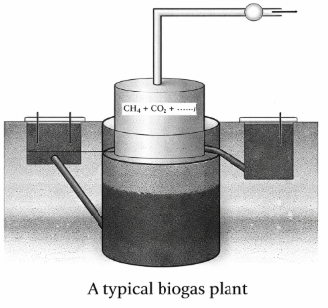
The floating cover of bio-gas plant is usually made-up of _________.CUET 2023 Easy