


CUET · MATHS · PYQ PAPER 2025
The general solution of the differential equation \(\frac{d y}{d x}+y \tan x=\sec x\)
- A \(y \sec x-\tan x=c\), where \(c\) is an arbitrary constant
- B \(y \sec x+\tan x=c\), where \(c\) is an arbitrary constant
- C \(y \tan x-\sec x=c\), where \(c\) is an arbitrary constant
- D \(y \tan x+\sec x=c\), where \(c\) is an arbitrary constant
Answer & Solution
Correct Answer
(A) \(y \sec x-\tan x=c\), where \(c\) is an arbitrary constant
Step-by-step Solution
Detailed explanation
\( \text{IF} = e^{\int \tan x dx} = e^{\ln |\sec x|} = \sec x \) \( y \cdot \sec x = \int (\sec x \cdot \sec x) dx + c \) \( y \sec x = \int \sec^2 x dx + c \) \( y \sec x = \tan x + c \) \( y \sec x - \tan x = c \)
See the Complete Solution
Get step-by-step explanations for this and 2.5 Lakh+ more JEE, NEET & CET questions.
- Unlock all solutions
- Practice the full chapter
- Track accuracy across PYQs
4.8 rated on Google Play · 14,000+ reviews
More questions from MATHS
- The direction ratios of the perpendicular from the point \((1,0,1)\) to the plane \(x-y+z=0\) are :CUET 2023 Hard
- Match List-I with List-II
Choose the correct answer from the options given below:List I (Function) List II (Derivative with respect to ' x ') (A) \(f(x)=x^x\) (I) \(a x^{a-1}\) (B) \(f(x)=a^x\) (II) 0 (C) \(f(x)=a^a\) (III) \(a^x \log _e a\) (D) \(f(x)=x^a\) (IV) \(x^x\left(1+\log _e x\right)\) CUET 2025 Medium - The sides of an equilateral triangle are increasing at the rate of 2 cm/s. The rate at which the area increases, when side is 10 cm is:CUET 2023 Medium
- If \(\left|\begin{array}{ll}x & 8 \\ 4 & x\end{array}\right|=\left|\begin{array}{cc}6 & 2 \\ 18 & 6\end{array}\right|\), then \(x\) is/are equal to:CUET 2025 Hard
- Match List - I with List - II.
Choose the correct answer from the options given below:LIST I
Differential equationLIST II
Integrating Factor (I.F)A. \(\frac{d y}{d x}-\frac{y}{x}=2 x\) I. \(x^2-1\) B. \(\frac{d y}{d x}+\left(\frac{2 x}{x^2-1}\right) y=\frac{2}{\left(x^2-1\right)^2}\) II. \(\sqrt{1-x^2}\) C. \(\frac{d y}{d x}-\left(\frac{x}{1-x^2}\right) y=\frac{1}{1-x^2}\) III. \(\frac{1}{x}\) D. \(\frac{d y}{d x}+\frac{2 x y}{1+x^2}=\frac{\cot x}{1+x^2}\) IV. \(1+x^2\) CUET 2023 Hard - Match List-I with List-II
List-I List-II (A) \(\int \frac{d x}{x^2-16}\) (I) \(\frac{1}{8} \log \left|\frac{4+x}{4-x}\right|+c\) (B) \(\int \frac{d x}{x^2+16}\) (II) \(\log \left|x+\sqrt{x^2-16}\right|+c\) (C) \(\int \frac{d x}{16-x^2}\) (III) \(\frac{1}{8} \log \left|\frac{x-4}{x+4}\right|+c\) (D) \(\int \frac{d x}{\sqrt{x^2-16}}\) (IV) \(\frac{1}{4} \tan ^{-1}\left(\frac{x}{4}\right)+c\)
Choose the Correct answer from the options given below :CUET 2025 Medium
More PYQs from CUET
- An electric dipole of length 4 cm, when placed with its axis making an angle of \( 60^{\circ} \) with a uniform electric field, experiences a torque of \( 4\sqrt{3} \text{ N m} \). If the dipole has charges of \( \pm 8 \text{ nC} \), then the potential energy of the dipole in the electric field is:CUET 2025 Hard
- The matrix \(\left[\begin{array}{lll}0 & 0 & 0 \\ 0 & 0 & 0 \\ 0 & 0 & 0\end{array}\right]\) is a
(A) Null matrix
(B) Unit matrix
(C) Symmetric matrix
(D) Skew-symmetric matrix
Choose the correct answer from the options given below:CUET 2025 Hard - If \(x=2 t^3\) and \(y=3 t^4\), then \(\frac{d^2 y}{d x^2}\) is equal to :CUET 2023 Easy
- The constraints of the given shaded feasible region below of an L.P.P., for non-negative variable constraints \(x\) and \(y\) are
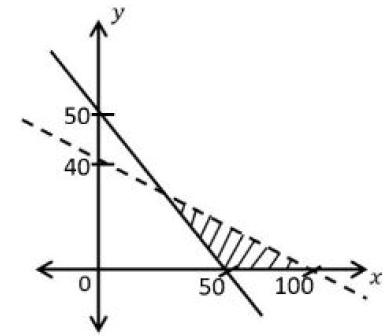 CUET 2025 Easy
 - Benzene ring in phenol is expected to give the characteristic substitution or replacement reactions i.e. halogenation, nitration, sulphonation, alkylation etc. In these reactions, the attacking reagent is electrophile. The phenolic group activates the ortho and para positions in the ring due to conjugation. Disubstitution reactions are quite fast as the electron density in the ring has increased considerably. Phenols do not respond to nucleophilic substitution reactions as it is influenced by phenolic group.
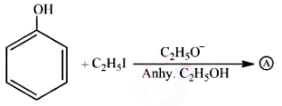 CUET 2023 Hard
 - Which transition metal ion is most stable against oxidation to its \(+3\) state?CUET 2023 Hard