


CUET · MATHS · PYQ PAPER 2025
The feasible region represented by the constraints \(x+2 y \geq 100,2 x-y \leq 0.2 x+y \leq 200, x \geq 0, y \geq 0\) of an LPP is
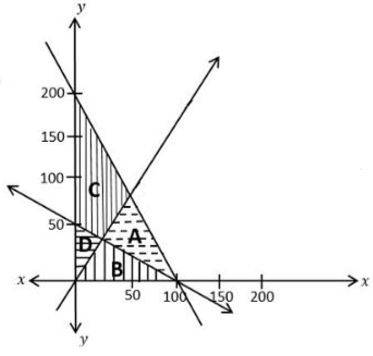
- A Region A
- B Region B
- C Region C
- D Region D
Answer & Solution
Correct Answer
(A) Region A
Step-by-step Solution
Detailed explanation
No Solution
See the Complete Solution
Get step-by-step explanations for this and 2.5 Lakh+ more JEE, NEET & CET questions.
- Unlock all solutions
- Practice the full chapter
- Track accuracy across PYQs
4.8 rated on Google Play · 14,000+ reviews
More questions from MATHS
- Out of the given statement, choose the correct statement.
(A) The direction ratios of the vector \(\vec{a}=3 \hat{i}-\hat{j}+4 \hat{k}\) is \(3,-1,4\).
(B) If \(\theta\) is the angle between two vectors \(\vec{a}\) and \(\vec{b}\), then their cross product is given as \(\vec{a} \times \vec{b}=|\vec{a}||\vec{b}| \cos \theta\).
(C) The unit vector in the direction of vector \(\vec{a}=\hat{i}+2 \hat{j}-2 \hat{k}\) is \(\hat{a}=\frac{1}{3}(\hat{i}+2 \hat{j}-2 \hat{k})\).
(D) If \(\vec{a}=3 \hat{i}\) and \(\vec{b}=4 \hat{j}\) then \(\vec{a} \cdot \vec{b}=12\).
(E) If \(\vec{a}\) and \(\vec{b}\) represent the adjacent sides of a triangle then its area is given of \(\frac{1}{2}|\vec{a} \times \vec{b}|\).
Choose the correct answer from the options given below :CUET 2023 Hard - The particular solution of the differential equation \(x d y=\left(2 x^2+1\right) d x, x \neq 0\), given that \(y=1\) when \(x=1\) is:CUET 2025 Medium
- Match List-I with List-II
Choose the correct answer from the options given below :List-I ( Matrix A ) List-II ( Determinant of adj A ) (A) \(\left[\begin{array}{cc}2 & 1 \\0 & -1\end{array}\right]\) (I) 6 (B) \(\left[\begin{array}{cc}0 & 1 \\4 & -1\end{array}\right]\) (II) 5 (C) \(\left[\begin{array}{cc}1 & 2 \\-3 & -1\end{array}\right]\) (III) \(-4\) (D) \(\left[\begin{array}{cc}4 & -2 \\3 & 0\end{array}\right]\) (IV) \(-2\) CUET 2025 Easy - Match List-I with List-II
Choose the correct answer from the options given below:Llst-I Llst-(II) (A) \(f(x)=[x]\) (I) Continuous everywhere but not differentiable at \(x=-1\) (B) \(f(x)=|x-1|\) (II) Continuous everywhere except at all integral values (C) \(f(x)=e^{|x|}\) (III) Continuous everywhere but not differentiable at \(x=1\) (D) \(f(x)=|x+1|\) (IV) Continuous everywhere but not differentiable at \(x=0\) CUET 2025 Easy - For a set A = {1, 2, 3}, the following functions are defined from A to A. Which of these functions has an inverse?CUET 2023 Medium
- If matrix A is of order 2 × 3 and B of order 3 × 2 thenCUET 2023 Hard
More PYQs from CUET
- \(\text{t}_{99.9\%}\) with respect to \(\text{t}_{90\%}\) for a first order reaction is :CUET 2023 Medium
- Read the passage carefully and answer the Questions
Werner in 1898, propounded his theory of coordination compounds. In coordination compounds metals show two types of linkages (valences)-primary and secondary. The primary valences are normally ionisable and are satisfied by negative ions. The secondary valences are non-ionisable. These are satisfied by neutral molecules or negative ions. The secondary valence is equal to the coordination number and is fixed for a metal. The ions or group bound by the secondary linkages to the metal have characteristic spatial arrangements corresponding to the different coordination numbers. Both double salts as well as complexes are formed by the combination of two or more stable compounds in stoichiometric ratio. However, they differ in the fact that double salts such as carnallite, Mohr's salt, potash alum etc. dissociate into simple ions completely when dissolved in water. But complex ions do not dissociate completely into simple ions.
Which of the following is a double salt?CUET 2025 Medium - The general solution of the differential equation \(\frac{d y}{d x}-\frac{y}{x}=x^2\) is :CUET 2023 Easy
- Let A = {1, 2, 3} Consider the relation R = {(1, 1), (2, 2), (3, 3), (1, 2), (2, 3), (1, 3)} Then R is:CUET 2023 Easy
- Answer the question on the basis of passage given below:
In the periodic table, the d-block contains the elements of group \(3\) to \(12\). The d-orbitals are progressively filled in each of the four long periods. The elements of d block referred as transition metals have partly filled d orbitals and exhibit certain characteristic properties such as variety of oxidation states, formation of coloured ions, act as catalyst and show paramagnetic behaviour.
The two inner transition metals series \(4f\) and \(5f\) are known as Lanthanoids and Actinoids respectively. The lanthanoids resemble one another more closely as compared to ordinary transition elements in any series.
The bonds present in the structure of dichromate ion are:CUET 2023 Easy - The current in a circuit having constant resistance is tripled. The power dissipation will become :CUET 2023 Easy