


CUET · MATHS · PYQ PAPER 2025
The corner points of the feasible region of a LPP with the constraints \(x+2 y \leq 40,3 x+y \geq 30,4 x+3 y \geq 60, x, y \geq 0\) are
- A \((0,0),(10,0),(6,12),(0,20)\)
- B \((0,20),(0,30),(4,18)\)
- C \((0,20),(6,12),(4,18)\)
- D \((15,0),(40,0),(4,18),(6,12)\)
Answer & Solution
Correct Answer
(D) \((15,0),(40,0),(4,18),(6,12)\)
Step-by-step Solution
Detailed explanation
Solve \(4x+3y=60\) and \(y=0\): \(4x=60 \Rightarrow x=15\). Intersection: \((15,0)\). Solve \(x+2y=40\) and \(y=0\): \(x=40\). Intersection: \((40,0)\). Solve \(3x+y=30 \ (1)\) and \(x+2y=40 \ (2)\). From (1), \(y=30-3x\). Substitute into (2):…
See the Complete Solution
Get step-by-step explanations for this and 2.5 Lakh+ more JEE, NEET & CET questions.
- Unlock all solutions
- Practice the full chapter
- Track accuracy across PYQs
4.8 rated on Google Play · 14,000+ reviews
More questions from MATHS
- \(\int \frac{\left(x^4-x\right)^{1 / 4}}{x^5} d x\) is equal toCUET 2025 Medium
- A die is thrown twice. The probability of occurrence of 5 at least once is:CUET 2025 Hard
- For the linear programming problem (LPP) :
Maximize \(Z=x+1.5 y\), subject to constraints, \(x+2 y \leq 40,2 x+y \leq 40, x+y \leq 25, x \geq 0, y \geq 0\).
Which of the following is NOT correct?CUET 2025 Medium - The feasible region corresponding to the linear constraints of a Linear Programming Problem (LPP) is represented by the shaded region in the given figure. Which of the following is not a constraint to the given LPP?
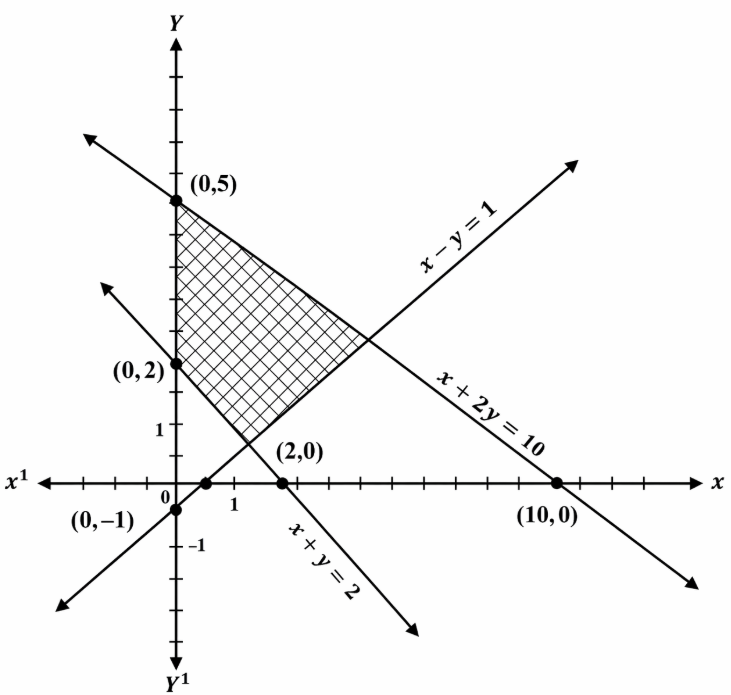 CUET 2025 Easy
 - Match List-I with List-II
Choose the correct answer from the options given below :List - I List - II (A) Point of minima of \(f(x)=|x+1|\) (I) 1 (B) Minimum value of \(f(x)=|x|\) (II) -1 (C) Maximum value of \(f(x)=1-x^2\) (III) 2 (D) Minimum value of \(f(x)=2+\sin ^2 x\) (IV) 0 CUET 2025 Medium - The linear programming problem:
Maximize \(Z = x + y\),
subject to the constraints \(x-y \leq-1,-x+y \leq 0, x, y \geq 0\) hasCUET 2023 Easy
More PYQs from CUET
- What is the color of Fe3+ (aq) ion?CUET 2025 Easy
- A cell supplies a current of 0.6 A through a 3 \( \Omega \) resistor and a current of 0.2 A through a 10 \( \Omega \) resistor. The internal resistance of the cell is :CUET 2025 Medium
- The corner points of the feasible region determined by a system of linear constraints are (0,0), (0, 40), (20, 40), (60, 20), (60, 0). If the objective function is \(Z = 4x + 3y\) then which one of the following is true?CUET 2025 Hard
- Which of the following properties are related to the complex \(\left[ Fe \left( H _2 O \right)_6\right]^{3+}\) ?
(A) Paramagnetic
(B) Number of unpaired electrons are five
(C) \(d ^2 sp ^3\) hybridisation
(D) \(H _2 O\) is a strong field ligand
Choose the correct answer from the options given below :CUET 2025 Easy - A pair of dice is thrown 5 times. If getting a total of 7 is considered a success, then the probability of at least 3 successes is :CUET 2023 Easy
- "Answer the question on basis of passage given below :
Carboxylic acids are weaker than mineral acids, but they are stronger acids than alcohols and many simple phenols (\(\text{pKa}\) is ~ 16 for ethanol and 10 for phenol). The higher acidity of carboxylic acids as compared to phenols can be understood similarly. The conjugate base of carboxylic acid, a carboxylate ion, is stabilised by two equivalent resonance structures in which the negative charge is at the more electronegative oxygen atom. The conjugate base of phenol, a phenoxide ion, has non-equivalent resonance structures in which the negative charge is at the less electronegative carbon atom. Further, the negative charge is delocalised over two electronegative oxygen atoms in carboxylate ion whereas it is less effectively delocalised over one oxygen atom and less electronegative carbon atoms in phenoxide ion. Thus, the carboxylate ion is more estabilised than phenoxide ion, so carboxylic acids are more acidic than phenols.
Effect of substituents on the acidity of carboxylic acids: substituents may affect the stabliity of the conjugate base and thus, also affect the acidity of the carboxylic acids. Electron withdrawing group increase the acidity of carboxylic acids by stabilising the conjugate base through delocalisation of the negative charge by inductive and/or resonance effects. Conversely, electron donating groups decrease the acidity by destabilising the conjugate base.
The correct order of decreasing acid strength of:
Acetic acid (A), Formic acid (B), Benzoic acid (C) is:"CUET 2023 Hard