


CUET · MATHS · PYQ PAPER 2023
The conditions required for applicability of Rolle's theorem for a real valued function \(f(x)\) on an interval \([a, b]\) are:
(A) \(f\) is continuous on \([a, b]\)
(B) \(f\) is differentiable on \((a, b)\)
(C) \(f(a)=f(b)\)
(D) \(f^{\prime}(c)=\)
Choose the correct answer from the options given below :
- A (A),(B)and(C)only
- B (A),(B),(C)and(D)
- C (A)and(B)only
- D (A)and(D)only
Answer & Solution
Correct Answer
(A) (A),(B)and(C)only
Step-by-step Solution
Detailed explanation
The conditions for Rolle's theorem are: (A) \(f\) is continuous on \([a, b]\) (B) \(f\) is differentiable on \((a, b)\) (C) \(f(a)=f(b)\) Thus, the correct answer is (A),(B)and(C)only.
See the Complete Solution
Get step-by-step explanations for this and 2.5 Lakh+ more JEE, NEET & CET questions.
- Unlock all solutions
- Practice the full chapter
- Track accuracy across PYQs
4.8 rated on Google Play · 14,000+ reviews
More questions from MATHS
- If \(A\) is any square matrix of order 3 and \(B=\left[\begin{array}{ccc}\sin \theta & \cos \theta & 0 \\ -\cos \theta & \sin \theta & 0 \\ 0 & 0 & a\end{array}\right]\), \(a\) is any constant, then \(|A B|\) is equal to:CUET 2023 Hard
- Which of the region shown in the given figures represents the feasible region bounded by the following constraint?
\(4 x+y \geq 80,2 x+y \geq 60, x+y \leq 80, x \geq 0, y \geq 0\)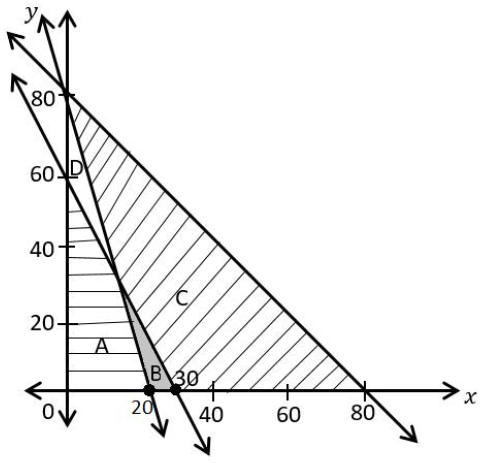 CUET 2025 Hard
 - The optimal value of the objective function of the LPP, Minimize \(Z=3 x-2 y\) subject to constraints \(x+y \geq 10,3 x+5 y \geq 15, x \geq 0, y \geq 0\), is equal to :CUET 2025 Hard
- The value of a depreciable asset at the end of its useful life is called __________ .CUET 2025 Easy
- Let \(f(x)=|x|\) and \(g(x)=[x]\), then the value of \(f \circ g\left(-\frac{9}{2}\right)-g \circ f\left(-\frac{9}{2}\right)\) is :CUET 2023 Hard
- Match List-I with List-II
Let \(f: A \rightarrow B\) be a function given by \(f(x)=x^2\)
Choose the correct answer from the options given below :List - I (Domain and Co-domain) List - II (Kind) (A) \(A= R\) and \(B= R\) (I) \(f\) is both one-one and onto (B) \(A= R\) and \(B=[0, \infty]\) (II) \(f\) is one-one but not onto (C) \(A=B=[0, \infty]\) (III) \(f\) is not one-one but onto (D) \(A=[0, \infty], B= R\) (IV) \(f\) is neither one-one nor ont CUET 2025 Easy
More PYQs from CUET
- Which of the following does NOT serve as biofertilizer in paddy field?CUET 2023 Hard
- Homologous structures have :CUET 2023 Hard
- How much calcium will be obtained when 4 Faradays of electricity is passed through molten CaCl2?CUET 2023 Medium
- If \(x=a t^2, y=2 a t\); then \(\frac{d^2 y}{d x^2}\) is equal toCUET 2025 Hard
- What will be the minimum length of antenna required to transmit a radio signal of frequency 10 MHz ?CUET 2023 Easy
- Answer the question on the basis of passage given below :
Adsorption is the phenomenon of attracting and retaining the molecules of a substance on the surface of a solid resulting into a higher concentration on the surface than in the bulk. The substance adsorbed is known as adsorbate and the substance on which adsorption takes place is called adsorbent. In physisorption adsorbate is held to the adsorbent by weak van der Waals forces and in chemisorption by strong chemical bond.
Argyrol is a medicine used forCUET 2023 Easy