


CUET · MATHS · PYQ PAPER 2023
The area of the parallelogram whose adjacent sides are \(\hat{i}-\hat{j}+3 \hat{k}\) and \(2 \hat{i}-7 \hat{j}+\hat{k}\) is:
- A \(\frac{15}{\sqrt{2}}\)
- B 15
- C 30
- D \(15 \sqrt{2}\)
Answer & Solution
Correct Answer
(D) \(15 \sqrt{2}\)
Step-by-step Solution
Detailed explanation
Area \( = |\vec{a} \times \vec{b}| \) \(\vec{a} \times \vec{b} = \begin{vmatrix} \hat{i} & \hat{j} & \hat{k} \\ 1 & -1 & 3 \\ 2 & -7 & 1 \end{vmatrix} = \hat{i}(-1+21) - \hat{j}(1-6) + \hat{k}(-7+2) = 20\hat{i} + 5\hat{j} - 5\hat{k}\) Area…
See the Complete Solution
Get step-by-step explanations for this and 2.5 Lakh+ more JEE, NEET & CET questions.
- Unlock all solutions
- Practice the full chapter
- Track accuracy across PYQs
4.8 rated on Google Play · 14,000+ reviews
More questions from MATHS
- Let \(f(x)=\left\{\begin{array}{ll}\frac{|x|}{x}, & x \neq 0 \\ 1, & x=0\end{array}\right.\), and \(g(x)=\left\{\begin{array}{ll}x \sin \frac{1}{x}, & x \neq 0 \\ 0, & x=0\end{array}\right.\). Then at the origin, which one is true?CUET 2025 Hard
- If \(y=5 e^{2 x}+4 e^{3 x}\), then \(\frac{d^2 y}{d x^2}\) equals:CUET 2025 Easy
- The points on the curve \(2 x=y^2\) which are nearest to the point \((5,0)\) lie in
A. I Quadrant
B. II Quadrant
C. III Quadrant
D. IV Quadrant
Choose the correct answer from the options given below:CUET 2023 Medium - The general solution of the differential equation \(\frac{d y}{d x}=x y+x+y+1\) isCUET 2025 Hard
- The direction cosines of z-axis are:CUET 2023 Medium
- The water and milk in two vessels are in the ratio 1:1 and 3: 8 respectively. In what ratio, the mixtures in the vessels be mixed to obtain a new mixture containing water and milk in the ratio 4 : 7?CUET 2025 Hard
More PYQs from CUET
- Which one of the following areas does not cover India's biodiversity hotspots?CUET 2023 Hard
- Which of the following is the most species-rich taxonomic group among animals?CUET 2023 Medium
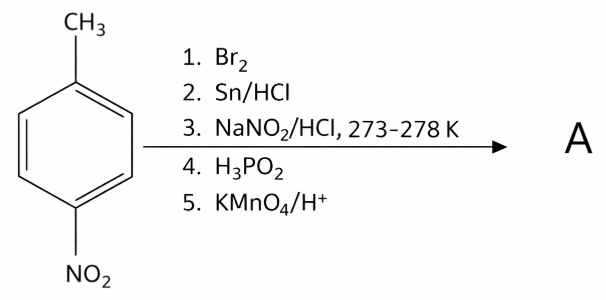
- In the following reaction, the product A is
 CUET 2025 Medium
 - Read the following passage carefully and answer the given questions.
Immune System in the Body
The human immune system consists of lymphoid organs, tissues, cells and soluble molecules like antibodies. The primary lymphoid organs are bone marrow and thymus where immature lymphocytes differentiate into antigen-sensitive lymphocytes. After maturation the lymphocytes migrate to secondary lymphoid organs like spleen, lymph nodes, tonsils, Peyer's patches of small intestine and appendix. The secondary lymphoid organs provide the sites for interaction of lymphocytes with the antigen, which then proliferate to become effector cells. The bone marrow is the main lymphoid organ where all blood cells including lymphocytes are produced. Each antibody molecule has four peptide chains, two small called light chains and two longer called heavy chains. Hence, an antibody is represented as H2L2. Different types of antibodies are produced in our body. IgA, IgM, IgE, IgG are some of them. Techniques like radiography (use of X-rays), CT (computed tomography) and MRI (magnetic resonance imaging) are very useful to detect cancers of the internal organs.
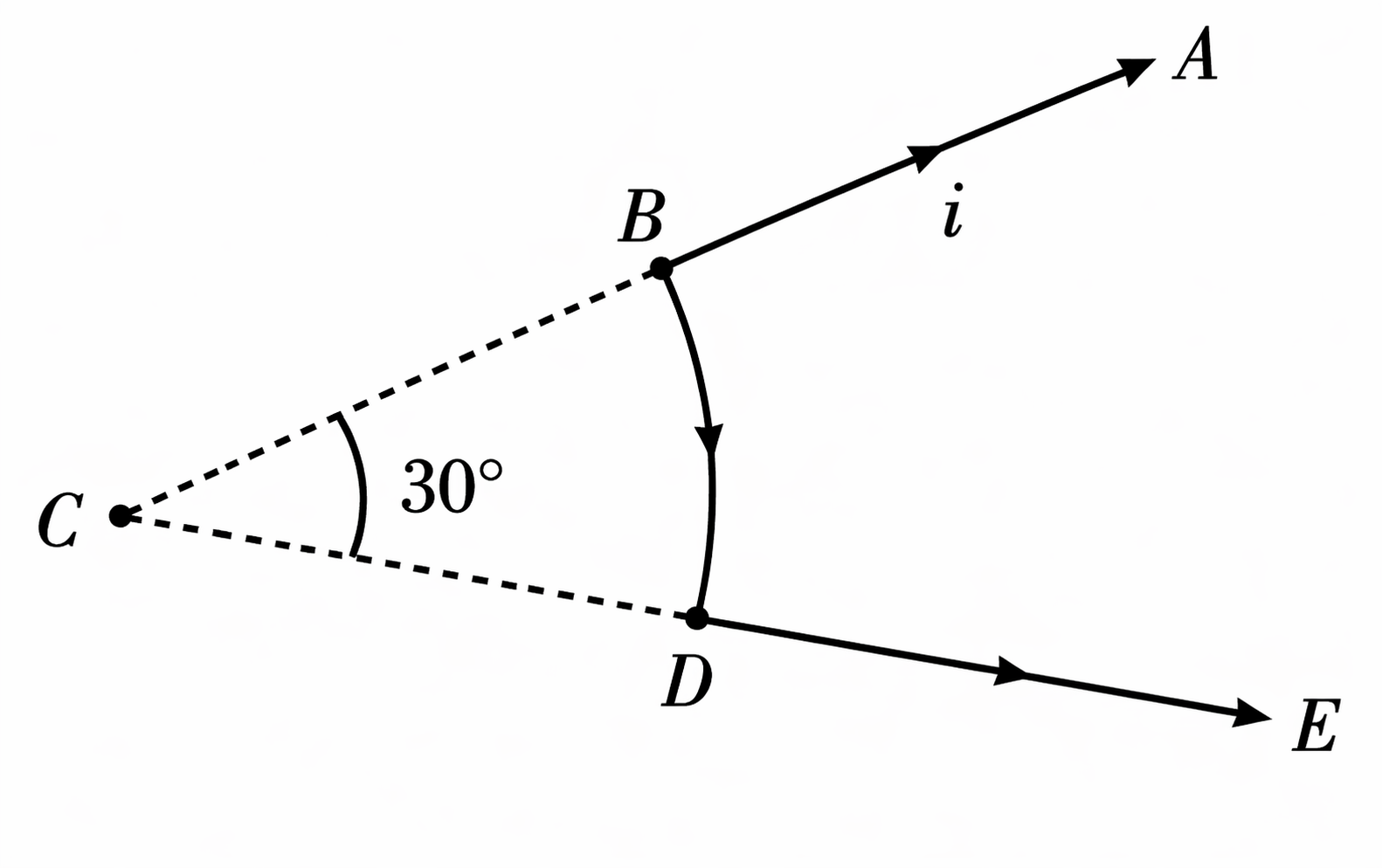
An antibody is represented as -CUET 2025 Easy - The radius of the arc BD representing a wire is 60 cm. The magnitude of the magnetic field produced at centre C, if a current of 3.0 A flows in the wire, will be:
 CUET 2025 Easy
 - An electric field in \(x-y\) plane is given by the equation \(\vec{E}=E_0 \hat{i} N / C\). A positively charged particle is given a velocity of \(5 \hat{j} m / s\) at point \(x=3, y=0\) in \(x-y\) plane. The particle will experience force :CUET 2023 Medium