


CUET · MATHS · PYQ PAPER 2025
Let \(L_1\) and \(L_2\) be two lines, represented as,
\(L_1: \vec{r}=\hat{i}+\hat{j}+\lambda(2 \hat{i}-\hat{j}+\hat{k})\) and \(L_2: \vec{r}=2 \hat{i}+\hat{j}-\hat{k}+\mu(4 \hat{i}-2 \hat{j}+2 \hat{k})\), where \(\lambda\) and \(\mu\) are scalars. Then which of the following are true?
(A)\(L_1\) is perpendicular to \(L_2\)
(B) \(L_1\) is parallel to \(L_2\)
(C) \(L_1\) passes through the point (1,1,0)
(D) \(L_2\) passes through the point (2,1,-1)
Choose the correct answer from the options given below:
- A (A) and (D) only
- B (B), (C) and (D) only
- C (C) and (D) only
- D (A) and (C) only
Answer & Solution
Correct Answer
(B) (B), (C) and (D) only
Step-by-step Solution
Detailed explanation
\((2 \hat{i}-\hat{j}+\hat{k}) \cdot (4 \hat{i}-2 \hat{j}+2 \hat{k}) = (2)(4)+(-1)(-2)+(1)(2) = 8+2+2 = 12 \neq 0 \Rightarrow\) (A) is false. \(4 \hat{i}-2 \hat{j}+2 \hat{k} = 2(2 \hat{i}-\hat{j}+\hat{k}) \Rightarrow\) (B) is true. \(L_1\) passes through…
See the Complete Solution
Get step-by-step explanations for this and 2.5 Lakh+ more JEE, NEET & CET questions.
- Unlock all solutions
- Practice the full chapter
- Track accuracy across PYQs
4.8 rated on Google Play · 14,000+ reviews
More questions from MATHS
- If the function defined by \(f(x)=\left\{\begin{array}{ll}k x^2+1, & \text { if } x \leq 1 \\ 2, & \text { if } x>1\end{array}\right.\) is continuous at \(x=1\), then \(k\) is equal toCUET 2025 Medium
- For \(95 \%\) confidence interval for a population mean reported to be 132 to 142 with standard deviation \(\sigma=17.85\) then the sample size used in this case, is :
[Given that : \(Z_{.0125}=1.96\)]CUET 2025 Easy - If \(A=\left[\begin{array}{ccc}0 & 0 & \sqrt{3} \\ 0 & \sqrt{3} & 0 \\ \sqrt{3} & 0 & 0\end{array}\right]\), then \(|\operatorname{adj} A|\) is equal to:CUET 2025 Medium
- If the area above x - axis, bounded by the curves \((y = 3^{\beta x}), \; x = 0\) and \(x = 3\) is \(\frac{(26)}{\log(e)} 3\), then the value of \(\beta\) is:CUET 2025 Easy
- The conditions required for applicability of Rolle's theorem for a real valued function \(f(x)\) on an interval \([a, b]\) are:
(A) \(f\) is continuous on \([a, b]\)
(B) \(f\) is differentiable on \((a, b)\)
(C) \(f(a)=f(b)\)
(D) \(f^{\prime}(c)=\)
Choose the correct answer from the options given below :CUET 2023 Hard - The random variable X has a probability distribution \(P(X=r)=\left\{\begin{array}{ll}r k, & \text { if } r \leq 2, \\ (r-1) k, & \text { if } 2 < r \leq 4, \text { where } r \in N \cup\{0\} \text { and } k \in R . \\ 0, & \text { otherwise },\end{array}\right.\), where \(n\) is the set of natural numbers
(A) \(k=\frac{1}{9}\)
(B) \(P(2 \leq X \leq 3)=\frac{1}{2}\)
(C) \(P(X=4)=\frac{1}{3}\)
(D) \(P(X>1)=\frac{7}{8}\)
Choose the correct answer from the options given below:CUET 2025 Medium
More PYQs from CUET
- Shown below is the graph of parabola \(y^2=x\), the area (in sq. units) of the shaded region is:
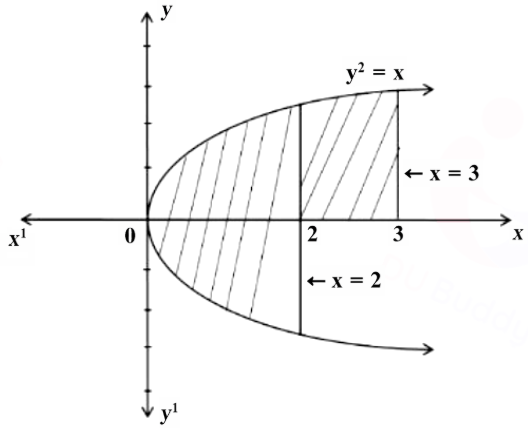 CUET 2025 Hard
 - Which of the following is not categorized under narrowly utilitarian benefit for conserving biodiversity?CUET 2023 Easy
- The sunlight reaching the earth has maximum magnetic field \(2.4 \mu T\). What is the maximum electric field in this light ? Speed of light \(=3 \times 10^8 m s ^{-1}\)CUET 2023 Easy
- Match List - I with List - II.
Choose the correct answer from the options given below :List - I List - II (A) \(XeF _6\) (I) Disproportionation Reaction (B) Liquid Helium (II) Thermodynamically unstable (C) \(FNO _2\) (III) MRI (D) \(O _3\) (IV) Distorted octahedral CUET 2023 Easy - Match List-l with List-ll:
List-1 (Molecule) List-II (Van't Hoff Factor) (A) Glucose (I) 3 (B) \(K _2 SO _4\) (II) 5 (C) \(Ca _3\left( PO _4\right)_2\) (III) 1 (D) \(K _3\left[ Fe ( CN )_6\right]\) (IV) 4
Choose the correct answer from the options given below:CUET 2025 Medium - The general solution of the differential equation \(\log _e\left(\frac{d y}{d x}\right)=a x+b y\) isCUET 2025 Hard