


CUET · MATHS · PYQ PAPER 2025
Let \(\vec{a}=3 \hat{i}+\hat{j}-4 \hat{k}\) and \(\vec{b}=6 \hat{i}+5 \hat{j}-2 \hat{k}\) be two vectors.
Then a vector perpendicular to both \(\vec{a}\) and \(\vec{b}\) with magnitude 3 units is :
- A \(2 \hat{i}+2 \hat{j}-\hat{k}\)
- B \(2 \hat{i}-2 \hat{j}+\hat{k}\)
- C \(-(2 \hat{i}-2 \hat{j}+\hat{k})\)
- D \(-(2 \hat{i}+2 \hat{j}-\hat{k})\)
Answer & Solution
Correct Answer
(B) \(2 \hat{i}-2 \hat{j}+\hat{k}\)
Step-by-step Solution
Detailed explanation
\(\vec{c} = \vec{a} \times \vec{b}\) \(\vec{c} = \begin{vmatrix} \hat{i} & \hat{j} & \hat{k} \\ 3 & 1 & -4 \\ 6 & 5 & -2 \end{vmatrix}\) \(\vec{c} = ((1)(-2) - (-4)(5)) \hat{i} - ((3)(-2) - (-4)(6)) \hat{j} + ((3)(5) - (1)(6)) \hat{k}\)…
See the Complete Solution
Get step-by-step explanations for this and 2.5 Lakh+ more JEE, NEET & CET questions.
- Unlock all solutions
- Practice the full chapter
- Track accuracy across PYQs
4.8 rated on Google Play · 14,000+ reviews
More questions from MATHS
- The corner points of the feasible region determined by a system of linear constraints are (0,0), (0, 40), (20, 40), (60, 20), (60, 0). If the objective function is \(Z = 4x + 3y\) then which one of the following is true?CUET 2025 Hard
- Given a linear programming problem max \(z=22 x+18 y\) subject to \(x+y \leq 20\), \(360 x+240 y \leq 5760\) and \(x \geq 0, y \geq 0\). Its corner points are:CUET 2023 Medium
- The linear programming problem : minimise \(z=3 x+2 y\)
subject to the constraints \(x+y \geq 8,3 x+5 y \leq 15, x \geq 0, y \geq 0\)
hasCUET 2023 Hard - The number of arbitrary constants in the general solution of a differential equation with degree 1 and order 3, isCUET 2025 Hard
- If \(x=4 t\) and \(y=\frac{4}{t}\), then \(\frac{d^2 y}{d x^2}\) isCUET 2025 Hard
- Which constraint correctly represents the situation "Mixture of x and y must be at least 8 units"?CUET 2023 Medium
More PYQs from CUET
- Read the passage carefully and answer the Questions
In the formation of coordination complexes, if the inner \(d\) orbital \((n-1) d\) is used in hybridisation, the complex, is called an inner orbital or low spin or spin paired complex. And if it uses outer \(d\) orbital ( \(n d\) ) in hybridisation (like \(s p^3 d^2\) ), it is called outer orbital or high spin or spin free complex. The degeneracy of the \(d\) orbitals has been removed due to ligand electron-metal electron repulsions in the complex. This splitting of the degenerate levels due to the presence of ligands in a definite geometry is termed as crystal field splitting. For coordination complexes, the magnetic moment is determined by the number of unpaired electrons and is calculated by using the 'spin-only' formula, \(\mu=\sqrt{n(n+2)}\) where \(n\) is the number of unpaired electrons and \(\mu\) is the magnetic moment in units of Bohr magneton (BM). The coordination compounds are of great importance. These compounds are widely present in the mineral, plant and animal worlds and are known to play many important functions in the area of analytical chemistry, metallurgy, biological systems, industry and medicine.
Which of the following metals belongs to Wilkinson catalyst?CUET 2025 Hard - Read the passage carefully to answer the questions given below
Some strains of `Bacillus thuringiensis` produce proteins that kill certain insects such as lepidopterans (tobacco budworm, armyworm), coleopterans (beetles) and dipterans (flies, mosquitoes). In `Bacillus thuringiensis` the toxin is coded by a gene `crylAc` named cry. There are a number of them, for example, the proteins encoded by the genes `crylAc` and `cryllAb` control the cotton bollworms, that of `crylAb` controls corn borer. Using conventional methods of diagnosis (serum and urine analysis, etc.) early detection is not possible. Recombinant DNA technology, Polymerase Chain Reaction (PCR) and Enzyme Linked Immuno-sorbent Assay (ELISA) are some of the techniques that serve the purpose of early diagnosis. The first clinical gene therapy was given in 1990 to a 4-year old girl with adenosine deaminase (ADA) deficiency. This enzyme is crucial for the immune system to function. The disorder is caused due to the deletion of the gene for adenosine deaminase. `RNAi` takes place in all eukaryotic organisms as a method of cellular defense. This method involves silencing of a specific `mRNA` due to a complementary `dsRNA` molecule that binds to and prevents translation of the `mRNA`.
Which of the following technique is not used for early diagnosis of diseases?CUET 2025 Medium - Read the following passage given below and answer the question.
Aldehydes and ketones undergo nucleophilic addition reactions. A nucleophile attacks the electrophilic carbon atom of polar carbonyl group from perpendicular to plane of \(sp^2\) hybridised orbitals of carbonyl carbon. The hybridisation of carbon changes from \(sp^2\) to \(sp^3\) and a tetrahedral alkoxide intermediate is formed. This captures \(H^+\) to give neutral product. In carboxylic acids, carbonyl carbon is less electrophilic than carbonyl carbon in aldehydes and ketones.How will you convert acetaldehyde to lactic acid ?CUET 2023 Medium - Four capacitors are connected in the circuit as shown. The equivalent capacitance between P and Q will be :
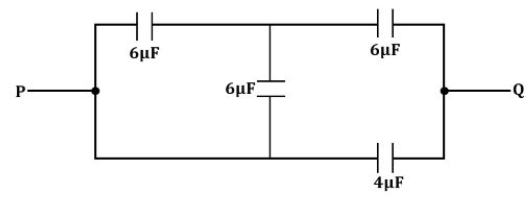
The equivalent capacitance between P and Q will be :CUET 2025 Hard - Which of the following base is not present in DNA?CUET 2025 Hard
- Match List-I with List-II
Choose the correct answer from the options given below:List-I (Terms) List-II (Explanations) (A) Natality (I) Exit of individuals (B) Mortality (II) Entry of individuals (C) Immigration (III) Death rate (D) Emigration (IV) Birth rate CUET 2025 Medium