


CUET · MATHS · PYQ PAPER 2023
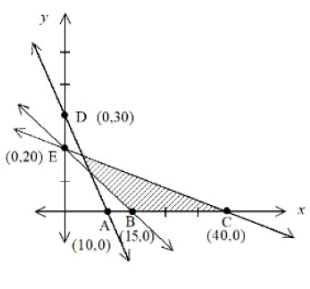
In the given figure, shaded region represents the feasible solution to a LPP problem. The constraint represented by AD is:
- A \(3 x+y \leq 30\)
- B \(3 x+y \geq 30\)
- C \(3 x+y>30\)
- D \(3 x+y<30\)
Answer & Solution
Correct Answer
(A) \(3 x+y \leq 30\)
Step-by-step Solution
Detailed explanation
Points on AD are \( (0, 30) \) and \( (10, 0) \). Equation of line: \( \frac{x}{10} + \frac{y}{30} = 1 \) \( 3x + y = 30 \) Test point \( (0,0) \) is in feasible region: \( 3(0) + 0 = 0 \). Since \( 0 \leq 30 \), the constraint is \( 3x + y \leq 30 \).
See the Complete Solution
Get step-by-step explanations for this and 2.5 Lakh+ more JEE, NEET & CET questions.
- Unlock all solutions
- Practice the full chapter
- Track accuracy across PYQs
4.8 rated on Google Play · 14,000+ reviews
More questions from MATHS
- The order of the differential equation \(\left[1+\left(\frac{d y}{d x}\right)^2\right]^2=\left(\frac{d^3 y}{d x^3}\right)\) is:CUET 2023 Medium
- Which of the following statements is/are true?
(A) \(\left(\tan ^{-1} y-x\right) d y=\left(1+y^2\right)\) dx is a differential equation where variables are separable.
(B) (1+ \(x^2\))dy + 2xydx = cot xdx(x ≠ 0) is a first order linear differential equation.
(C) (4x + 6y + 5)dy - (3y + 2x + 4)dx = 0 is not a homogeneous differential equation.
(D) (xy)dx - (x + \(\left.y^2\right)\)dy = 0 is a homogeneous differential equation.
Choose the correct answert from the option given below :CUET 2025 Easy - The number of all possible matrices of order \(3 \times 3\) with each entry 2 or 3 is:CUET 2023 Hard
- A piece of machinery is bought for Rs. 50,000
In the first year, it depreciates by 15%
In each subsequent year, the depreciation rate increases by 5%
Find the value of the machinery after 3 yearsCUET 2025 Easy - Which one of the following statement is not correct?CUET 2025 Easy
- The value of \(|\text{adj}(2A)|\), if \(A = [a_{ij}]_{3 \times 3}\) and \(|A| = 2\) is:CUET 2023 Hard
More PYQs from CUET
- Sparrow comes under which of the following categories:CUET 2023 Hard
- Match List-I and List-II
List-I List-II A. Tranquilizers I. Ofloxacin B. Antibiotics II. Chlorodiazepoxide C. Antacids III. Seldane D. Antihistamines IV. Cimetidine
Choose the correct answer from the options given below:CUET 2023 Medium - Read the passage carefully and answer the questions
The chemical reactions proceed at different rates which depend on various factors like concentration, temperature, etc. Rate law is an expression which relates the rate of reaction with concentration of various reacting species in the reaction. For a first order reaction, the concentration of the reactant after time \(t\) is related with its initial concentration by the relation, \(C=C_0 e^{-k t}\). The rate constants for different orders have different expressions. For a first order reaction, \(k=\frac{2.303}{t} \log \frac{a}{a-x}\), where \(a\) is the initial concentration and \(x\) is the extent of reaction.
The Rate law relates the rate of a chemical reaction toCUET 2025 Hard - A magnetic needle has magnetic moment of \( 5 \times 10^{-2} \, \text{Am}^2 \) and Moment of inertia \( 12 \times 10^{-6} \, \text{Kg m}^2 \). It performs 60 oscillations in 1 minute when suspended in a magnetic field. What is the magnitude of the magnetic field ?CUET 2023 Easy
- The magnetic field at the centre of a closely wound circular coil of 100 turns, radius 22 cm, carrying a current of 3.5 A will beCUET 2025 Hard
- Read the following passage carefully and answer the given questions.
Plasmodium, a tiny protozoan is responsible for the disease malaria. Different species of Plasmodium (P. vivax, P. malaria and P. falciparum) are responsible for different types of malaria. Of these, malignant malaria caused by Plasmodium falciparum is the most serious one and can even be fatal. Innate immunity consist of four types of barriers. These are – (i) Physical barriers- skin on our body is the main barrier which prevents entry of the micro-organisms. (ii) Physiological barriers- Acid in the stomach, saliva in the mouth, tears from eyes-all prevent microbial growth. (iii) Cellular barriers- Certain types of leukocytes (WBC) of our body like polymorpho-nuclear leukocytes (PMNL-neutrophils) and monocytes and natural killer (type of lymphocytes) in the blood as well as macrophages in tissues can phagocytose and destroy microbes. (iv) Cytokine barriers- virus-infected cells secrete proteins called interferons which protect non-infected cells from further viral infection. Allergy is due to the release of chemicals like histamine and serotonin from the mast cells. The use of drugs like anti-histamine, adrenalin and steroids quickly reduce the symptoms of allergy. Drugs like barbiturates, amphetamines, benzodiazepines, and other similar drugs, that are normally used as medicines to help patients cope with mental illnesses like depression and insomnia, are often abused.
Malignant malaria is caused by _____ is the most serious one and can even be fatal.CUET 2025 Medium