


CUET · MATHS · PYQ PAPER 2023
In a 100 metre race, \(A\) beats \(B\) by 10 metres and \(C\) by 13 metres. By how many meters will \(B\) beat \(C\) in a 180 metre race?
- A 13 metres
- B 6 metres
- C 16 metres
- D 10 metres
Answer & Solution
Correct Answer
(B) 6 metres
Step-by-step Solution
Detailed explanation
When A runs 100m, B runs 90m and C runs 87m. When B runs 90m, C runs 87m. When B runs 180m, C runs \( \frac{87}{90} \times 180 = 87 \times 2 = 174 \)m. B beats C by \( 180 - 174 = 6 \)m.
See the Complete Solution
Get step-by-step explanations for this and 2.5 Lakh+ more JEE, NEET & CET questions.
- Unlock all solutions
- Practice the full chapter
- Track accuracy across PYQs
4.8 rated on Google Play · 14,000+ reviews
More questions from MATHS
- \(\int \frac{\sin 2 x d x}{\sqrt{9-\cos ^4 x}}\) equalsCUET 2025 Medium
- If \(\left[\begin{array}{ll}1 & 3 \\ 2 & 4\end{array}\right]\left[\begin{array}{cc}3 & 5 \\ -1 & 3\end{array}\right]=\left[\begin{array}{cc}m & 14 \\ 2 & n\end{array}\right]\), then m + n is equal to:CUET 2025 Hard
- Area lying in the first quadrant and bounded by the circle \(x^2+y^2=4\) and the lines x = 0 and x = 2 is:CUET 2023 Easy
- The general solution of the differential equation \(\frac{d y}{d x}+\sqrt{\frac{1-y^2}{1-x^2}}=0\) is :CUET 2023 Medium
- If the lines \(\frac{1-x}{3}=\frac{y-2}{2 \lambda}=\frac{z-3}{2}\) and \(\frac{x-1}{3 \lambda}=\frac{y-1}{1}=\frac{6-z}{5}\) are perpendicular, then \(\lambda\) is equal toCUET 2025 Medium
- The intervals for which \(f(x)=x^4-2 x^2\) is increasing are:CUET 2023 Easy
More PYQs from CUET
- Two coherent monochromatic light beams of intensities 16I and 4I are superposed. The maximum and minimum possible intensities in the resulting beam are-CUET 2023 Easy
- Which of the following can be an objective function for a Linear Programming problems in two variables x and y?CUET 2023 Easy
- Read the passage carefully and answer the Questions
In the formation of coordination complexes, if the inner \(d\) orbital \((n-1) d\) is used in hybridisation, the complex, is called an inner orbital or low spin or spin paired complex. And if it uses outer \(d\) orbital ( \(n d\) ) in hybridisation (like \(s p^3 d^2\) ), it is called outer orbital or high spin or spin free complex. The degeneracy of the \(d\) orbitals has been removed due to ligand electron-metal electron repulsions in the complex. This splitting of the degenerate levels due to the presence of ligands in a definite geometry is termed as crystal field splitting. For coordination complexes, the magnetic moment is determined by the number of unpaired electrons and is calculated by using the 'spin-only' formula, \(\mu=\sqrt{n(n+2)}\) where \(n\) is the number of unpaired electrons and \(\mu\) is the magnetic moment in units of Bohr magneton (BM). The coordination compounds are of great importance. These compounds are widely present in the mineral, plant and animal worlds and are known to play many important functions in the area of analytical chemistry, metallurgy, biological systems, industry and medicine.
Fe(II) octahedral complexes can show different 'spin only' magnetic moments for arrangements in the presence of weak and strong ligands. The 'spin only' magnetic moments of these complexes with weak and strong ligands, respectively, areCUET 2025 Medium - The following reaction of benzene with carbon monoxide and hydrogen chloride in the presence of aluminum trichloride to give benzaldehyde is known as
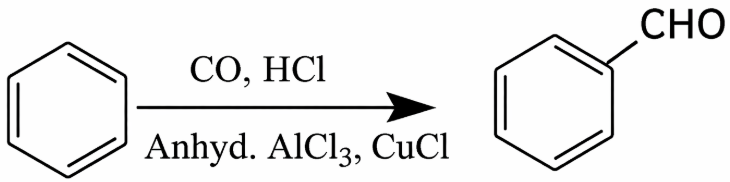 CUET 2025 Hard
 - The maximum value of \(f(x)=\frac{1}{4 x^2+2 x+1}\) isCUET 2025 Medium
- Read the Passage carefully and answer the questions
When a ligand is bound to a metal ion through a single donor atom, it is said to be a unidentate ligand but when it bind through two donor atoms, then it is said to be didentate ligand and when several donor atoms are present in a single ligand, it is said to be a polydentate ligand. When a dior polydentate ligand uses its two or more donor atoms simultaneously to bind a single metal ion, it is said to be a chelate ligand. The number of such ligating groups is called the denticity of the ligand. ligand which has two different donor atoms and either of the two ligetes in the complex is called ambidentate ligands. The number of ligand donor atoms to which the metal is directly bonded, is called coordination number of the metal ion in the complex. Complexes in which a metal is bound to only one kind of donor groups are known as homoleptic and in which a metal is bound to more than one kind of donor groups are known as heteroleptic complexes.
Which of the following is a chelate complex?CUET 2025 Medium