


CUET · MATHS · PYQ PAPER 2025
If the lines \(\frac{1-x}{3}=\frac{3 y-6}{k}=\frac{3-z}{-2}\) and \(\frac{1-x}{2 k}=\frac{y-5}{3}=\frac{6-z}{5}\) are perpendicular, then \(k\) is equal to :
- A \(\frac{10}{7}\)
- B \(\frac{10}{9}\)
- C \(-\frac{10}{9}\)
- D \(-\frac{10}{7}\)
Answer & Solution
Correct Answer
(A) \(\frac{10}{7}\)
Step-by-step Solution
Detailed explanation
\(\vec{d_1} = \langle -3, k/3, 2 \rangle\) \(\vec{d_2} = \langle -2k, 3, -5 \rangle\) \(\vec{d_1} \cdot \vec{d_2} = 0\) \((-3)(-2k) + (k/3)(3) + (2)(-5) = 0\) \(6k + k - 10 = 0\) \(7k = 10\) \(k = \frac{10}{7}\)
See the Complete Solution
Get step-by-step explanations for this and 2.5 Lakh+ more JEE, NEET & CET questions.
- Unlock all solutions
- Practice the full chapter
- Track accuracy across PYQs
4.8 rated on Google Play · 14,000+ reviews
More questions from MATHS
- A mobile phone costing ₹ 50000 has a useful life of 5 years. If the annual depreciation is ₹ 5000, then by using a linear method, its scrap value isCUET 2025 Medium
- Mohini purchases a house worth Rs. 50 lakhs and makes a down payment of Rs. 11.2 lakhs. She pays the remaining amount on monthly EMI using a reducing balance method. The bank charges 6% per annum compounded monthly for a tenure of 25 years.
Her EMI is:
[Given: \((1.005)^{-300}\) ≈ 0.224]CUET 2025 Easy - If a young man drives his vehicle \(25 km / hr\), he has to spend Rs. 2 per km on petrol.
If he drives it at faster speed of \(40 km / hr\), the petrol cost increases to Rs. 5 per km.
He has Rs. 100 to spend on petrol and travel within one hour. The maximum distance he travels is :CUET 2023 Hard - The area of a triangle having the points \(A (1,1,1), B (1,2,3)\) and \(C (2,3,1)\) as its vertices is :CUET 2023 Medium
- A man rows downstream 30 km and upstream 20 km. If he takes 5 hours to cover each distance, then the speed of stream isCUET 2025 Medium
- If A and B are invertible matrices of order \(3,|A|=2\) and \(\left|(A B)^{-1}\right|=-\frac{1}{0}\), then the value of \(|B|\) is :CUET 2023 Hard
More PYQs from CUET
- Read the following statements related to telescopes carefully:
(A) The main considerations of an astronomical telescope are its light gathering power and its resolution.
(B) the ability to observe two objects (very nearly in the same direction) distinctly depends on the diameter of the objective
(C) large-sized lenses which form images that are free from any kind of chromatic aberration and distortions can be made easily
(D) Telescopes with mirror objectives are free from chromatic aberration
Choose the correct answer from the options given below:CUET 2025 Easy - A network of resistors is connected as shown in the figure. The potential drop across 4\(\Omega\) resistors is
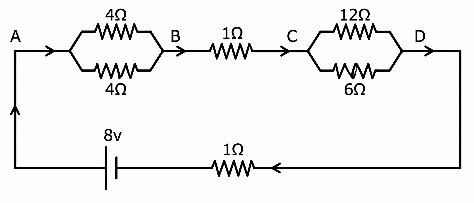 CUET 2025 Easy
 - The standard electrode potential for Daniell cell is 1.1 V , calculate the standard Gibb's energy for the reaction:
\(Z n(s)+C u^{2+}(a q) \rightarrow Z n^{2+}(a q)+C u(s)\)
It is found to beCUET 2023 Easy - Two charged particles, placed at a distance d apart in vacuum, exert a force F on each other. Now, each of the charges is doubled. To keep the force unchanged, the distance between the charges should be changed to :CUET 2024 Medium
- The demand function for a certain product is represented by the equation: p = 20 + 5x - \(3 x^2\), where \(x\) is the number of units demanded and p is the price per unit (in Rs.), then the marginal revenue when 2 units are sold, is:CUET 2025 Medium
- Read the following passage carefully and answer the given questions
The separated DNA fragments can be visualized only after staining the DNA with ethidium bromide followed by exposure to UV radiation. Bright orange colored bands of DNA in ethidium bromide stained gel exposed to UV light can be seen. The separated bands of DNA are cut out from the agarose gel and extracted from the gel piece. This step is known as elution. The DNA fragments purified in this way are used in constructing recombinant DNA by joining them with a cloning vector.
The extraction of separated bands of DNA from the gel piece is called:CUET 2025 Medium